People wearing Christmas hats bath in a pool of watermelon peel during a Christmas service at a hot spring in Luoyang, Henan province, China, December 24, 2016. (Photo by Reuters/Stringer)
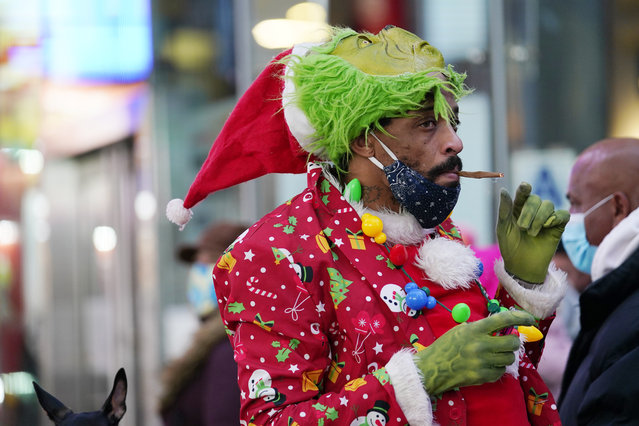
A man dressed in Christmas garb smokes a hand-rolled cigarette, Thursday, December 24, 2020, in Times Square on Christmas Eve in New York. (Photo by Kathy Willens/AP Photo)
Women dressed in traditional costumes sing Christmas carols as they gather to celebrate Orthodox Christmas at a compound of the National Architecture museum in Kyiv, Ukraine on January 7, 2022. (Photo by Valentyn Ogirenko/Reuters)
Divers perform during an event to celebrate the upcoming Christmas at the aquarium in Seoul, South Korea, Friday, December 1, 2023. Christmas is one of the biggest holidays celebrated in South Korea. (Photo by Lee Jin-man/AP Photo)
Aerial view of Skanderbeg Square in Tirana, lit with Christmas decorations and surrounded by an open Christmas market on December 29, 2021. (Photo by Gent Shkullaku/AFP Photo)
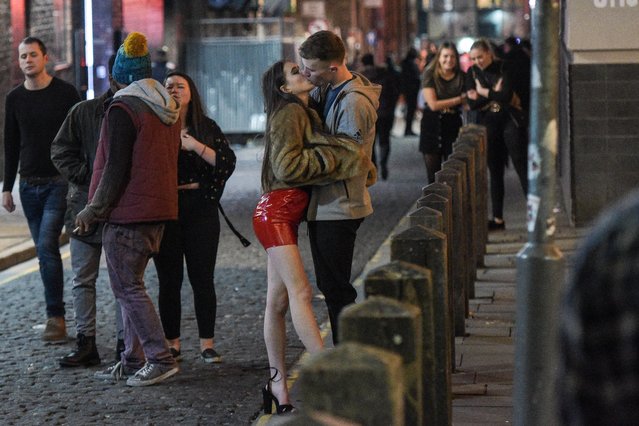
Christmas party goers seen on December 14, 2018 in Liverpool, United Kingdom. Revellers hit the bars as they partied hard on the second-to-last Friday before Christmas. (Photo by Mercury Press)
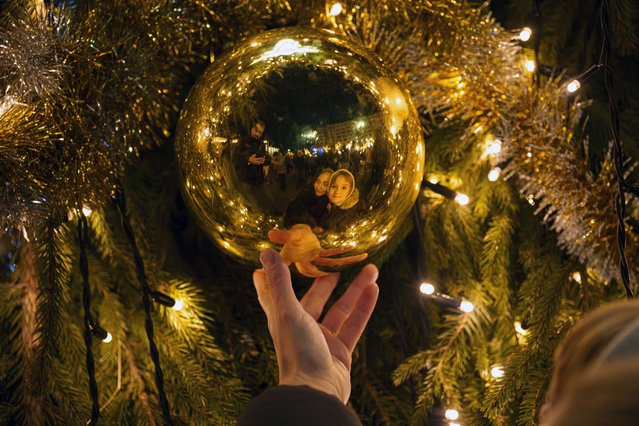
People take pictures of their reflections in the decorations of a Christmas tree, at a Christmas fair in Bucharest, Romania, Saturday, December 14, 2024. (Photo by Andreea Alexandru/AP Photo)
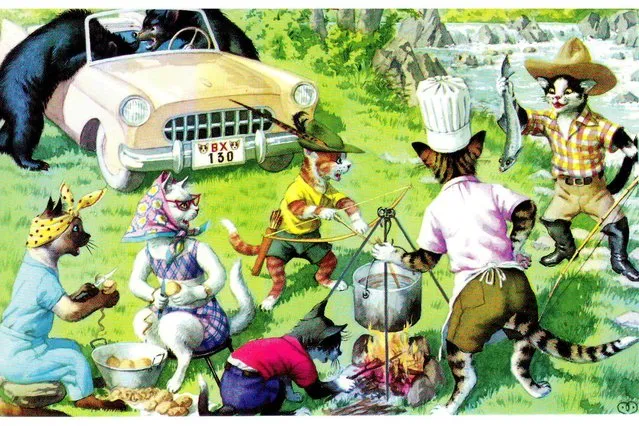
From the 1940s through the 1960s, the Alfred Mainzer Company of Long Island City, NY published a series of linen and photochrome humorous cat postcards illustrated by Eugen Hartung (or Hurtong) (1897–1973), sometimes referred to as “Mainzer Cats”. These postcards normally illustrate settings that are filled with action, often with a minor disaster just about to occur. While the dressed cats were by far the most popular and most plentiful cards, Hartung also painted other dressed animals – primarily mice, dogs, and hedgehogs.