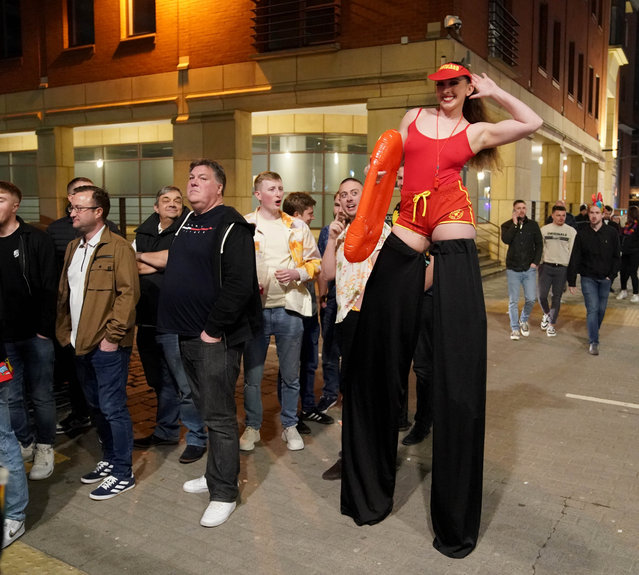
Revellers took to the bars and clubs of Birmingham, UK on Thursday night, April 6, 2023, knowing that they didn't have to go to work on Good Friday. (Photo by Roland Leon/News Group Newspapers Ltd)
Azerbaijan's Mariya Stadnik (R) wrestles Mongolia's Otgonjargal Dolgorjav (L) in their women's freestyle 50kg wrestling quarter-final match at the Champ-de-Mars Arena during the Paris 2024 Olympic Games, in Paris on August 6, 2024. (Photo by Punit Paranjpe/AFP Photo)
(L-R) Models Jasmine Tookes, Paloma Elsesser, Barbara Palvin and Ashley Graham prepare backstage at the Victoria's Secret Fashion Show 2024 on October 15, 2024 in New York City. (Photo by Arturo Holmes/Getty Images for Victoria's Secret)
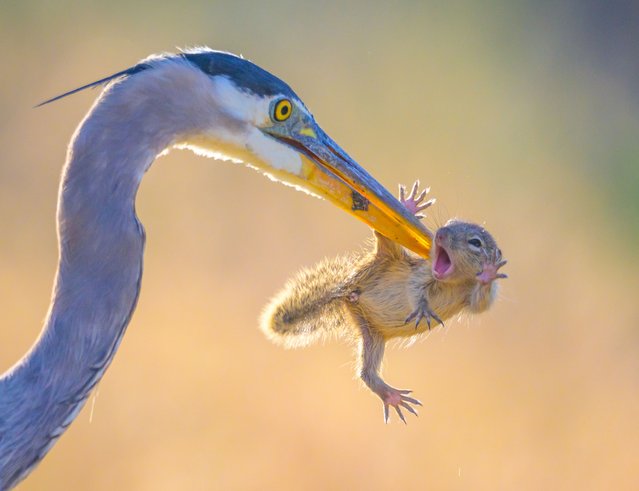
A squirrel fights for its life in the bill of a great blue heron at the Mission Trails Regional Park in California in the second decade of April 2025. (Phoot by Decker Nomura/Solent News & Photo Agency)
A woman smokes a cigar as she reads the newspaper in a street of Havana, on November 26, 2016, the day after Cuban revolutionary leader Fidel Castro died aged 90. One of the world's longest-serving rulers and modern history's most singular characters, Castro defied 11 US administrations and hundreds of assassination attempts. (Photo by Yamil Lage/AFP Photo)
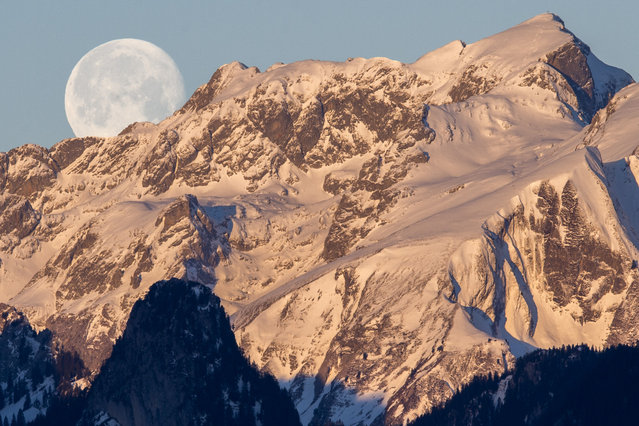
The waning moon is setting over the mountain “Les Cornettes de Bise” located at the border of the Haute-Savoie and the Valais canton of Switzerland in the Chablais Alps, photographed from Glutieres, January 7, 2015. (Photo by Anthony Anex/EPA)
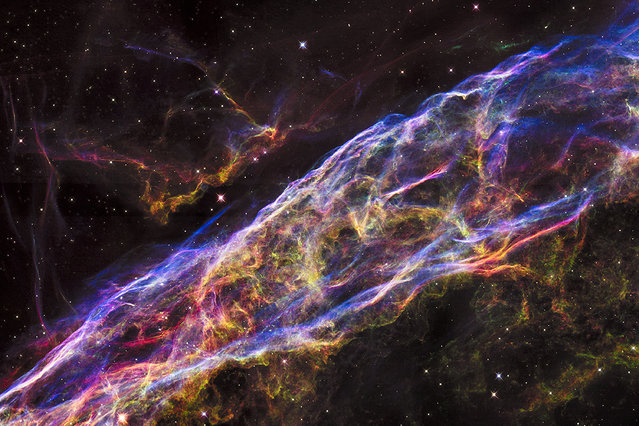
A small section of the expanding remains of the Veil Nebula, a massive star that exploded about 8,000 years ago. The entire nebula is 110 light-years across, covering six full moons on the sky as seen from Earth, and resides about 2,100 light-years away in the constellation Cygnus, the Swan. Image taken by NASA's Hubble Space Telescope. Released September 24, 2015. (Photo by Reuters/NASA/ESA/Hubble Heritage Team)
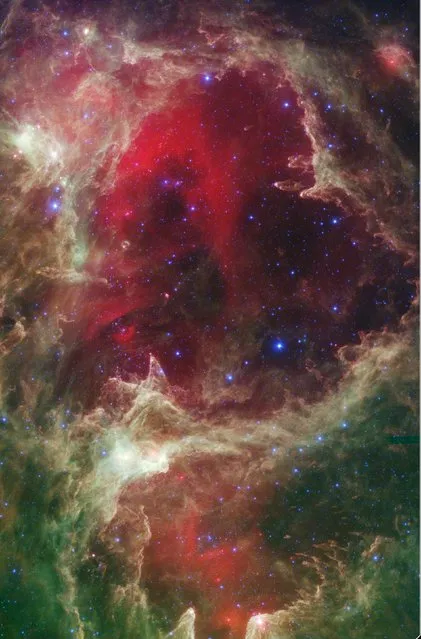
An infrared portrait from NASA's Spitzer Space Telescope which shows generations of stars is seen in this undated NASA handout image released February 14, 2013. In this wispy star-forming region, called W5, the oldest stars can be seen as blue dots in the centers of the two hollow cavities (other blue dots are background and foreground stars not associated with the region). Red shows heated dust that pervades the region's cavities, while green highlights dense clouds. (Photo by NASA/Reuters/JPL-Caltech/Harvard-Smithsonian/Handout)