Loading...
Done
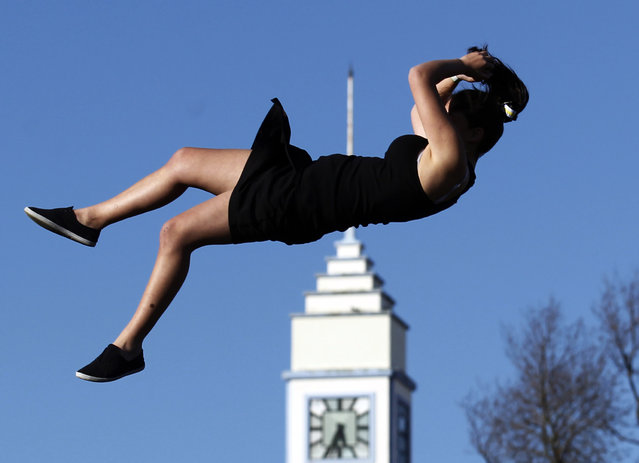
8. NEW ZEALAND: A woman dives from a platform into a giant air bed at a park in Palmerston North September 29, 2011. (Photo by Marcos Brindicci/Reuters)

The report, prepared by the Sustainable Development Solutions Network (SDSN) and the Earth Institute at Columbia University, showed Syria, Afghanistan and eight sub-Saharan countries as the 10 least happy places on earth to live. The top 10 this year were Denmark, Switzerland, Iceland, Norway, Finland, Canada, Netherlands, New Zealand, Australia, and Sweden. Denmark was in third place last year, behind Switzerland and Iceland. The bottom 10 were Madagascar, Tanzania, Liberia, Guinea, Rwanda, Benin, Afghanistan, Togo, Syria and Burundi. The United States came in at 13, the United Kingdom at 23, France at 32, and Italy at 50. Here: #8. NEW ZEALAND: A woman dives from a platform into a giant air bed at a park in Palmerston North September 29, 2011. (Photo by Marcos Brindicci/Reuters)
Details
26 Mar 2016 13:19:00
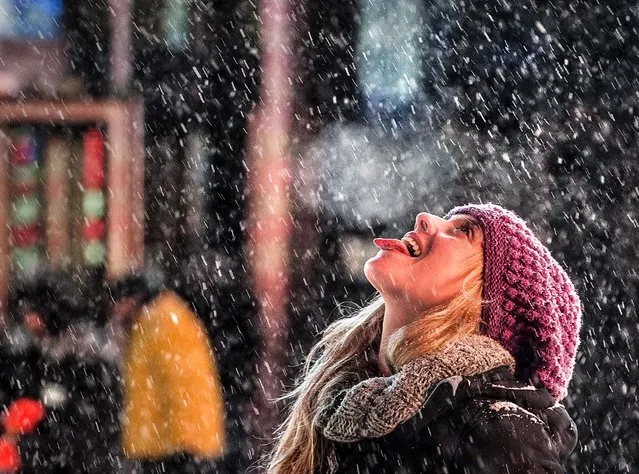
A tourist catches snowflakes on her tongue during snow fall in Times Square, Midtown, New York, on January 3, 2013. A major snowstorm producing blizzard-like conditions hammered the northeastern United States on Friday, causing more than 1,000 U.S. flight delays and cancellations, paralyzing road travel, and closing schools and government offices. (Photo by Darren Ornitz/Reuters)

A tourist catches snowflakes on her tongue during snow fall in Times Square, Midtown, New York, on January 3, 2013. A major snowstorm producing blizzard-like conditions hammered the northeastern United States on Friday, causing more than 1,000 U.S. flight delays and cancellations, paralyzing road travel, and closing schools and government offices. (Photo by Darren Ornitz/Reuters)
Details
04 Jan 2014 14:45:00
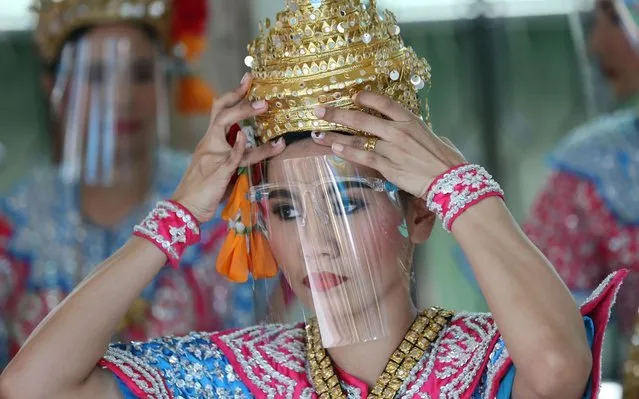
Thai dancers use face shield while waiting for worshippers, after the government eased some coronavirus restrictions, at the Erawan shrine, a popular tourists site, in Bangkok, Thailand, 03 May 2020. The Thai government announced that some businesses and shops can reopen and services and some activities can be resumed from 03 May 2020 on as long as social distancing and regulations are in place. (Photo by Narong Sangnak/EPA/EFE/Rex Features/Shutterstock)

Thai dancers use face shield while waiting for worshippers, after the government eased some coronavirus restrictions, at the Erawan shrine, a popular tourists site, in Bangkok, Thailand, 03 May 2020. The Thai government announced that some businesses and shops can reopen and services and some activities can be resumed from 03 May 2020 on as long as social distancing and regulations are in place. (Photo by Narong Sangnak/EPA/EFE/Rex Features/Shutterstock)
Details
15 May 2020 00:05:00
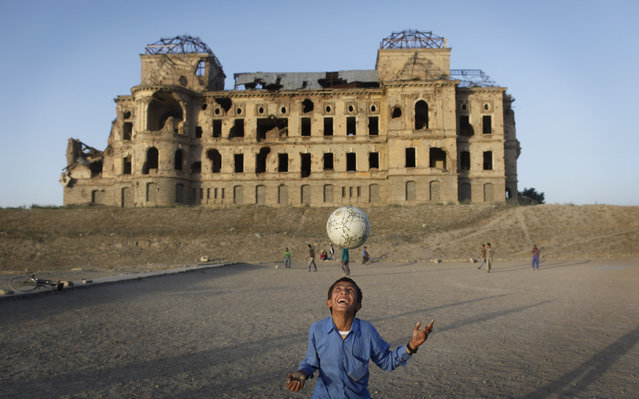
Afghan children play soccer in front of the  war-damaged Darul Aman Palace in the suburbs of Kabul, Afghanistan, Wednesday, June 8, 2011. (Photo by Gemunu Amarasinghe/AP Photo)

Afghan children play soccer in front of the war-damaged Darul Aman Palace in the suburbs of Kabul, Afghanistan, Wednesday, June 8, 2011. (Photo by Gemunu Amarasinghe/AP Photo)
Details
20 Jul 2016 09:46:00
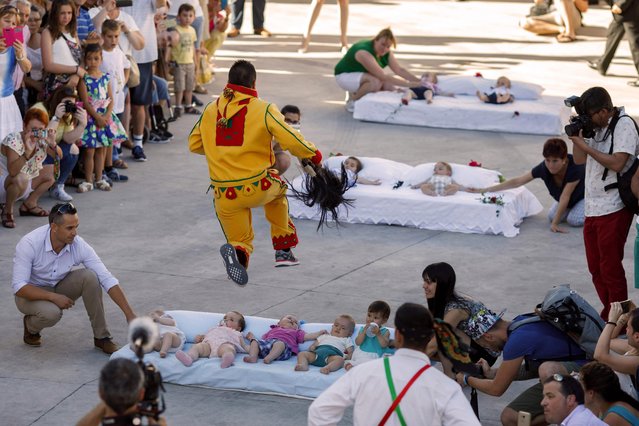
A man dressed up as the devil jumps over babies lying on a mattress in the street during “El Colacho”, the “baby jumping festival” in the village of Castrillo de Murcia, near Burgos on June 18, 2017. Baby jumping (El Colacho) is a traditional Spanish practice dating back to 1620 that takes place annually to celebrate the Catholic feast of Corpus Christi. During the act – known as El Salto del Colacho (the devil's jump) or simply El Colacho – men dressed as the Devil jump over babies born in the last twelve months of the year who lie on mattresses in the street. (Photo by Cesar Manso/AFP Photo)

A man dressed up as the devil jumps over babies lying on a mattress in the street during “El Colacho”, the “baby jumping festival” in the village of Castrillo de Murcia, near Burgos on June 18, 2017. Baby jumping (El Colacho) is a traditional Spanish practice dating back to 1620 that takes place annually to celebrate the Catholic feast of Corpus Christi. During the act – known as El Salto del Colacho (the devil's jump) or simply El Colacho – men dressed as the Devil jump over babies born in the last twelve months of the year who lie on mattresses in the street. (Photo by Cesar Manso/AFP Photo)
Details
20 Jun 2017 07:29:00
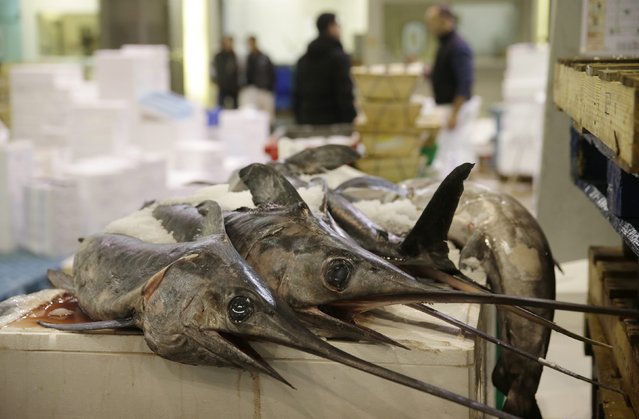
Swordfish are sold at the fish pavilion in Rungis International food market as buyers prepare for the Christmas holiday season in Rungis, south of Paris, December 11, 2015. (Photo by Philippe Wojazer/Reuters)

Rungis is a commune in the southern suburbs of Paris, France. It is best known as the location of the large wholesale food market serving the Paris metropolitan area and beyond, the Marché d'Intérêt National de Rungis, said to be the largest food market in the world. The name Rungis was recorded for the first time in a royal charter of 1124 as Rungi Villa. Here: swordfish are sold at the fish pavilion in Rungis International food market as buyers prepare for the Christmas holiday season in Rungis, south of Paris, December 11, 2015. (Photo by Philippe Wojazer/Reuters)
Details
13 Dec 2015 08:02:00
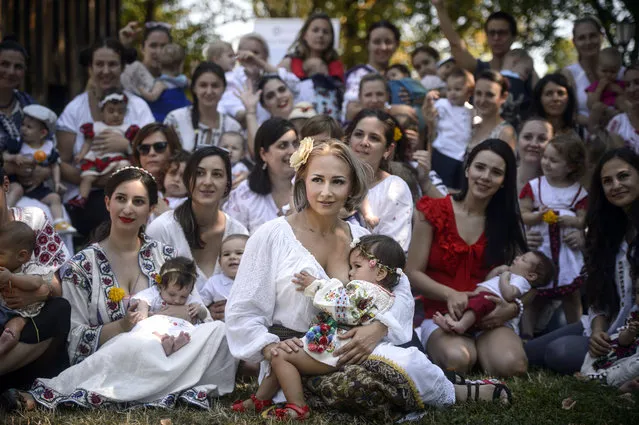
Women breastfeed their babies at an event promoting the freedom of mothers to breastfeed in public, during World Breastfeeding Week, at the Village Museum in Bucharest Romania, Saturday, August 6, 2016. (Photo by Andreea Alexandru/AP Photo)

Women breastfeed their babies at an event promoting the freedom of mothers to breastfeed in public, during World Breastfeeding Week, at the Village Museum in Bucharest Romania, Saturday, August 6, 2016. (Photo by Andreea Alexandru/AP Photo)
Details
07 Aug 2016 09:43:00
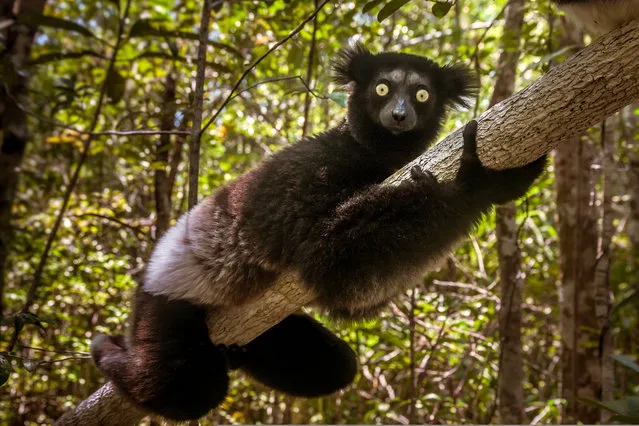
The secretive indri (Indri indri) of Madagascar, the largest living lemur. It is also critically endangered and highly evolutionarily distinct with no close relatives, which makes its branch one of most precarious on the mammal evolutionary tree. In the likely event that the indri goes extinct, we will lose 19m years of unique evolutionary history from the mammal tree of life. (Photo by Pierre-Yves Babelon/Aarhus University)

The secretive indri (Indri indri) of Madagascar, the largest living lemur. It is also critically endangered and highly evolutionarily distinct with no close relatives, which makes its branch one of most precarious on the mammal evolutionary tree. In the likely event that the indri goes extinct, we will lose 19m years of unique evolutionary history from the mammal tree of life. (Photo by Pierre-Yves Babelon/Aarhus University)
Details
18 Nov 2018 00:02:00