A woman shouting into a megaphone during a “Kill the Bill” protest in Manchester City Centre on April 3, 2021 in Manchester, United Kingdom. Protests around the United Kingdom have been held in opposition to the Police, Crime, Sentencing and Courts Bill. The proposed legislation, which would apply to England and Wales, covers a wide range of issues and would broaden the police's authority for regulating protests. (Photo by Mercury Press and Media)
A view of the platform of the Leviathan natural gas field in the Mediterranean Sea is pictured from the Israeli northern coastal beach of Nasholim, on August 29, 2022. (Photo by Jack Guez/AFP Photo)
An Iraqi army cadet participates in “the leap of faith”, from a bridge as part of their training, in Baghdad, Iraq on December 15, 2023. (Photo by Ahmed Saad/Reuters)
Children play in artificial snow as they visit NightGarden, an annual holiday experience featuring thousands of lights and special effects, at Fairchild Tropical Botanic Garden, Friday, November 15, 2024, in Coral Gables, Fla. (Photo by Rebecca Blackwell/AP Photo)
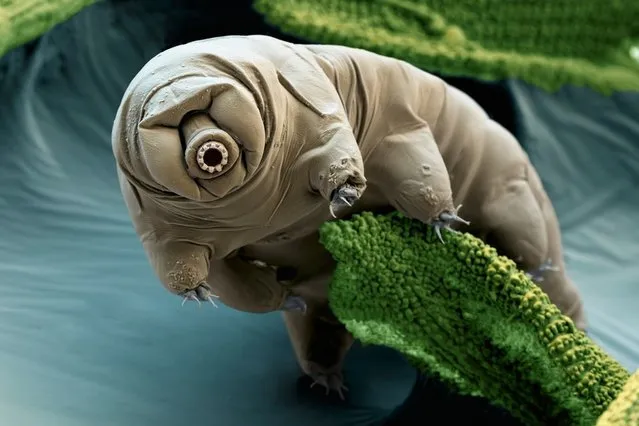
“Tardigrades (commonly known as waterbears or moss piglets) are small, water-dwelling, segmented animals with eight legs. Tardigrades were first discovered in 1773 by Johann August Ephraim Goeze, who called them kleiner Wasserbär, meaning “little water bear” in German. The name Tardigrada means “slow walker” and was given by Lazzaro Spallanzani in 1777. The name water bear comes from the way they walk, reminiscent of a bear's gait. The biggest adults may reach a body length of 1.5 millimetres (0.059 in), the smallest below 0.1 mm. Freshly hatched tardigrades may be smaller than 0.05 mm”. – Wikipedia. Photo: Tardigrades. (Photo by SPL/East News)
Aspiring models wait for their turn to be judged during auditions for the upcoming Lakme Fashion Week in Mumbai, India, June 30, 2016. (Photo by Shailesh Andrade/Reuters)