Loading...
Done
A selection of prizewinning images from the Take a View 2016 photography awards. Here: Finding Gold, taken in Wast Water in Cumbria, which won the Great Britain #OMGB “Home of Amazing Moments” award. (Photo by Mark Gilligan/PA Wire)

A selection of prizewinning images from the Take a View 2016 photography awards. Here: Finding Gold, taken in Wast Water in Cumbria, which won the Great Britain #OMGB “Home of Amazing Moments” award. (Photo by Mark Gilligan/PA Wire)
Details
24 Oct 2016 12:52:00
After finding the bricklaying business too full of ups and downs, this amazing young girl decided to take a shot at iron girdering for a change. She is Miss “Collie” Collier, a reporter for the Chicago Herald-Examiner. August 17, 1920. (Photo by Bettmann Archive/Getty Images)

After finding the bricklaying business too full of ups and downs, this amazing young girl decided to take a shot at iron girdering for a change. She is Miss “Collie” Collier, a reporter for the Chicago Herald-Examiner. August 17, 1920. (Photo by Bettmann Archive/Getty Images)
Details
25 Apr 2021 07:43:00
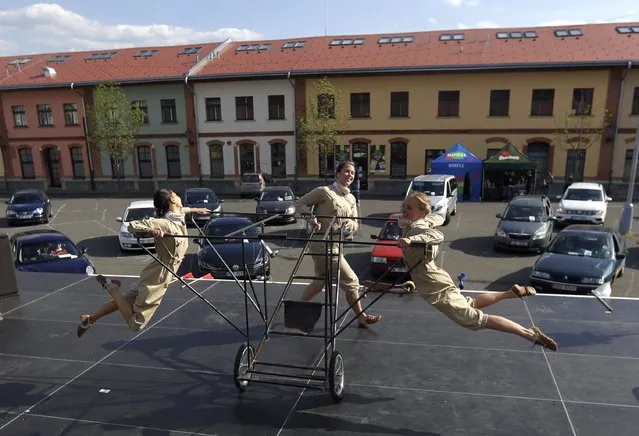
Artists perform as people watch from the safety of their cars, during the Art Parking drive-in festival in Prague, Czech Republic, Sunday, April 26, 2020. Artists in Czech Republic are finding different ways to perform as regular theaters remain closed in an effort to stem the spread of coronavirus. (Photo by Petr David Josek/AP Photo)

Artists perform as people watch from the safety of their cars, during the Art Parking drive-in festival in Prague, Czech Republic, Sunday, April 26, 2020. Artists in Czech Republic are finding different ways to perform as regular theaters remain closed in an effort to stem the spread of coronavirus. (Photo by Petr David Josek/AP Photo)
Details
28 Apr 2020 00:07:00
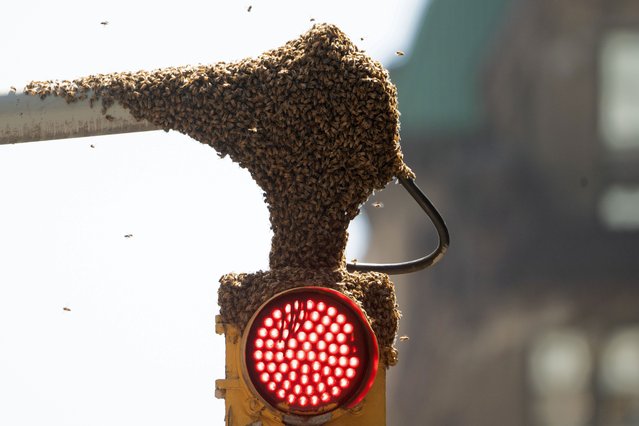
A colonly of honey bees swarms one of the traffic lights on 41st Street and Broadway on May 1st, 2024. Bees would frequest the area, even finding residence in the flowerbeds rooftop of WeWork offices at 1460 Broadway in prior seasons. (Photo by Derek French/Rex Features/Shutterstock)

A colonly of honey bees swarms one of the traffic lights on 41st Street and Broadway on May 1st, 2024. Bees would frequest the area, even finding residence in the flowerbeds rooftop of WeWork offices at 1460 Broadway in prior seasons. (Photo by Derek French/Rex Features/Shutterstock)
Details
11 May 2024 05:37:00
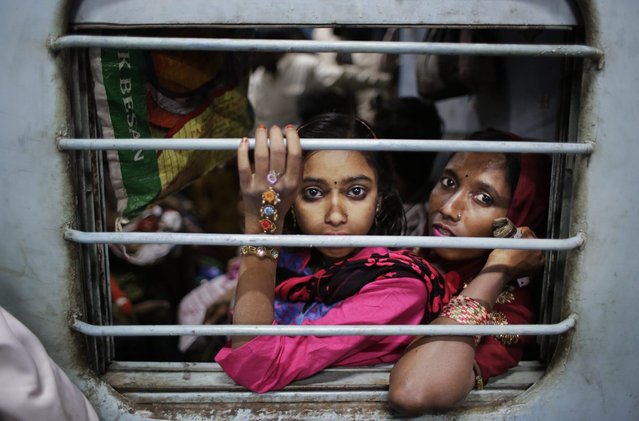
In this November 18, 2014 photo, Murshida, 12, sits on the lap of her mother Marjina as the train leaves for their village in West Bengal, at a railway station in New Delhi, India. Six months ago, Marjina stepped off a train in New Delhi with her two children, hoping to find a better life after her husband abandoned them without so much as a goodbye. (Photo by Altaf Qadri/AP Photo)

In this November 18, 2014 photo, Murshida, 12, sits on the lap of her mother Marjina as the train leaves for their village in West Bengal, at a railway station in New Delhi, India. Six months ago, Marjina stepped off a train in New Delhi with her two children, hoping to find a better life after her husband abandoned them without so much as a goodbye. The family spent their days at a landfill picking through other people’s garbage to find salvageable bits to resell or recycle. After six months of poverty, illness and shame, they returned to that train station in New Delhi, headed back to an uncertain future to their hometown in West Bengal. (Photo by Altaf Qadri/AP Photo)

Details
09 Dec 2014 09:47:00


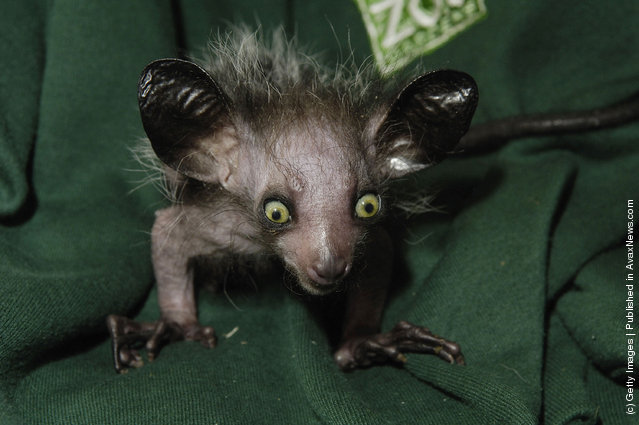
“The aye-aye (Daubentonia madagascariensis) is a lemur, a strepsirrhine primate native to Madagascar that combines rodent-like teeth and a special thin middle finger to fill the same ecological niche as a woodpecker. It is the world's largest nocturnal primate, and is characterized by its unusual method of finding food; it taps on trees to find grubs, then gnaws holes in the wood and inserts its narrow middle finger to pull the grubs out. The only other animal species known to find food in this way is the striped possum. From an ecological point of view the aye-aye fills the niche of a woodpecker as it is capable of penetrating wood to extract the invertebrates within”. – Wikipedia

Photo: In this handout image from Bristol Zoo is seen the first captive bred aye-aye in the UK named “Kintana” (meaning star in Malagasy) April 15, 2005 at Bristol Zoo Gardens, England. The zoo announced today only the second baby aye-aye to be hand-reared in the world (the first was in Jersey Zoo) and has now made his first public appearance since his birth on 11 February 2005. (Photo by Rob Cousins/Bristol Zoo via Getty Images)
Details
13 Apr 2011 13:33:00
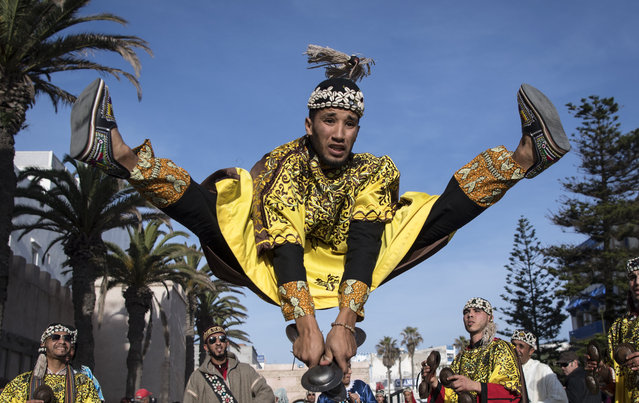
A Gnawa traditional group performs in the city of Essaouira on December 14, 2019, to celebrate the decision of adding the Gnawa culture to UNESCO's list of Intangible Cultural Heritage of Humanity. Gnawa culture, a centuries-old Moroccan practice rooted in music, African rituals and Sufi traditions, was added to UNESCO's list of Intangible Cultural Heritage of Humanity earlier in the week. Gnawa refers to a “set of musical productions, fraternal practices and therapeutic rituals where the secular mixes with the sacred”, according to the nomination submitted by Morocco. Often dressed in colourful outfits, Gnawa musicians play the guenbri, a type of lute with three strings, accompanied by steel castanets called krakebs. (Photo by Fadel Senna/AFP Photo)

A Gnawa traditional group performs in the city of Essaouira on December 14, 2019, to celebrate the decision of adding the Gnawa culture to UNESCO's list of Intangible Cultural Heritage of Humanity. Gnawa culture, a centuries-old Moroccan practice rooted in music, African rituals and Sufi traditions, was added to UNESCO's list of Intangible Cultural Heritage of Humanity earlier in the week. Gnawa refers to a “set of musical productions, fraternal practices and therapeutic rituals where the secular mixes with the sacred”, according to the nomination submitted by Morocco. Often dressed in colourful outfits, Gnawa musicians play the guenbri, a type of lute with three strings, accompanied by steel castanets called krakebs. (Photo by Fadel Senna/AFP Photo)
Details
18 Dec 2019 00:05:00
People look up at a dead body hanged by the Taliban from a crane in the main square of Herat city in western Afghanistan, on Saturday September 25, 2021. A witness told The Associated Press that the bodies of four men were brought to the main square and three of them were moved to other parts of the city for public display. The Taliban announced in the square that the four were caught taking part in a kidnapping and were killed by police. (Photo by AP Photo/Stringer)

People look up at a dead body hanged by the Taliban from a crane in the main square of Herat city in western Afghanistan, on Saturday September 25, 2021. A witness told The Associated Press that the bodies of four men were brought to the main square and three of them were moved to other parts of the city for public display. The Taliban announced in the square that the four were caught taking part in a kidnapping and were killed by police. (Photo by AP Photo/Stringer)
Details
09 Oct 2021 07:50:00