Loading...
Done
A girl presents the new Oktoberfest beer festival mug in a Oktoberfest tent in Munich, southern Germany, on August 21, 2014. The world famous beer festival Oktoberfest will takes place from September 20 to October 5, 2014. (Photo by Christof Stache/AFP Photo)

A girl presents the new Oktoberfest beer festival mug in a Oktoberfest tent in Munich, southern Germany, on August 21, 2014. The world famous beer festival Oktoberfest will takes place from September 20 to October 5, 2014. (Photo by Christof Stache/AFP Photo)
Details
23 Aug 2014 10:47:00
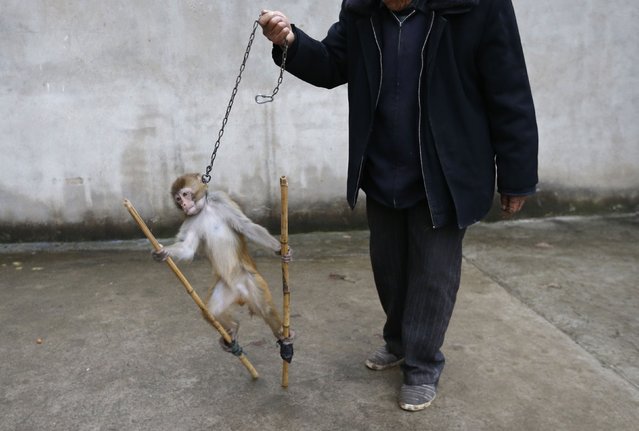
A monkey is led by its trainer Qi Defang during training for a circus in Suzhou, Anhui province, November 29, 2014. (Photo by William Hong/Reuters)

A monkey is led by its trainer Qi Defang during training for a circus in Suzhou, Anhui province, November 29, 2014. Suzhou is known as the hometown of circus troupes in China and has more than 300 circus troupes. (Photo by William Hong/Reuters)
Details
06 Dec 2014 12:21:00
A participant prepares for the Red Bull Air Race World Championships in Abu Dhabi, United Arab Emirates on February 6, 2017. (Photo by Red Bull Content Pool/SIPA Press/Rex Features/Shutterstock)

A participant prepares for the Red Bull Air Race World Championships in Abu Dhabi, United Arab Emirates on February 6, 2017. (Photo by Red Bull Content Pool/SIPA Press/Rex Features/Shutterstock)
Details
08 Feb 2017 09:30:00
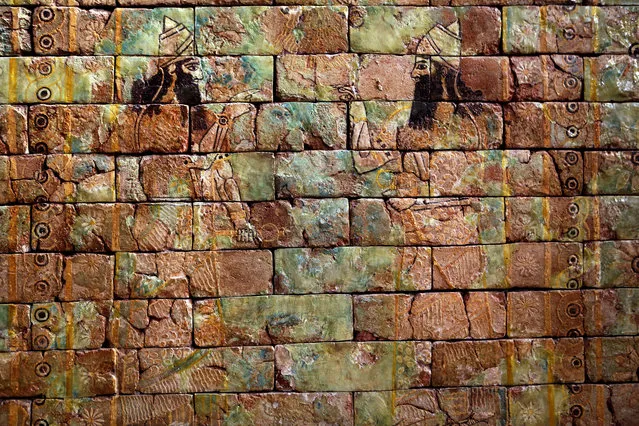
This Monday, September 15, 2014 photo shows glazed bricks displayed at the Iraqi National Museum in Baghdad. The Islamic State militants seek to purge society of all influences that don't conform with their strict, puritanical version of Islam. That means destroying not only relics seen as pagan but also Muslim sites they see as contradicting their ideology, particularly Sunni Muslim shrines they see as idolatrous as well as mosques used by Shiites, a branch of Islam they consider heretical. (Photo by Hadi Mizban/AP Photo)

This Monday, September 15, 2014 photo shows glazed bricks displayed at the Iraqi National Museum in Baghdad. The Islamic State militants seek to purge society of all influences that don't conform with their strict, puritanical version of Islam. That means destroying not only relics seen as pagan but also Muslim sites they see as contradicting their ideology, particularly Sunni Muslim shrines they see as idolatrous as well as mosques used by Shiites, a branch of Islam they consider heretical. (Photo by Hadi Mizban/AP Photo)
Details
21 Sep 2014 10:31:00
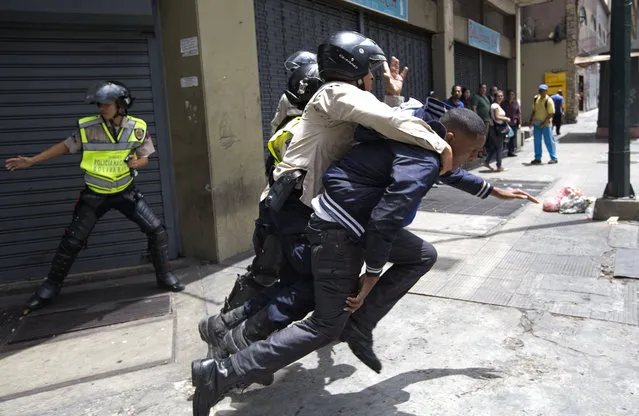
A National Bolivarian Police officer rescues a man who was being attacked by protesters, who then threw rocks at them, during a protest demanding food a few blocks from Miraflores presidential palace in Caracas, Venezuela, Thursday, June 2, 2016. (Photo by Fernando Llano/AP Photo)

A National Bolivarian Police officer rescues a man who was being attacked by protesters, who then threw rocks at them, during a protest demanding food a few blocks from Miraflores presidential palace in Caracas, Venezuela, Thursday, June 2, 2016. Venezuela is seeing rising frustration with widespread food shortages and triple-digit inflation. (Photo by Fernando Llano/AP Photo)
Details
03 Jun 2016 13:01:00
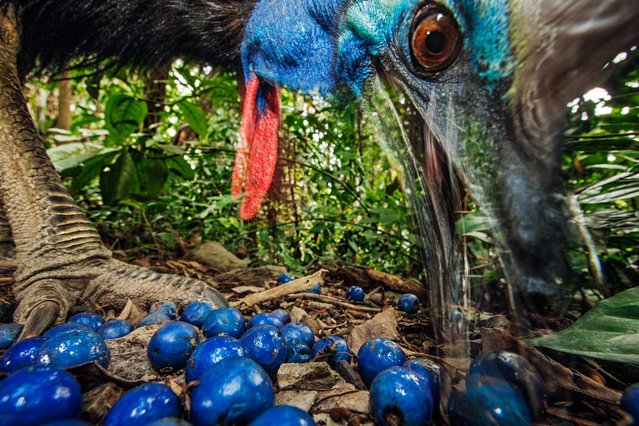
“Cassowaries are large, flightless birds related to emus and (more distantly) to ostriches, rheas, and kiwis”, writes Olivia Judson in the September issue of National Geographic magazine. (Photo by Christian Ziegler/National Geographic)

“Cassowaries are large, flightless birds related to emus and (more distantly) to ostriches, rheas, and kiwis”, writes Olivia Judson in the September issue of National Geographic magazine. How large? People-size: Adult males stand well over five foot five and top 110 pounds. Females are even taller, and can weigh more than 160 pounds. Dangerous when roused, they’re shy and peaceable when left alone. But even birds this big and tough are prey to habitat loss. The dense New Guinea and Australia rain forests where they live have dwindled. Today cassowaries might number 1,500 to 2,000. And because they help shape those same forests – by moving seeds from one place to another – “if they vanish”, Judson writes, “the structure of the forest would gradually change” too. (Photo by Christian Ziegler/National Geographic)

Details
06 Jan 2014 12:21:00
Zhao Qiang walks across a street in Shenyang, Liaoning province, April 14, 2014. Zhao, a community officer of the China Disabled Persons' Federation, was diagnosed with multiple  when he was two, with the resulting tumour affecting the growth of his left leg, his grandmother told local media, citing a doctor's diagnosis. His uncle modified his shoes, fitting them with stools, to allow Zhao to stand and walk. (Photo by Reuters/Stringer)

Zhao Qiang walks across a street in Shenyang, Liaoning province, April 14, 2014. Zhao, a community officer of the China Disabled Persons' Federation, was diagnosed with multiple when he was two, with the resulting tumour affecting the growth of his left leg, his grandmother told local media, citing a doctor's diagnosis. His uncle modified his shoes, fitting them with stools, to allow Zhao to stand and walk. (Photo by Reuters/Stringer)
Details
19 Apr 2014 11:38:00
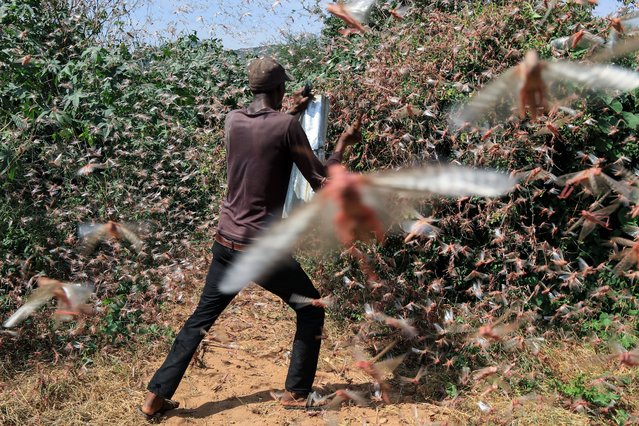
A man uses iron sheet to make noises, as a way of trying to disperse desert locusts that had invaded their farms during the second wave invasion in Kakongo village, in Nuu-Mwingi East, in Kitui, Kenya, 06 February 2021. The second wave invasion of the desert locusts in the country comes at a time where most famers are expecting to harvest their farm produce in the country. According to the United Nations Food and Agriculture Organization (FAO), on 04 February, warned numerous immature desert locust swarms persist in southern Ethiopia and Kenya. Some of the swarms are in community areas and therefore cannot be treated. In Kenya, immature swarms continue to spread westwards across northern and central counties where there are currently about 20 small swarms present, mostly about 50 hectares in size, it said. (Photo by Daniel Irungu/EPA/EFE)

A man uses iron sheet to make noises, as a way of trying to disperse desert locusts that had invaded their farms during the second wave invasion in Kakongo village, in Nuu-Mwingi East, in Kitui, Kenya, 06 February 2021. The second wave invasion of the desert locusts in the country comes at a time where most famers are expecting to harvest their farm produce in the country. (Photo by Daniel Irungu/EPA/EFE)
Details
25 Feb 2021 08:17:00