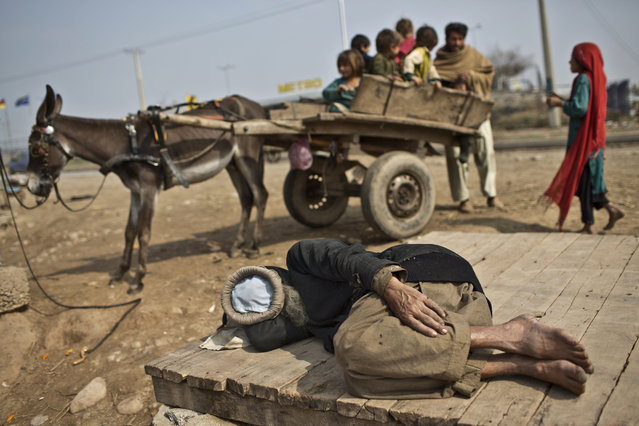
Children play on a donkey cart belonging to an elderly Afghan refugee sleeping on a roadside on the outskirts of Islamabad, Pakistan, Wednesday, February 18, 2015. (Photo by Muhammed Muheisen/AP Photo)
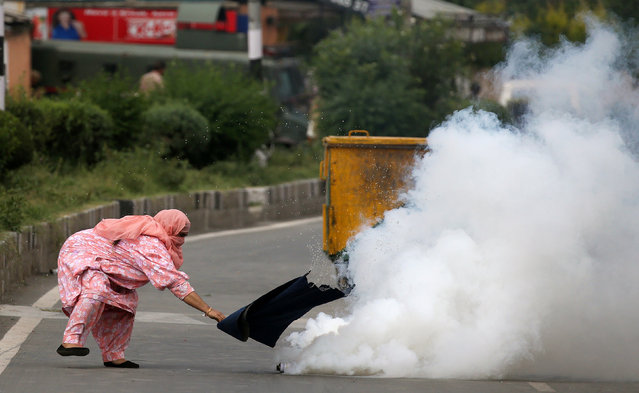
A woman attempts to cover a tear gas canister fired by police at a crowd in Srinagar protesting against the recent killings in Kashmir, August 17, 2016. (Photo by Cathal McNaughton/Reuters)
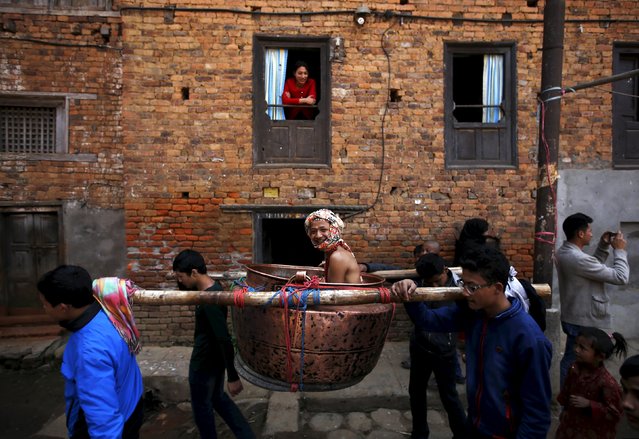
A devotee is carried around town in a vessel as part of rituals during the Swasthani Bratakatha festival at Thecho in Lalitpur, Nepal, February 19, 2016. During the month long festival, devotees recite one chapter of a Hindu tale daily from the 31-chapter sacred Swasthani Brata Katha book that is dedicated to God Madhavnarayan and Goddess Swasthani, alongside various other gods and goddess and the miraculous feats performed by them. (Photo by Navesh Chitrakar/Reuters)
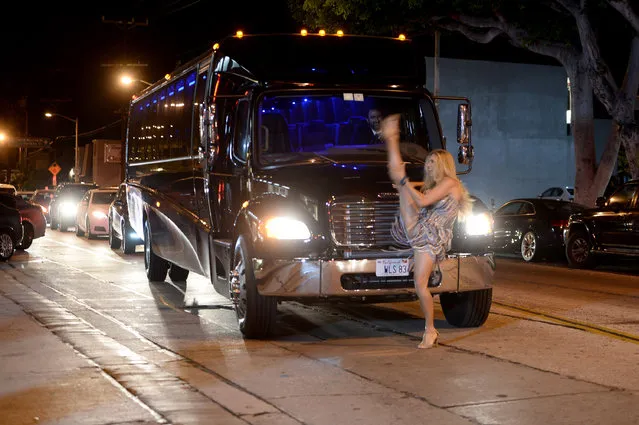
Actor Candis Cayne performs at John Varvatos + OUT Support the Gay Men's Chorus of LA on September 29, 2016 in Los Angeles, California. (Photo by Matt Winkelmeyer/Getty Images for John Varvatos)
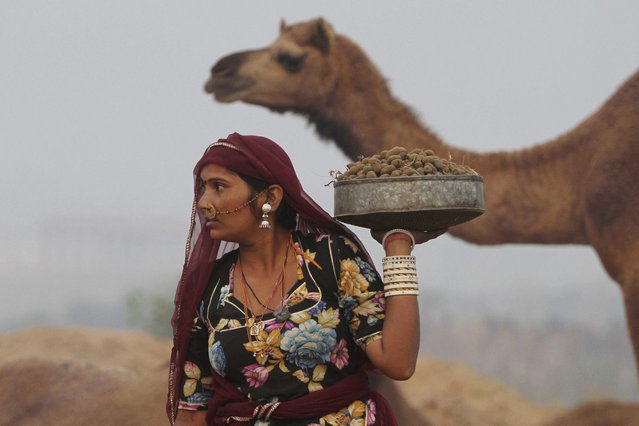
An Indian woman collects camel dung during the annual cattle fair in Pushkar, in the western Indian state of Rajasthan, Sunday, November 10, 2013. Pushkar, located on the banks of Pushkar Lake, is a popular Hindu pilgrimage spot that is also frequented by foreign tourists who come to the town for the annual cattle fair and camel races. (Photo by Ajit Solanki/AP Photo)
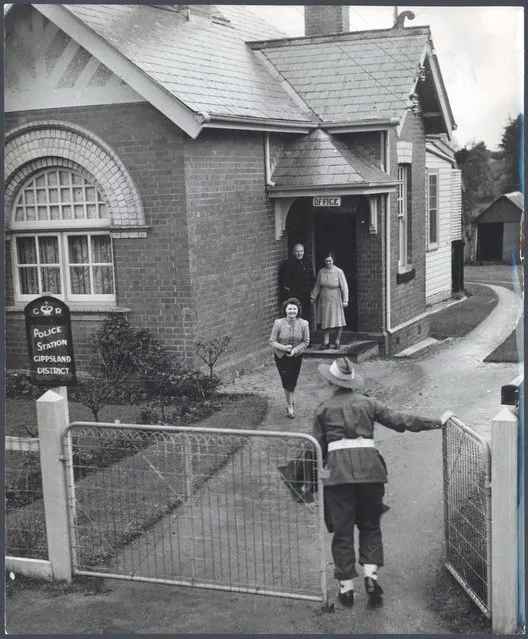
Private Wallace Tratford arrives home on leave, Drouin, Victoria, ca. 1944. A.I.F. Private Wallace Tratford, son of 1st Constable James Tratford, Drouin's only policeman (responsible for area of 105 square miles; 3,000 people), arrives home on his first leave from New Guinea battlefronts since he was married.
The sun rises beside St Mary's Lighthouse in Whitley Bay, Tyne and Wear, as the unseasonably cool weather continues on Thursday, April 28, 2016. (Photo by Owen Humphreys/PA Wire)
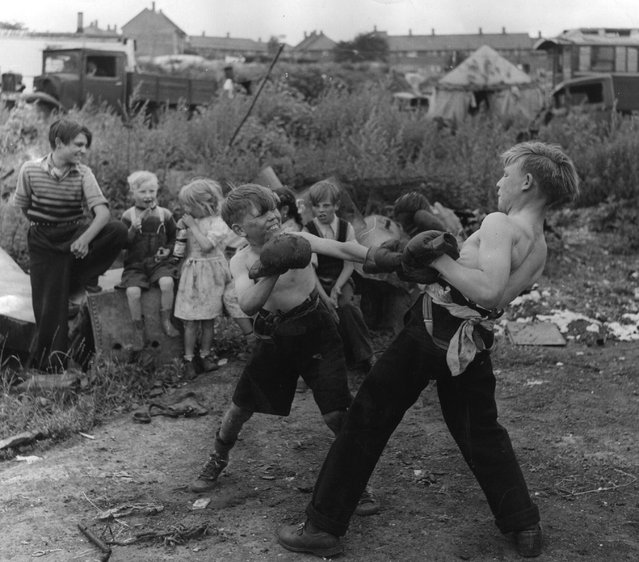
The unromantic gypsies. Children boxing in a gypsy camp in Kent, England on July 1, 1951. Like all boys these gypsy lads like to try their hand at boxing. Encouraged by their friends they fight it out on Corke's Meadow. Few Romanies now live a life of wandering romance. Most are like the three hundred squatters of Corke's Meadow, Kent, which is part of a “gypsy problem” that involves about 100,000 today. Of those about 25,000 can be rightly called gypsies, the rest are Mumpers and Posh-rats and Hobos. Corke's Meadow has both kinds. “Picture Post” cameraman Bert Hardy photographs the Corke's Meadow gypsies in their encampment. (Photo by Hulton-Deutsch Collection/Corbis via Getty Images)