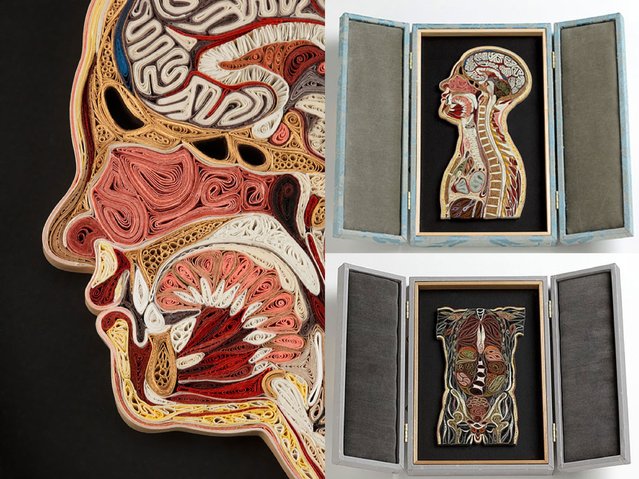
These pieces are made of Japanese mulberry paper and the gilded edges of old books. They are constructed by a technique of rolling and shaping narrow strips of paper called quilling or paper filigree. Quilling was first practiced by Renaissance nuns and monks who are said to have made artistic use of the gilded edges of worn out bibles, and later by 18th century ladies who made artistic use of lots of free time. I find quilling exquisitely satisfying for rendering the densely squished and lovely internal landscape of the human body in cross section.
A hostage runs towards a police officer outside Lindt cafe, where other hostages are being held, in Martin Place in central Sydney December 15, 2014. Two more hostages have run out of the cafe at the center of a siege in Sydney, Australia's largest city, according to a Reuters witness at the site. The two women were both wearing aprons indicating they were staff at the Lindt cafe where a gunman has been holding an unknown number of hostages for several hours. Three men had earlier run out of the cafe. (Photo by Jason Reed/Reuters)
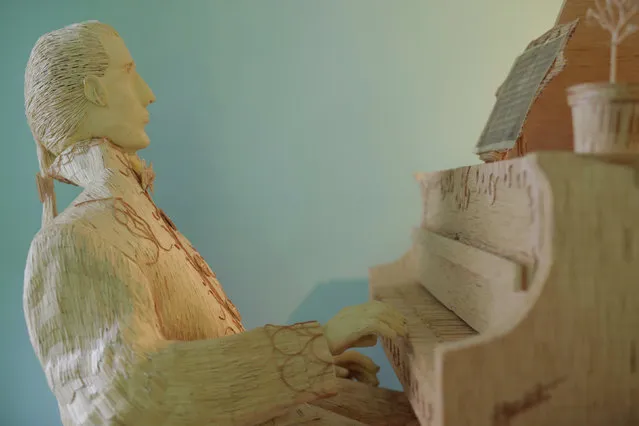
A life-size sculpture of a pianist, made of approximately 210,000 matches and weighs around 100 kilograms, is seen in Tomislav Horvat's studio in Podturen, Croatia, October 27, 2016. For the last ten years, Horvat has built sculptures made from matches. This is his biggest sculpture to date that took him some 30 months to build. (Photo by Antonio Bronic/Reuters)
A model presents a creation during the Biofashion show, which features designs made from plants, recycled and natural materials, in Cali, Colombia, November 19, 2016. BioFashion is an environmental initiative that seeks to create awareness about the preservation and management of natural resources where new designers develop dresses made with living plants, flowers and organic elements. (Photo by Jaime Saldarriaga/Reuters)
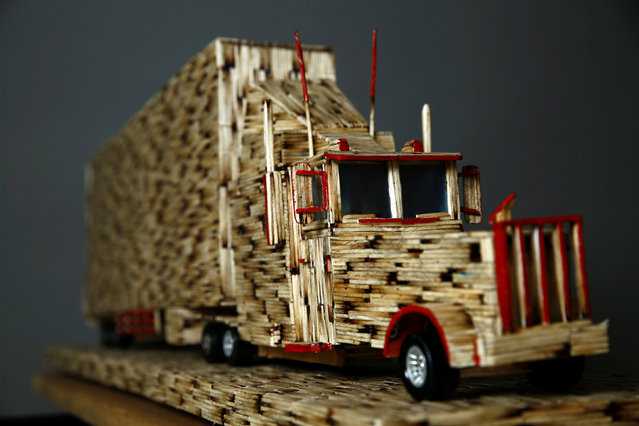
A replica of the truck made from matchsticks by Janusz Urbanski is pictured at his flat in Ruda Slaska, Poland May 4, 2016. Janusz Urbanski has a one of a kind chessboard he never plays, a personalised guitar he does not strum and a boat he cannot sail. Why? They are all made from tens of thousands of matches. For the last 40 years, the former Polish miner and ironworker has harboured a passion to build replicas of objects, buildings and famous sites with just matchsticks and glue. (Photo by Kacper Pempel/Reuters)