These pieces are made of Japanese mulberry paper and the gilded edges of old books. They are constructed by a technique of rolling and shaping narrow strips of paper called quilling or paper filigree. Quilling was first practiced by Renaissance nuns and monks who are said to have made artistic use of the gilded edges of worn out bibles, and later by 18th century ladies who made artistic use of lots of free time. I find quilling exquisitely satisfying for rendering the densely squished and lovely internal landscape of the human body in cross section.
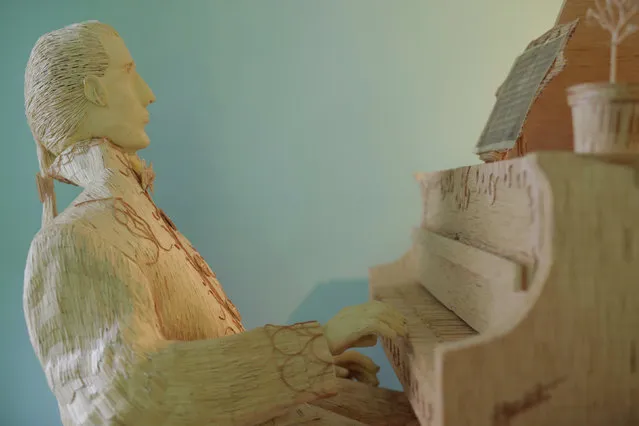
A life-size sculpture of a pianist, made of approximately 210,000 matches and weighs around 100 kilograms, is seen in Tomislav Horvat's studio in Podturen, Croatia, October 27, 2016. For the last ten years, Horvat has built sculptures made from matches. This is his biggest sculpture to date that took him some 30 months to build. (Photo by Antonio Bronic/Reuters)
A model presents a creation during the Biofashion show, which features designs made from plants, recycled and natural materials, in Cali, Colombia, November 19, 2016. BioFashion is an environmental initiative that seeks to create awareness about the preservation and management of natural resources where new designers develop dresses made with living plants, flowers and organic elements. (Photo by Jaime Saldarriaga/Reuters)
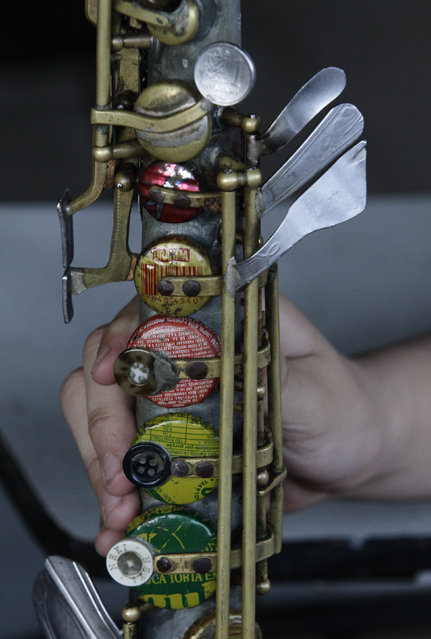
A student of the Orchestra of Recycled Instruments of Cateura holds an instrument made from recycled material by craftsman Nicolas Gomez, in Cateura, near Asuncion, May 9, 2013. The orchestra is the brainchild of its conductor Favio Chavez, who wanted to help the children of garbage pickers at the local landfill, and the instruments are made from salvaged materials by craftsman Gomez. The orchestra now involves 30 schoolchildren who have toured countries in Latin America, North America and Europe to play music ranging from Beethoven and Mozart to the Beatles and Paraguayan folk songs. (Photo by Jorge Adorno/Reuters)
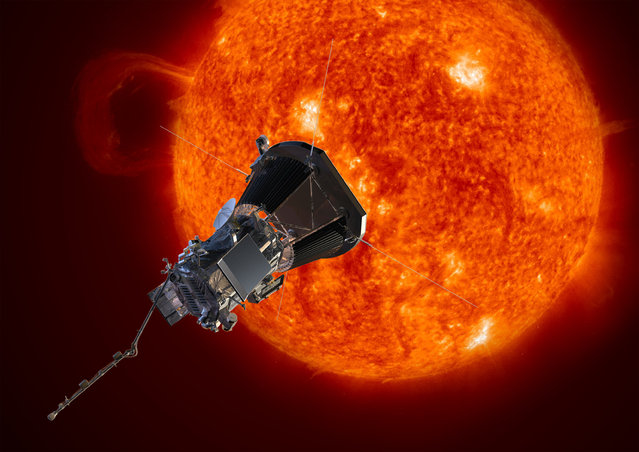
This image made available by the Johns Hopkins University Applied Physics Laboratory on Wednesday, May 31, 2017 depicts NASA's Solar Probe Plus spacecraft approaching the sun. On Wednesday, NASA announced it will launch the probe in summer 2018 to explore the solar atmosphere. It will be subjected to brutal heat and radiation like no other man-made structure before. (Photo by Johns Hopkins University Applied Physics Laboratory via AP Photo)