Loading...
Done
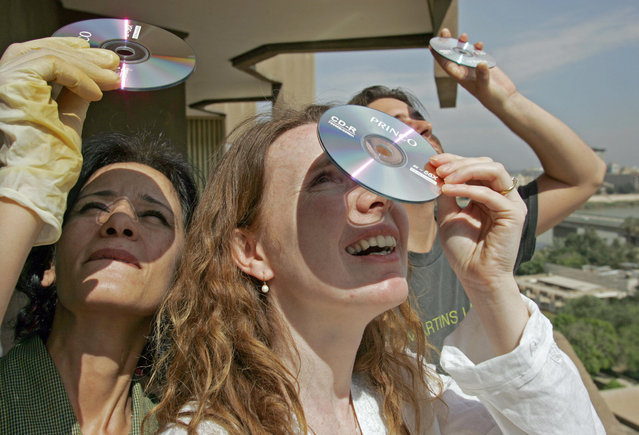
An Iraqi woman and foreigners use  pair of compact discs as a filter to watch the partial solar eclipse in war-torn Baghdad, 29 March 2006. Without access to proper equipment to protect their eyes from the sun's rays, eclipse watchers in Iraq used makeshift filters.  The moon blotted out the sun over northwest Africa early Wednesday, turning day into night in a total solar eclipse as it swept a shadowy path from the outer tip of Brazil to the steppes of Mongolia. (Photo by Hassan Ammar/AFP Photo)

An Iraqi woman and foreigners use pair of compact discs as a filter to watch the partial solar eclipse in war-torn Baghdad, 29 March 2006. Without access to proper equipment to protect their eyes from the sun's rays, eclipse watchers in Iraq used makeshift filters. The moon blotted out the sun over northwest Africa early Wednesday, turning day into night in a total solar eclipse as it swept a shadowy path from the outer tip of Brazil to the steppes of Mongolia. (Photo by Hassan Ammar/AFP Photo)
Details
25 Jul 2017 09:31:00
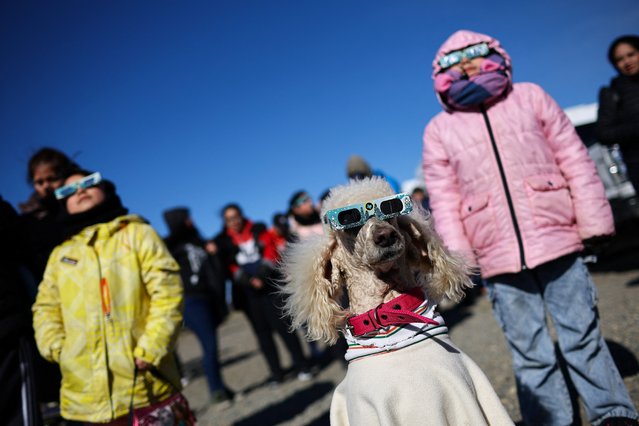
Dana the dog wears glasses as people watch an annular solar eclipse, in Las Horquetas, Santa Cruz, Argentina, on October 2, 2024. (Photo by Agustin Marcarian/Reuters)

Dana the dog wears glasses as people watch an annular solar eclipse, in Las Horquetas, Santa Cruz, Argentina, on October 2, 2024. (Photo by Agustin Marcarian/Reuters)
Details
06 Oct 2024 03:44:00


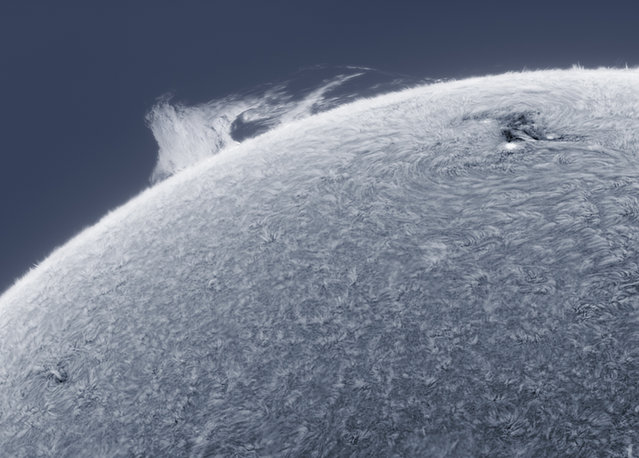
Alan Friedman, sun photographed with a solar telescope using a Hydrogen alpha filter.
Details
03 Oct 2012 09:02:00
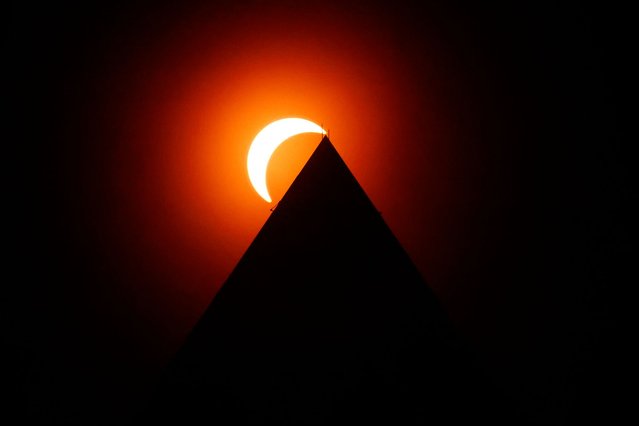
The solar eclipse is seen above the Washington Monument on April 08, 2024 in Washington, DC. People have traveled to areas across North America that are in the “path of totality” in order to experience the eclipse today. The next total solar eclipse that can be seen from a large part of North America won't happen until 2044. (Photo by Chip Somodevilla/Getty Images)

The solar eclipse is seen above the Washington Monument on April 08, 2024 in Washington, DC. People have traveled to areas across North America that are in the “path of totality” in order to experience the eclipse today. The next total solar eclipse that can be seen from a large part of North America won't happen until 2044. (Photo by Chip Somodevilla/Getty Images)
Details
20 May 2024 02:29:00
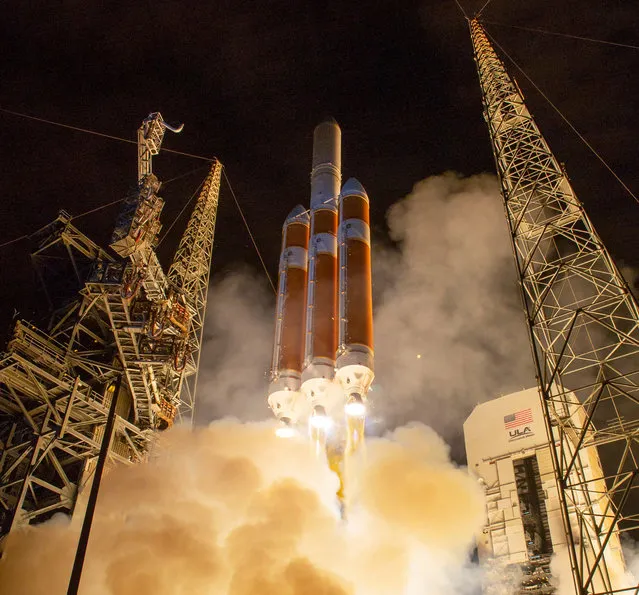
A handout photo made available by the NASA shows the United Launch Alliance Delta IV Heavy rocket launches NASA's Parker Solar Probe to touch the Sun, from Launch Complex 37 at Cape Canaveral Air Force Station, Florida, USA, 12 August 2018. Parker Solar Probe is humanity’s first-ever mission into a part of the Sun’s atmosphere called the corona. Here it will directly explore solar processes that are key to understanding and forecasting space weather events that can impact life on Earth. (Photo by Bill Ingalls/EPA-EFE/NASA)

A handout photo made available by the NASA shows the United Launch Alliance Delta IV Heavy rocket launches NASA's Parker Solar Probe to touch the Sun, from Launch Complex 37 at Cape Canaveral Air Force Station, Florida, USA, 12 August 2018. Parker Solar Probe is humanity’s first-ever mission into a part of the Sun’s atmosphere called the corona. Here it will directly explore solar processes that are key to understanding and forecasting space weather events that can impact life on Earth. (Photo by Bill Ingalls/EPA-EFE/NASA)
Details
13 Aug 2018 07:26:00
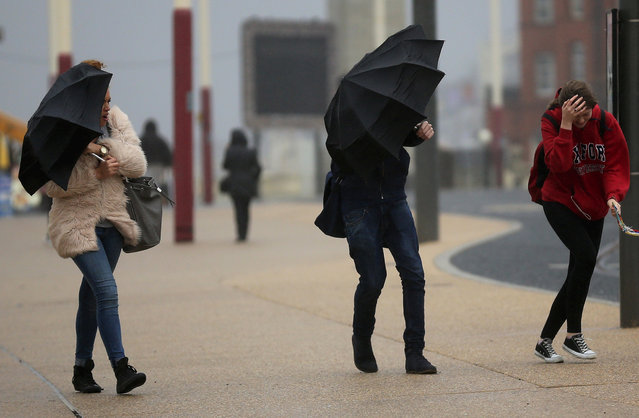
Students brave high winds and rain on Blackpool promenade as Britain prepares for high winds over the next two days on October 20, 2014 in Blackpool, England. (Photo by Christopher Furlong/Getty Images)

Students brave high winds and rain on Blackpool promenade as Britain prepares for high winds over the next two days on October 20, 2014 in Blackpool, England. (Photo by Christopher Furlong/Getty Images)
Details
15 Nov 2014 12:47:00
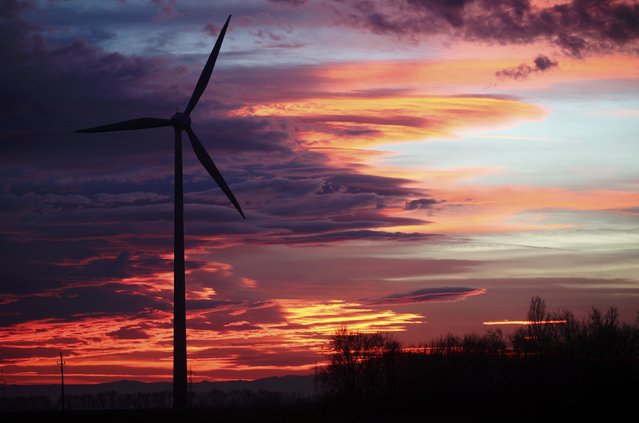
The setting sun illuminates the sky behind wind turbines of a wind park near Neusiedl am See, December 22, 2014. (Photo by Heinz-Peter Bader/Reuters)

The setting sun illuminates the sky behind wind turbines of a wind park near Neusiedl am See, December 22, 2014. (Photo by Heinz-Peter Bader/Reuters)
Details
08 Jan 2015 14:27:00
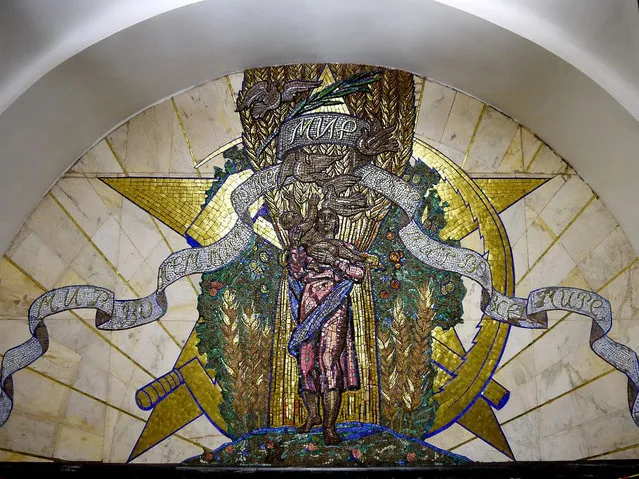
Moscow Metro

The is a rapid transit system serving Moscow and the neighbouring town of Krasnogorsk. Opened in 1935 with one 11-kilometre (6.8 mi) line and 13 stations, it was the first underground railway system in the Soviet Union. As of 2011, the Moscow Metro has 185 stations and its route length is 305.7 kilometres (190.0 mi). The system is mostly underground, with the deepest section 84 metres (276 ft) at the Park Pobedy station. The Moscow Metro is the world's second most heavily used rapid transit system after Tokyo's twin subway.
Details
13 Jun 2012 09:17:00