Loading...
Done
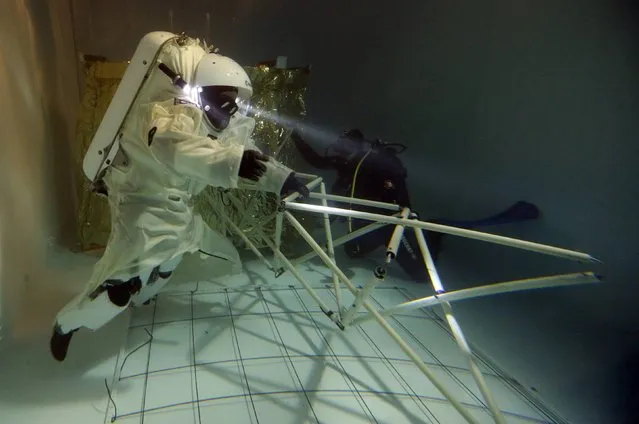
National Diving School director Jerome Vincent, wearing a Gandolfi space suit, executes training procedures in a swimming pool in Marseille October 22, 2014. (Photo by Jean-Paul Pelissier/Reuters)

National Diving School director Jerome Vincent, wearing a Gandolfi space suit, executes training procedures in a swimming pool in Marseille October 22, 2014. The underwater test session develops European expertise in spacewalk simulations under partial gravity for exploring the Moon, asteroids and Mars.The training is organised by Comex, a French company specializing in engineering and deep sea diving operations, in collaboration with the European Space Agency (ESA) and with Apollo XI “Under the sea”. (Photo by Jean-Paul Pelissier/Reuters)
Details
26 Oct 2014 12:47:00
Key Monastery illuminated on a mountain in the Spiti Valley, Himachal Pradesh, northern India with an amazing nights sky illuminated beyond. (Photo by Grey Chow/Caters News Agency)

The Tibetan night sky was captured in these beautiful images showing the stunning buildings and statues in the Himalayan mountains. Grey Chow, 33, traveled for two hours to get to the Spiti Valley to capture the starry backdrop along the isolated, deserted roads. The senior project engineer was able to take amazingly clear images thanks to the limited amount of pollution at the 4,500-foot (1371m) altitude. (Photo by Grey Chow/Caters News Agency)
Details
06 Aug 2018 00:05:00
Upside Down Race Car By Jeff Bloch Aka SpeedyCop

An American inventor has built a unique upside-down racecar – and successfully taken it on a 24-hour spin around the LeMons track. Jeff Bloch – also known as SpeedyCop – built his upside down 1999 Chevrolet Camaro by combining it with a decrepit 1990 Ford Festiva. To enter the latest LeMons race the car had to cost less than $500, which Bloch achieved by picking a Festiva model with a worn-out 1.3-litre engine and more than 300,000 kilometres on the clock.
Details
03 Dec 2013 09:47:00
Art by Christian Faur

Christian Faur is an artist based in Granville, Ohio. Looking for a new technique, he experimented with painting with wax, but he didn’t feel the results were satisfactory.Then, at Christmas in 2005, his young daughter opened a box of 120 Crayola crayons he’d bought her, and everything clicked into place. Faur decided he would create pictures out of the crayons themselves, packing thousands of them together so they become like the colored pixels on a TV screen. He starts each work by scanning a photo into a computer and breaking the image down into colored blocks He then draws a grid that shows him exactly where to place each crayon The finished artworks are packed tightly into wooden frames. He actually makes the crayons himself, hand-casting each one in a mould.
Details
28 Jul 2012 10:03:00
Tridacna Gigas, or Giant Clams

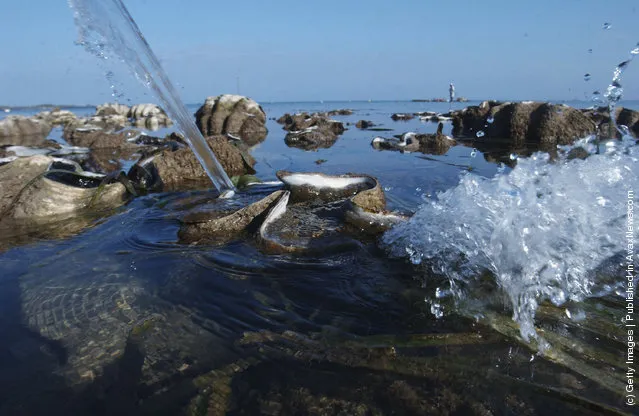
“The giant clam, Tridacna gigas (known as pā’ua in Cook Islands Māori), is the largest living bivalve mollusc. T. gigas is one of the most endangered clam species. It was mentioned as early as 1825 in scientific reports. One of a number of large clam species native to the shallow coral reefs of the South Pacific and Indian oceans, they can weigh more than 200 kilograms (440 lb) measure as much as 120 cm (47 in) across, and have an average lifespan in the wild of 100 years or more”. – Wikipedia

Photo: Tridacna Gigas, or Giant Clams spew water as a traditional fisherman passes by a small sanctuary on January 23, 2004 near Bolinao in the Northern Philippines. The clams, prime builders for coral reefs and providing shelter for spawning fish and other marine life, are exposed by low tides in the sanctuary. Overfishing and pollution throughout the country are not only threatening food security, but are also starting to choke one of the few working clam sanctuaries in the world. (Photo by David Greedy/Getty Images)
Details
01 Oct 2011 13:10:00
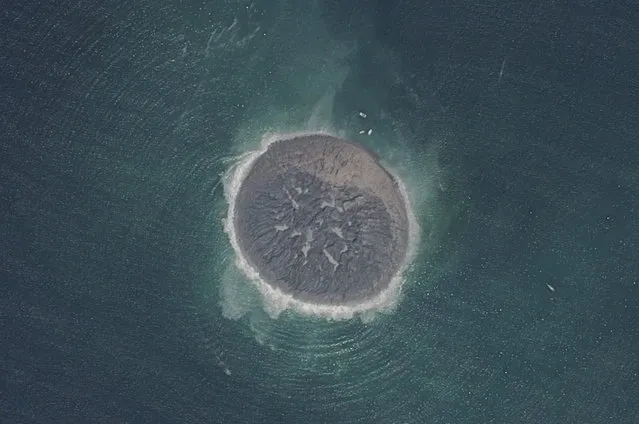
This handout picture taken by Pleiades satellite and released on September 27, 2013 shows a small island of mud and rock created by the huge earthquake that hit southwest Pakistan has fascinated locals but experts – who found methane gas rising from it – say it is unlikely to last long

This handout picture taken by Pleiades satellite and released on September 27, 2013 shows a small island of mud and rock created by the huge earthquake that hit southwest Pakistan has fascinated locals but experts – who found methane gas rising from it – say it is unlikely to last long. The 7.7-magnitude quake struck on September 25 in Baluchistan's remote Awaran district, killing at least 271 people and affecting hundreds of thousands. The island is about 60 to 70 feet (18 to 21 metres) high, up to 300 feet wide and up to 120 feet long and sits about 650 feet from the coast. (Photo by AFP Photo/CNES/Distribution Astrium Services)
Details
01 Oct 2013 08:23:00
Zhang Jinduo's wife tries on a self-made racing car on the outskirts of Shenyang, Liaoning province May 10, 2008. Zhang, the 53-year-old local farmer made the racing car with the help of his son who is a car mechanic. The car is equipped with a rear-mounted motorcycle engine and can achieve 60-80 km per hour, according to local media. (Photo by Reuters/Stringer)

Zhang Jinduo's wife tries on a self-made racing car on the outskirts of Shenyang, Liaoning province May 10, 2008. Zhang, the 53-year-old local farmer made the racing car with the help of his son who is a car mechanic. The car is equipped with a rear-mounted motorcycle engine and can achieve 60-80 km per hour, according to local media. (Photo by Reuters/Stringer)
Details
17 Sep 2013 08:46:00
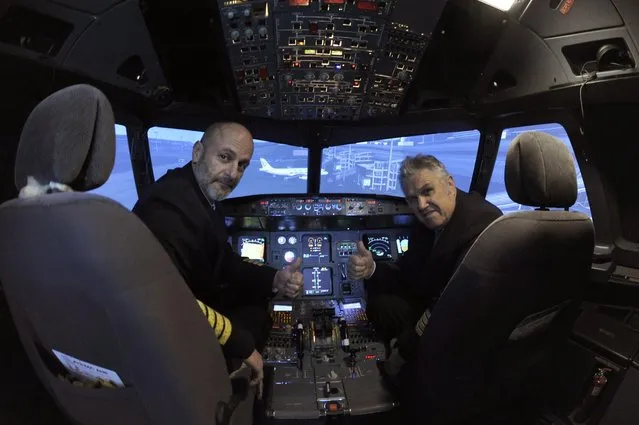
Igor Perne (L), 53, an electronic engineer and a member of the International Virtual Aviation Organisation (IVAO), and fellow virtual pilot Franc Lavric gesture for the camera before taking off on a virtual flight in a flight simulator in Nova Vas, Slovenia November 13, 2014. In 2011, Perne, a lifelong flying enthusiast, bought parts of a written-off Cyprus Airways airliner and then spent two and a half years turning the entire nose of the scrapped aircraft into an elaborate flight simulator. (Photo by Srdjan Zivulovic/Reuters)

Igor Perne (L), 53, an electronic engineer and a member of the International Virtual Aviation Organisation (IVAO), and fellow virtual pilot Franc Lavric gesture for the camera before taking off on a virtual flight in a flight simulator in Nova Vas, Slovenia November 13, 2014. In 2011, Perne, a lifelong flying enthusiast, bought parts of a written-off Cyprus Airways airliner and then spent two and a half years turning the entire nose of the scrapped aircraft into an elaborate flight simulator. (Photo by Srdjan Zivulovic/Reuters)
Details
16 Nov 2014 12:07:00