Loading...
Done
On August 31, 2012, a long filament of solar material that had been hovering in the sun's atmosphere, the corona, erupted out into space at 4:36 p.m. EDT. The coronal mass ejection, or CME, traveled at over 900 miles per second. The CME did not travel directly toward Earth, but did connect with Earth's magnetic environment, or magnetosphere, causing aurora to appear on the night of Monday, September 3. (Photo by NASA/GSFC/SDO)

On August 31, 2012, a long filament of solar material that had been hovering in the sun's atmosphere, the corona, erupted out into space at 4:36 p.m. EDT. The coronal mass ejection, or CME, traveled at over 900 miles per second. The CME did not travel directly toward Earth, but did connect with Earth's magnetic environment, or magnetosphere, causing aurora to appear on the night of Monday, September 3. (Photo by NASA/GSFC/SDO via The Atlantic)
Details
14 Sep 2012 09:01:00
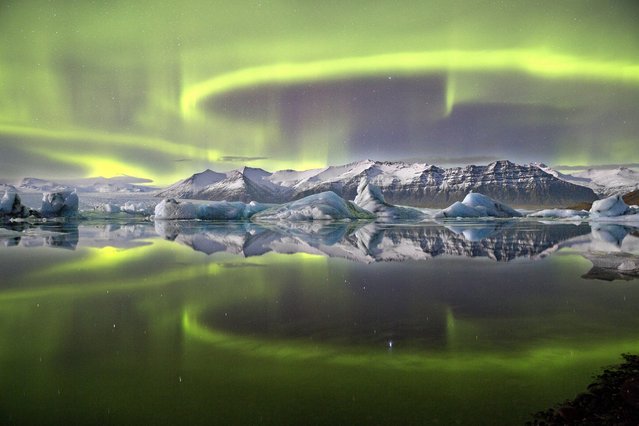
“Aurora over a glacier lagoon”. A vivid green overheaded aurrora pictured in Iceland's Vatnajokull National Park reflected almost symetrically in Jokulsrlon Glacier lagoon. A complete lack of wind and currrent combin in this sheltred lagoon scene to crete an arresting mirror effect giving the image a sensation of utter stillness. Despite theis there is motion on a suprising scale, as the loops and arcs of the aurora are shaped by the shifting forces of the Earth's magnetic field. (Photo by  James Woodend/The Astronomy Photographer of the Year 2014 Contest)

“Aurora over a glacier lagoon”. A vivid green overheaded aurrora pictured in Iceland's Vatnajokull National Park reflected almost symetrically in Jokulsrlon Glacier lagoon. A complete lack of wind and currrent combin in this sheltred lagoon scene to crete an arresting mirror effect giving the image a sensation of utter stillness. Despite theis there is motion on a suprising scale, as the loops and arcs of the aurora are shaped by the shifting forces of the Earth's magnetic field. James Woodend of Great Britain won the grand prize with the image, beating out more than 2,500 other entries. The Astronomy Photographer of the Year 2014 contest is judged by the Royal Observatory Greenwich and BBC Sky at Night magazine. (Photo by James Woodend/The Astronomy Photographer of the Year 2014 Contest)
Details
26 Sep 2014 13:39:00
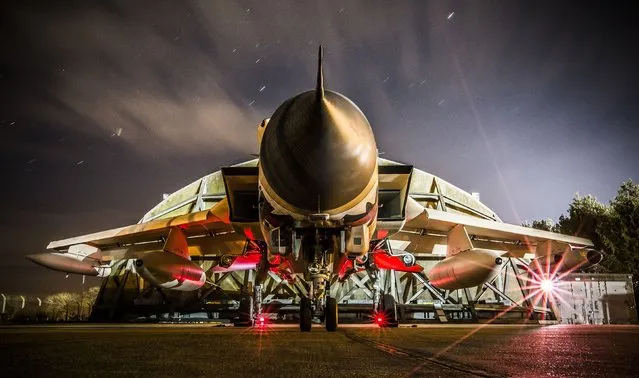
Undated UK Ministry of Defence handout photo of an RAF Tornado GR4 which has been painted in Gulf War “desert pink” paint scheme to honour the aircraft type's almost continuous operational service since the Royal Air Force helped liberate Kuwait from Saddam Hussein's forces, taken by SAC Rose Buchanan, which has been shortlisted for the general public to pick their favourite RAF Image of the Year. (Photo by SAC Rose Buchanan/MoD Crown Copyright/PA Wire)

Undated UK Ministry of Defence handout photo of an RAF Tornado GR4 which has been painted in Gulf War “desert pink” paint scheme to honour the aircraft type's almost continuous operational service since the Royal Air Force helped liberate Kuwait from Saddam Hussein's forces, taken by SAC Rose Buchanan, which has been shortlisted for the general public to pick their favourite RAF Image of the Year. (Photo by SAC Rose Buchanan/MoD Crown Copyright/PA Wire)
Details
15 Sep 2016 09:50:00
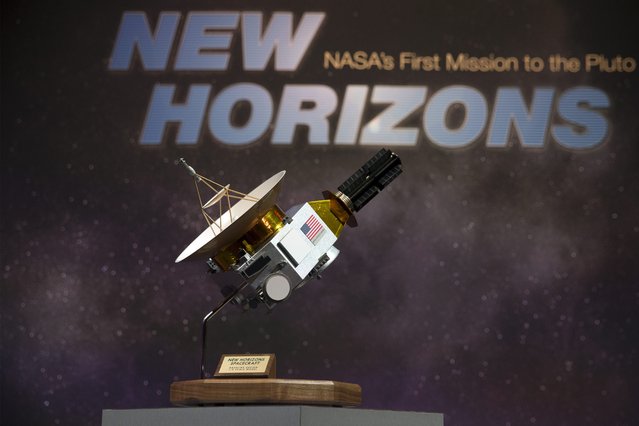
A model of the New Horizons spacecraft is seen at a live television program on NASA television celebrating the spacecraft's closest proximity to Pluto, at Johns Hopkins University Applied Physics Laboratory, site of the mission operations center, in Laurel, Maryland, USA, 14 July 2015. (Photo by Michael Reynolds/EPA)

A model of the New Horizons spacecraft is seen at a live television program on NASA television celebrating the spacecraft's closest proximity to Pluto, at Johns Hopkins University Applied Physics Laboratory, site of the mission operations center, in Laurel, Maryland, USA, 14 July 2015. At approximately 7:49 am ET (11:49 am GMT), 14 July, New Horizons was scheduled to be as close to Pluto as the spacecraft will get; about 7,800 miles (12,500 kilometers) above the surface, following a journey of more than nine years and three billion miles. This is the first mission to the Pluto System and the Kuiper Belt. (Photo by Michael Reynolds/EPA)
Details
15 Jul 2015 10:08:00
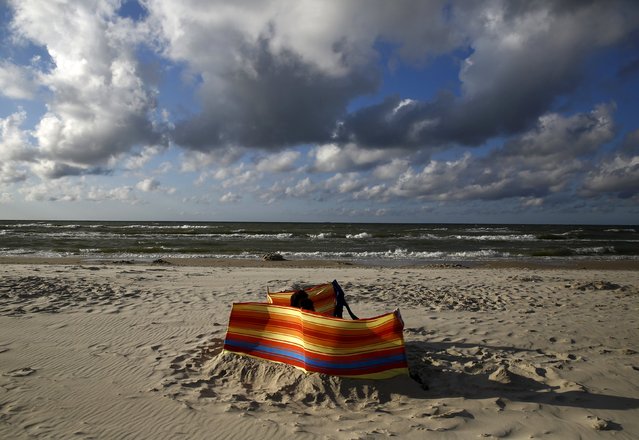
A couple sunbath on the beach in Ostrowo, northern Poland, July 20, 2015. Picture taken July 20, 2015. (Photo by Kacper Pempel/Reuters)

A couple sunbath on the beach in Ostrowo, northern Poland, July 20, 2015. Picture taken July 20, 2015. (Photo by Kacper Pempel/Reuters)
Details
10 Nov 2015 08:06:00
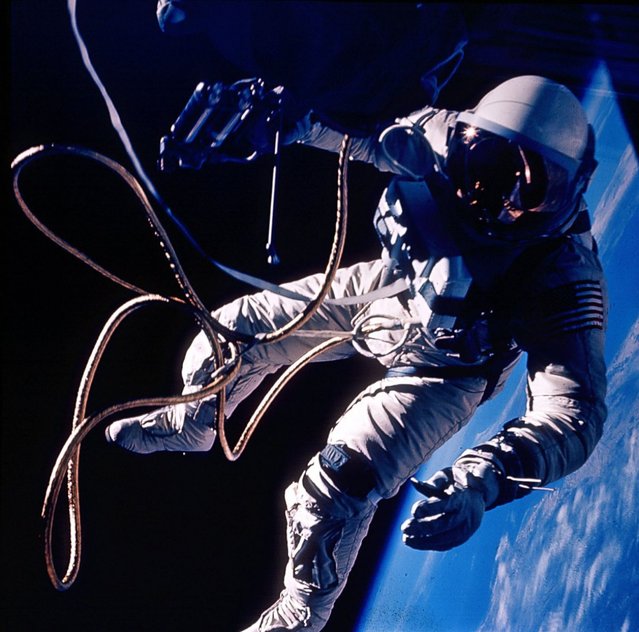
The First U.S. Spacewalk – Gemini 4 Ed White made the United States' first spacewalk on June 3, 1965 during the Gemini 4 mission. The extra-vehicular activity (EVA) started at 19:45 UT (3:45 p.m. EDT) on the third orbit when White opened his hatch and used the hand-held manuevering oxygen-jet gun to push himself out of the capsule. (Photo by NASA)

The First U.S. Spacewalk – Gemini 4 Ed White made the United States' first spacewalk on June 3, 1965 during the Gemini 4 mission. The extra-vehicular activity (EVA) started at 19:45 UT (3:45 p.m. EDT) on the third orbit when White opened his hatch and used the hand-held manuevering oxygen-jet gun to push himself out of the capsule. (Photo by NASA)
Details
11 Apr 2014 08:40:00
Gazan artist wears a face mask to raise awareness to the novel coronavirus (Covid-19) spread in Gaza Strip on March 25, 2020. (Photo by Ali Jadallah/Anadolu Agency via Getty Images)

Gazan artist wears a face mask to raise awareness to the novel coronavirus (Covid-19) spread in Gaza Strip on March 25, 2020. (Photo by Ali Jadallah/Anadolu Agency via Getty Images)
Details
30 Mar 2020 00:07:00
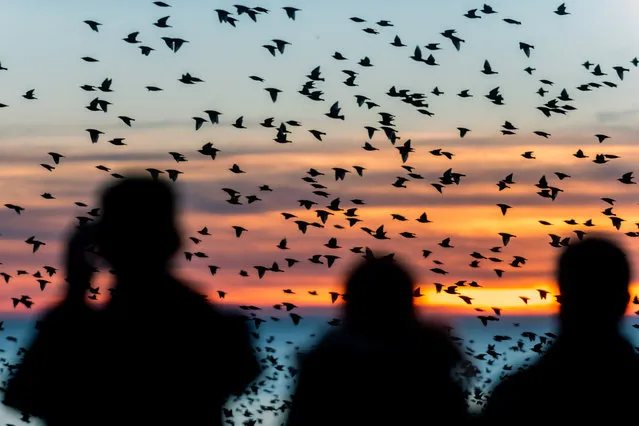
Sunset on Brighton beach on February 24, 2019 in Brighton, England. (Photo by Andrew Hasson/Getty Images)

Sunset on Brighton beach on February 24, 2019 in Brighton, England. (Photo by Andrew Hasson/Getty Images)
Details
27 Feb 2019 00:03:00