Loading...
Done
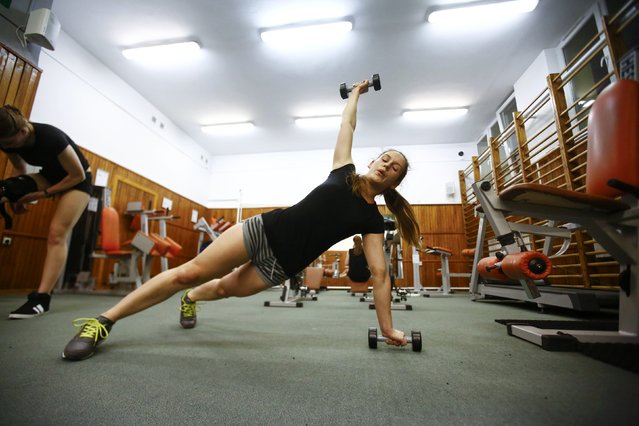
Urszula Sidoruk, 19, from the paramilitary group SJS Strzelec (Shooters Association), trains her workout at a gym in Siedlce, eastern Poland March 18, 2014. (Photo by Kacper Pempel/Reuters)

Urszula Sidoruk, 19, from the paramilitary group SJS Strzelec (Shooters Association), trains her workout at a gym in Siedlce, eastern Poland March 18, 2014. Inspired by the war in Ukraine, growing numbers of Poles are joining volunteer paramilitary groups, where they receive basic army training and prepare to defend their homeland. (Photo by Kacper Pempel/Reuters)
Details
22 Mar 2015 11:36:00
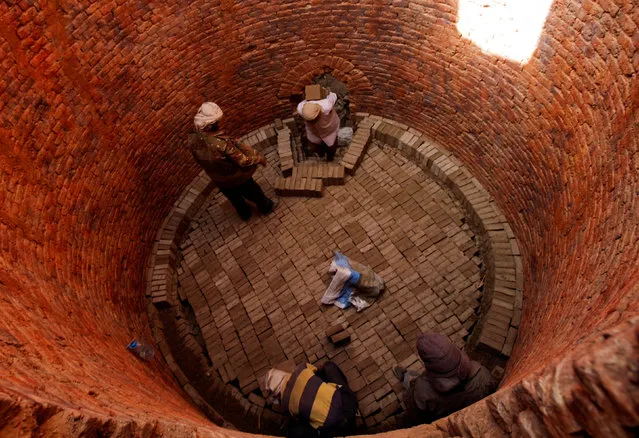
Labourers stack dried bricks inside a kiln, where they will be fired, at a brick factory on the outskirt of Sanaa, Yemen, June 1, 2016. (Photo by Mohamed al-Sayaghi/Reuters)

Labourers stack dried bricks inside a kiln, where they will be fired, at a brick factory on the outskirt of Sanaa, Yemen, June 1, 2016. Traditional mud brick tower houses have always been a source of pride to Yemenis, and over a year into a devastating civil war, they are also providing some much-needed jobs in the ancient capital Sanaa. (Photo by Mohamed al-Sayaghi/Reuters)
Details
27 Jul 2016 09:23:00
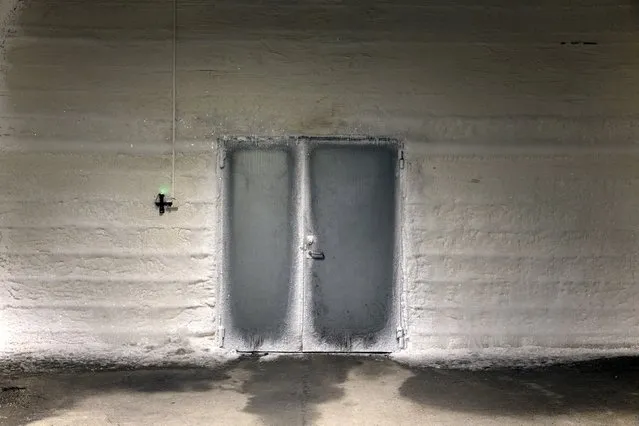
An ice covered entrance door to the international gene bank Svalbard Global Seed Vault (SGSV) near Longyearbyen on Spitsbergen, Norway, October 20, 2015. (Photo by Anna Filipova/Reuters)

An ice covered entrance door to the international gene bank Svalbard Global Seed Vault (SGSV) near Longyearbyen on Spitsbergen, Norway, October 20, 2015. Two consignments of crop seeds will be deposited next year in a “doomsday vault” built in an Arctic mountainside to safeguard global supplies. The vault, which opened on the Svalbard archipelago in 2008, is designed to protect crop seeds, such as beans, rice and wheat against the worst cataclysms of nuclear war or disease. (Photo by Anna Filipova/Reuters)
Details
17 Dec 2015 08:01:00
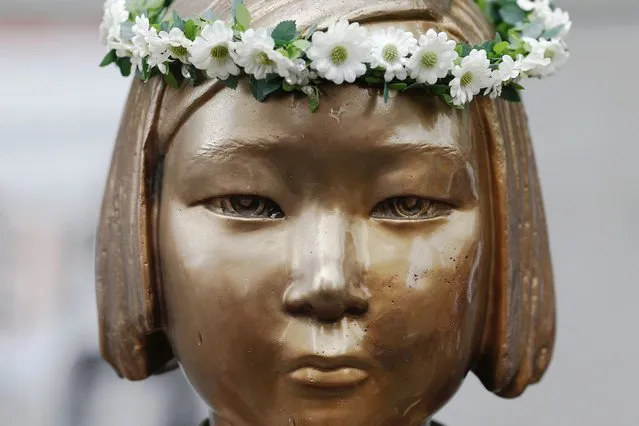
Flowers are placed on a “comfort woman” statue during the weekly Wednesday protest in front of Japanese embassy demanding for an apology and compensation from Japanese government in Seoul, South Korea, July 22, 2015. (Photo by Kim Kyung-Hoon/Reuters)

Flowers are placed on a “comfort woman” statue during the weekly Wednesday protest in front of Japanese embassy demanding for an apology and compensation from Japanese government in Seoul, South Korea, July 22, 2015. “Comfort women” is the Japanese euphemism for women who were forced into prostitution and sexually abused at Japanese military brothels before and during World War Two. (Photo by Kim Kyung-Hoon/Reuters)
Details
13 Aug 2015 11:06:00
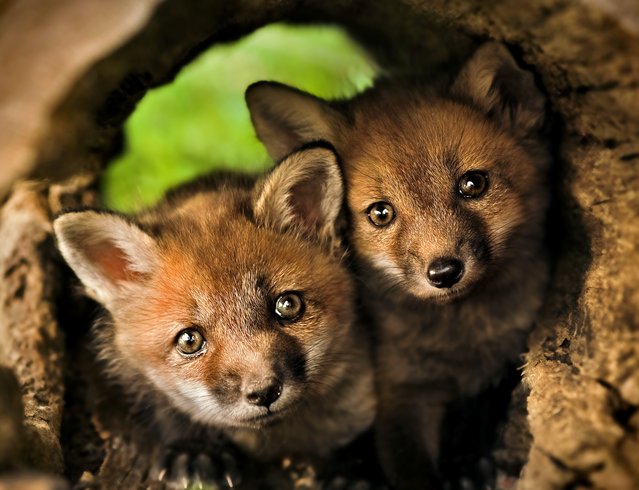
Red fox kits look out from a hollow log. (Photo by Kevin Fleming)

Wildlife photographer Kevin Fleming has covered the world as a photographer for National Geographic and has been recognized America’s Best Observer by Readers Digest. His assignments have taken him into war and famine in Somalia, to the Mediterranean for a re-creation of the voyage of Ulysses and put him on a dogsled crossing the Canadian arctic. Now Kevin is working on his 27th book. Here: Red fox kits look out from a hollow log. (Photo by Kevin Fleming)
Details
02 Oct 2014 10:28:00
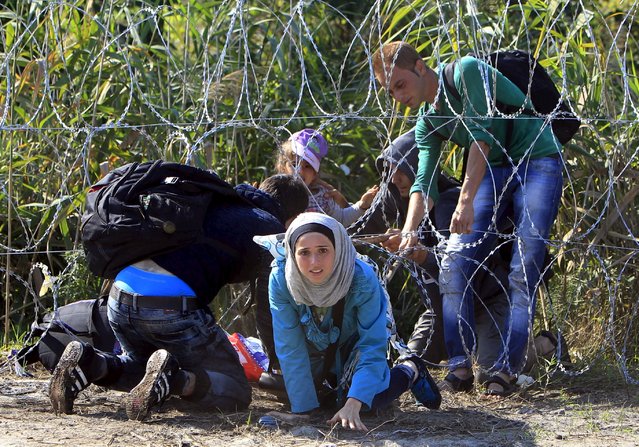
A Syrian migrant family enters Hungary at the border with Serbia near Roszke, Hungary August 28, 2015. (Photo by Bernadett Szabo/Reuters)

A Syrian migrant family enters Hungary at the border with Serbia near Roszke, Hungary August 28, 2015. As Europe struggles with its worst migrant crisis since World War II, Hungary has become, like Italy and Greece, a “frontline” state. So far this year, police say around 141,500 migrants have been intercepted crossing into Hungary, mostly from neighbouring Serbia. (Photo by Bernadett Szabo/Reuters)
Details
29 Aug 2015 11:33:00
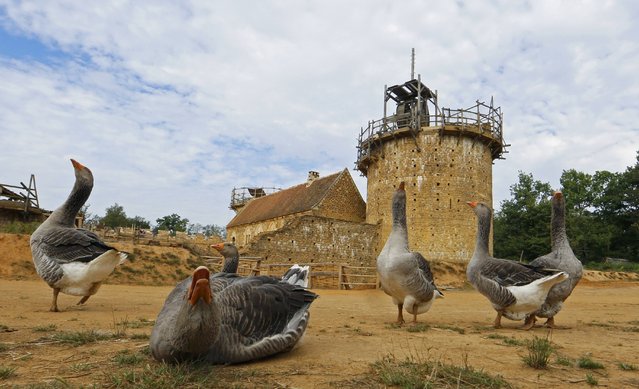
A view of the construction site of the Chateau de Guedelon near Treigny in the Burgundy region of France, September 13, 2016. Blacksmiths, stonemasons and quarry men are hard at work in a Burgundy forest building a 13th-century-style castle using the most basic tools and materials, replicating the methods used hundreds of years ago to better understand them. Forgoing all modern technology, workers use hammers to break stones and forge iron, operate wooden wheels to hoist their materials up to where they are needed, and rely on a quarry for stone, clay and sand as they build up a castle from scratch. Construction on Guedelon Castle in central France began in 1997 after an archaeological survey revealed a medieval fortress hidden inside the walls of nearby Chateau de Saint-Fargeau. Those behind the project hope to answer questions about medieval construction and provide lessons on sustainable building. (Photo by Jacky Naegelen/Reuters)

A view of the construction site of the Chateau de Guedelon near Treigny in the Burgundy region of France, September 13, 2016. Blacksmiths, stonemasons and quarry men are hard at work in a Burgundy forest building a 13th-century-style castle using the most basic tools and materials, replicating the methods used hundreds of years ago to better understand them. (Photo by Jacky Naegelen/Reuters)
Details
15 Sep 2016 09:43:00
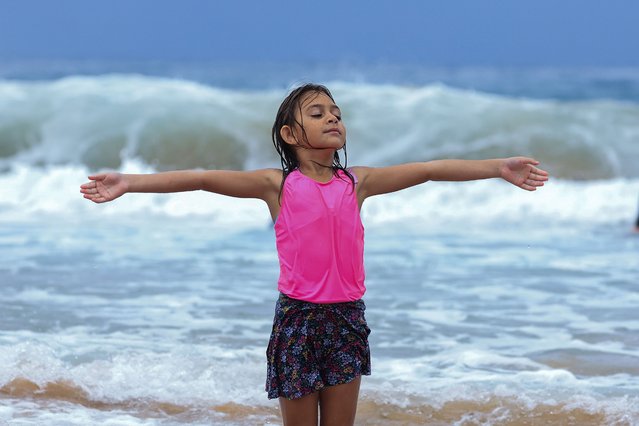
A girl stands with arms outstretched at North Narrabeen on January 27, 2024 in Sydney, Australia. Around 30 indigenous children from Brewarrina, Weilmoringle, and Goodooga in the far North West NSW travelled to Sydney to participate in the program. The initiative is part of the Bush to Beach programme, which now in its 19th year, gives indigenous children a unique opportunity to learn and explore Sydney's beach culture. The efforts are made possible entirely by volunteers, donations and sponsorship. Bush to Beach is a charity dedicated to inspiring hope, confidence, and self-esteem and promoting education for Aussie bush kids, a release by the charity said. This trip is a reward for school attendance and an opportunity for the kids to see that there is another world outside their community and help develop confidence and self-esteem, according to Bush to Beach co-founder Jack Cannons. (Photo by Jenny Evans/Getty Images)

A girl stands with arms outstretched at North Narrabeen on January 27, 2024 in Sydney, Australia. Around 30 indigenous children from Brewarrina, Weilmoringle, and Goodooga in the far North West NSW travelled to Sydney to participate in the program. The initiative is part of the Bush to Beach programme, which now in its 19th year, gives indigenous children a unique opportunity to learn and explore Sydney's beach culture. (Photo by Jenny Evans/Getty Images)
Details
10 Feb 2024 09:26:00