Loading...
Done
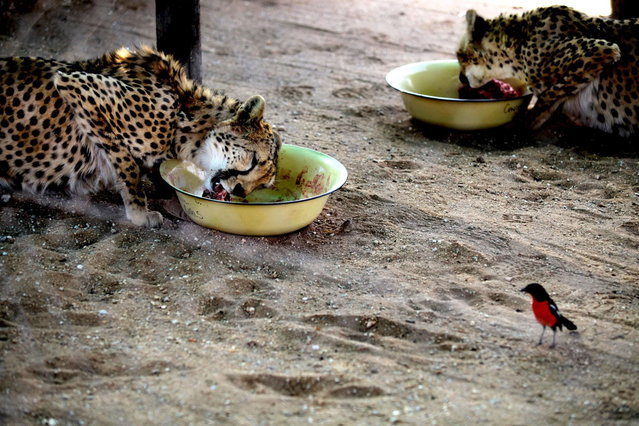
Young cheetahs eat meat at The Cheetah Conservation Fund (CCF) center in Otjiwarongo, Namibia, on August 13, 2013. The CCF started breeding Anatolian livestock dogs to promote cheetah-friendly farming after some 10,000 big cats – the current total worldwide population – were killed or moved off farms in the 1980s.  Up to 1,000 cheetahs were being killed a year, mostly by farmers who saw them as livestock killers. But the use of dogs has slashed losses for sheep and goat farmers and led to less retaliation against the vulnerable cheetah. (Photo by Jennifer Bruce/AFP Photo)

Young cheetahs eat meat at The Cheetah Conservation Fund (CCF) center in Otjiwarongo, Namibia, on August 13, 2013. The CCF started breeding Anatolian livestock dogs to promote cheetah-friendly farming after some 10,000 big cats – the current total worldwide population – were killed or moved off farms in the 1980s. Up to 1,000 cheetahs were being killed a year, mostly by farmers who saw them as livestock killers. But the use of dogs has slashed losses for sheep and goat farmers and led to less retaliation against the vulnerable cheetah. (Photo by Jennifer Bruce/AFP Photo)
Details
29 Aug 2013 10:56:00
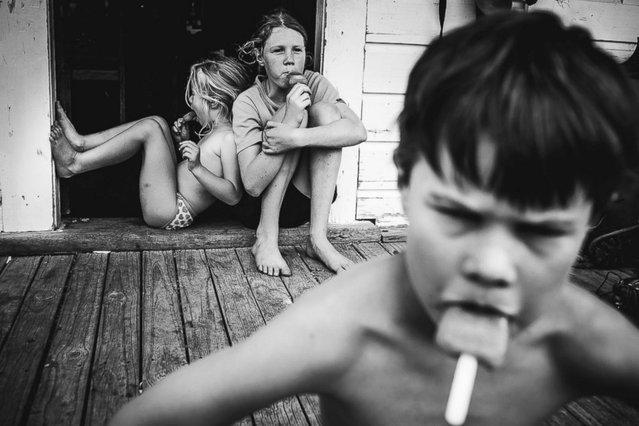
New Zealand photographer Niki Boon captured her children, who are growing up with limited electronics, in the photo series “Childhood in the Raw Photos”. Niki Boon began taking photos as a hobby while she was working as a physiotherapist in Scotland. However, the New Zealand native found her interest in the art waning while she travelled, and it wasn’t until she had returned home and started raising a family that her passion was rekindled. “Childhood in the Raw”, an ongoing photo series of her four children’s technology-free life on her 10-acre property in New Zealand, is the perennial fruit of this passion. (Photo by Niki Boon)

New Zealand photographer Niki Boon captured her children, who are growing up with limited electronics, in the photo series “Childhood in the Raw Photos”. Niki Boon began taking photos as a hobby while she was working as a physiotherapist in Scotland. However, the New Zealand native found her interest in the art waning while she travelled, and it wasn’t until she had returned home and started raising a family that her passion was rekindled. “Childhood in the Raw”, an ongoing photo series of her four children’s technology-free life on her 10-acre property in New Zealand, is the perennial fruit of this passion. (Photo by Niki Boon)
Details
20 Apr 2016 12:01:00
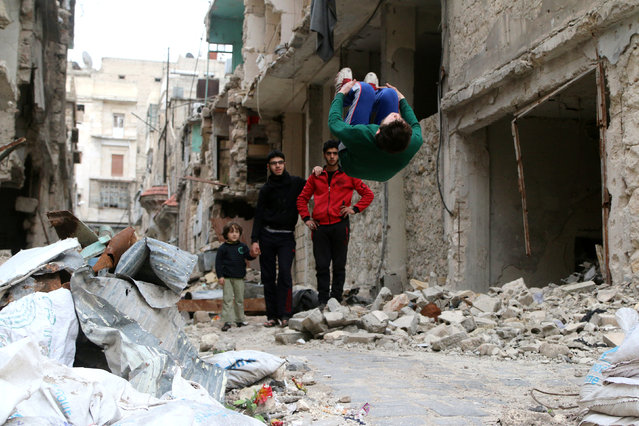
Gymnast Ahmad al-Sawas performs gymnastic moves near damaged buildings in the rebel-held Bustan al-Qasr neighbourhood of Aleppo, Syria March 26, 2016. As Syrian gymnast Ahmad al-Sawas watched his country fall apart, his Olympic dream collapsed too. The last national champion before the fighting began, he knew that supporting the anti-government side in the five-year-old civil war would prevent him from being selected for the Rio Games. “I chose to be an athlete who participates in the revolution”, said Ahmad, who trains where he can for two hours a day – be it on a mattress on a soccer field, in a local hall or somersaulting off a wall. (Photo by Abdalrhman Ismail/Reuters)

Gymnast Ahmad al-Sawas performs gymnastic moves near damaged buildings in the rebel-held Bustan al-Qasr neighbourhood of Aleppo, Syria March 26, 2016. As Syrian gymnast Ahmad al-Sawas watched his country fall apart, his Olympic dream collapsed too. The last national champion before the fighting began, he knew that supporting the anti-government side in the five-year-old civil war would prevent him from being selected for the Rio Games. (Photo by Abdalrhman Ismail/Reuters)
Details
05 Aug 2016 13:25:00
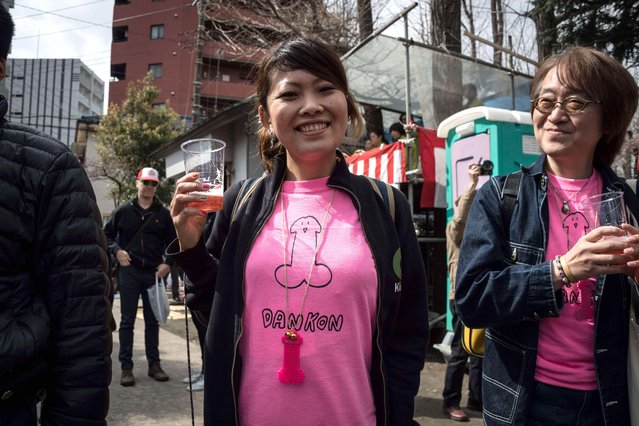
Festival goer with phallus logo t-shirt during the Kanamara Matsuri Steel Phallus Festival at Kawasaki, Japan on April 2, 2017. The Kanamara Matsuri or Festival of the Steel Phallus is held on the first Sunday of April at the Kanayama shrine. The shrine celebrates a legend of a steel pen*s and was frequented by prostitutes who wished to pray for protection from sexually transmitted diseases. Visitors now wish for easy delivery, marriage and matrimonial harmony. Because of the large steel phallus the unusual festival has become a tourist attraction attracting many overseas visitors and is used to raise money for HIV charities. Phallus shaped candy, carved vegetables, decorations, and a big parade are all part of the festival. (Photo by DELETREE/SIPA Press/Rex Features/Shutterstock)

Festival goer with phallus logo t-shirt during the Kanamara Matsuri Steel Phallus Festival at Kawasaki, Japan on April 2, 2017. The Kanamara Matsuri or Festival of the Steel Phallus is held on the first Sunday of April at the Kanayama shrine. The shrine celebrates a legend of a steel pen*s and was frequented by prostitutes who wished to pray for protection from sexually transmitted diseases. Visitors now wish for easy delivery, marriage and matrimonial harmony. Because of the large steel phallus the unusual festival has become a tourist attraction attracting many overseas visitors and is used to raise money for HIV charities. Phallus shaped candy, carved vegetables, decorations, and a big parade are all part of the festival. (Photo by DELETREE/SIPA Press/Rex Features/Shutterstock)
Details
04 Apr 2017 09:48:00
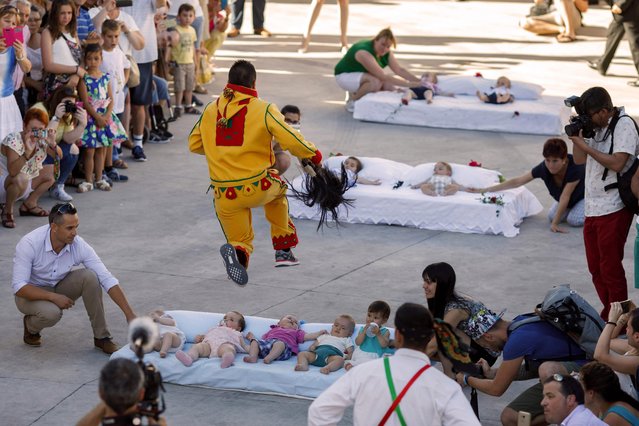
A man dressed up as the devil jumps over babies lying on a mattress in the street during “El Colacho”, the “baby jumping festival” in the village of Castrillo de Murcia, near Burgos on June 18, 2017. Baby jumping (El Colacho) is a traditional Spanish practice dating back to 1620 that takes place annually to celebrate the Catholic feast of Corpus Christi. During the act – known as El Salto del Colacho (the devil's jump) or simply El Colacho – men dressed as the Devil jump over babies born in the last twelve months of the year who lie on mattresses in the street. (Photo by Cesar Manso/AFP Photo)

A man dressed up as the devil jumps over babies lying on a mattress in the street during “El Colacho”, the “baby jumping festival” in the village of Castrillo de Murcia, near Burgos on June 18, 2017. Baby jumping (El Colacho) is a traditional Spanish practice dating back to 1620 that takes place annually to celebrate the Catholic feast of Corpus Christi. During the act – known as El Salto del Colacho (the devil's jump) or simply El Colacho – men dressed as the Devil jump over babies born in the last twelve months of the year who lie on mattresses in the street. (Photo by Cesar Manso/AFP Photo)
Details
20 Jun 2017 07:29:00
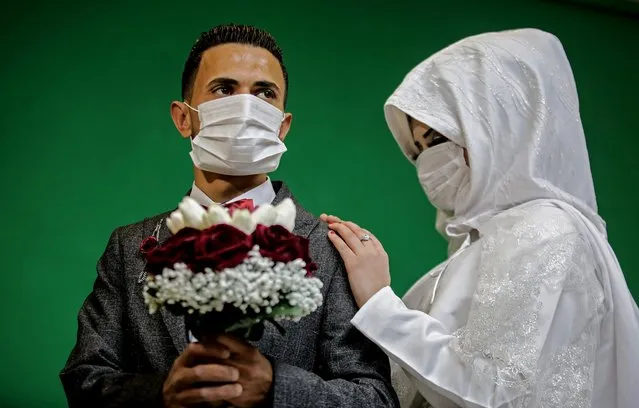
Palestinian groom Mohamed abu Daga and his bride Israa wear face masks amid the COVID-19 epidemic, during a photoshoot at a studio before their wedding ceremony in Khan Yunis in the southern Gaza Strip, on March 23, 2020. Authorities in Gaza confirmed on March 22 the first two cases of novel coronavirus, identifying them as Palestinians who had travelled to Pakistan and were being held in quarantine since their return, as the United Nations warned of potential disastrous outcomes to an outbreak given the high poverty rates and weak health system in the coastal strip, under Israeli blockade since 2007. (Photo by Said Khatib/AFP Photo)

Palestinian groom Mohamed abu Daga and his bride Israa wear face masks amid the COVID-19 epidemic, during a photoshoot at a studio before their wedding ceremony in Khan Yunis in the southern Gaza Strip, on March 23, 2020. Authorities in Gaza confirmed on March 22 the first two cases of novel coronavirus, identifying them as Palestinians who had travelled to Pakistan and were being held in quarantine since their return, as the United Nations warned of potential disastrous outcomes to an outbreak given the high poverty rates and weak health system in the coastal strip, under Israeli blockade since 2007. (Photo by Said Khatib/AFP Photo)
Details
27 Mar 2020 00:07:00
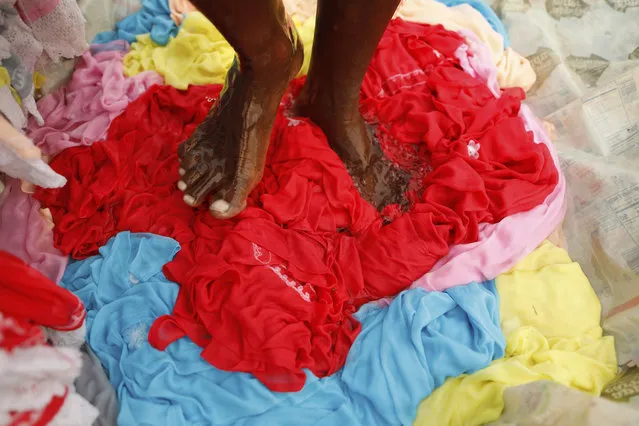
A dhobi, or a washerman washes cloths on the banks of the River Gomti in Lucknow, India, Saturday, September 12, 2020. Dhobis are traditional laundry workers who wash clothes by hand and dry them in the sun, an occupation which has been in existence for generations. Most cities in India have a Dhobi Ghat, or washermen's area, where the city's pile of clothes is laundered. This practice is still popular in India, despite of modern technology. Around 1,000 families work in Lucknow's Dhobi Ghat. However, in light of the novel coronavirus, their wages have decreased drastically. With each family earning around US$100-200 per month. (Photo by Rajesh Kumar Singh/AP Photo)

A dhobi, or a washerman washes cloths on the banks of the River Gomti in Lucknow, India, Saturday, September 12, 2020. Dhobis are traditional laundry workers who wash clothes by hand and dry them in the sun, an occupation which has been in existence for generations. Most cities in India have a Dhobi Ghat, or washermen's area, where the city's pile of clothes is laundered. This practice is still popular in India, despite of modern technology. Around 1,000 families work in Lucknow's Dhobi Ghat. However, in light of the novel coronavirus, their wages have decreased drastically. With each family earning around US$100-200 per month. (Photo by Rajesh Kumar Singh/AP Photo)
Details
25 Sep 2020 00:03:00
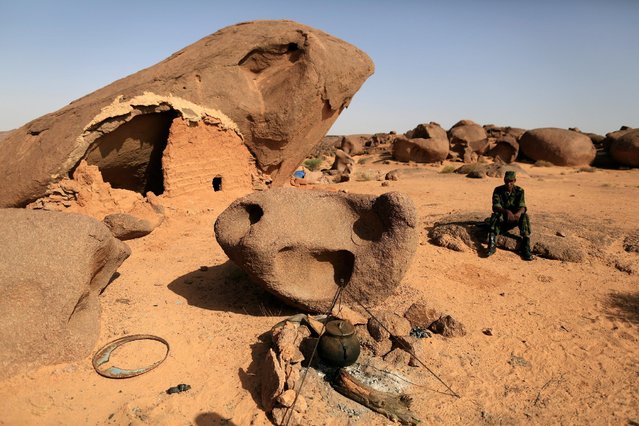
A Polisario fighter sits on a rock at a forward base on the outskirts of Tifariti, Western Sahara, September 9, 2016. At a rocky outpost in Western Sahara, a new generation of soldiers who have never known war are mobilising as tensions resurface in one of Africa's oldest disputes after a quarter century of uneasy peace. Young Sahrawi troops man new desert posts for the Polisario Front, which for more than 40 years has sought independence for the vast desert region - first in a guerrilla war against Morocco and then politically since a ceasefire deal in 1991. Now a standoff with Morocco, which controls the majority of Western Sahara, is renewing pressure for a diplomatic solution to ensure foot soldiers don't return to fighting as the last generation of commanders once did. The standoff since August has brought Moroccan and Polisario forces within 200 metres of each other in a narrow strip of land near the Mauritanian border. Rich in phosphate, Western Sahara has been contested since 1975 when Spanish colonial powers left. Morocco claimed the territory and fought the 16-year war with Polisario. (Photo by Zohra Bensemra/Reuters)

A Polisario fighter sits on a rock at a forward base on the outskirts of Tifariti, Western Sahara, September 9, 2016. At a rocky outpost in Western Sahara, a new generation of soldiers who have never known war are mobilising as tensions resurface in one of Africa's oldest disputes after a quarter century of uneasy peace. (Photo by Zohra Bensemra/Reuters)
Details
04 Nov 2016 12:09:00