Loading...
Done
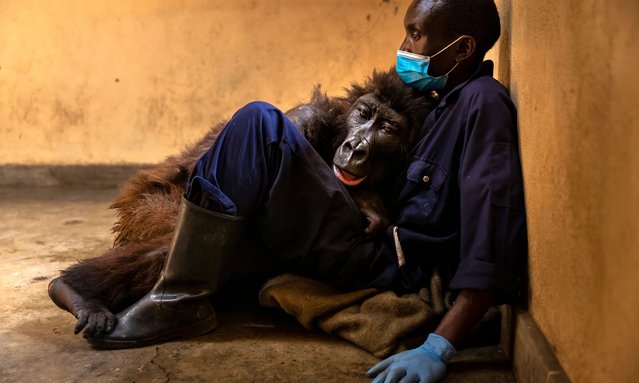
Orphaned mountain gorilla, Ndakasi, lies in the arms of her caregiver, Andre Bauma, on September 21, 2021 shortly before her death, which the park confirmed on September 26. Mr Bauma and others at the Senkwekwe Mountain Gorilla Center had cared for Ndakasi and other orphans for 13 years. Ndakasi had suffered a prolonged illness prior to her death. This is the only mountain gorilla orphanage in the world and takes in mountain gorilla orphans who have lost their families to poaching or conflict. A number of the orphans here were rescued from sales by poachers in sting operations carried out by Congolese National Park Authority (ICCN) rangers. (Photo by Brent Stirton/Getty Images)

Orphaned mountain gorilla, Ndakasi, lies in the arms of her caregiver, Andre Bauma, on September 21, 2021 shortly before her death, which the park confirmed on September 26. Mr Bauma and others at the Senkwekwe Mountain Gorilla Center had cared for Ndakasi and other orphans for 13 years. Ndakasi had suffered a prolonged illness prior to her death. This is the only mountain gorilla orphanage in the world and takes in mountain gorilla orphans who have lost their families to poaching or conflict. A number of the orphans here were rescued from sales by poachers in sting operations carried out by Congolese National Park Authority (ICCN) rangers. (Photo by Brent Stirton/Getty Images)
Details
17 Oct 2021 08:04:00
Visitors take pictures inside Kuala Lumpur Tower's “Sky Box”, one of the city's touristic attractions, in Kuala Lumpur, Malaysia, 05 January 2024. Malaysian Tourism Minister Tiong King Sing recently said that the tourism industry “is not just an engine for economic growth but also a bridge for cultural exchange and international friendship”. (Photo by Fazry Ismail/EPA/EFE)

Visitors take pictures inside Kuala Lumpur Tower's “Sky Box”, one of the city's touristic attractions, in Kuala Lumpur, Malaysia, 05 January 2024. Malaysian Tourism Minister Tiong King Sing recently said that the tourism industry “is not just an engine for economic growth but also a bridge for cultural exchange and international friendship”. (Photo by Fazry Ismail/EPA/EFE)
Details
23 Jan 2024 09:41:00
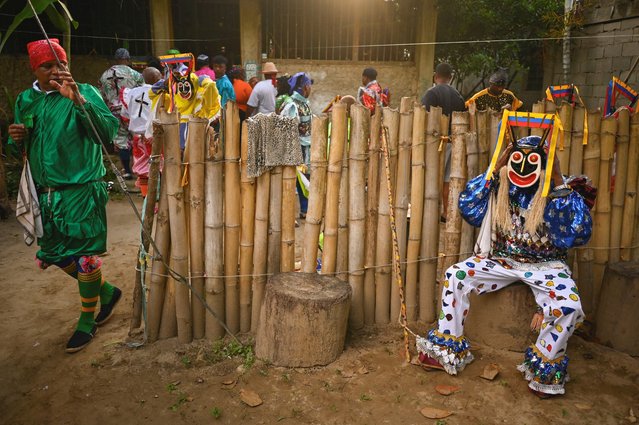
A member of the Brotherhood of the Diablos Danzantes de Chuao (Dancing Devils of Chuao) arranges his mask during the Corpus Christi festival in the town of Chuao, Aragua state, Venezuela on June 18, 2025. (Photo by Maxwell Briceno/Reuters)

A member of the Brotherhood of the Diablos Danzantes de Chuao (Dancing Devils of Chuao) arranges his mask during the Corpus Christi festival in the town of Chuao, Aragua state, Venezuela on June 18, 2025. (Photo by Maxwell Briceno/Reuters)
Details
15 Aug 2025 03:13:00
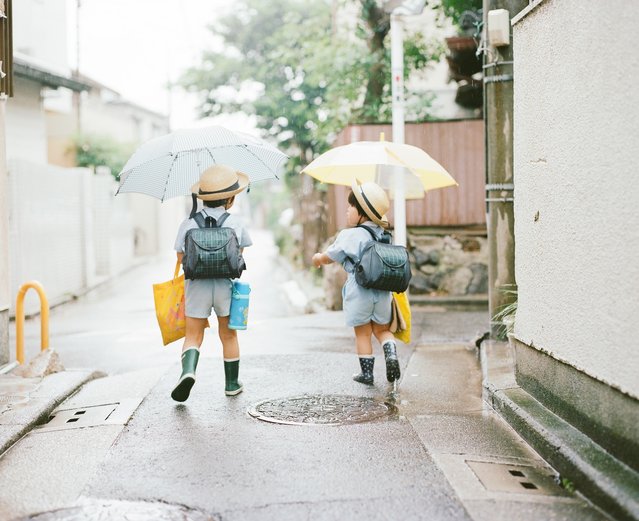
“Rainy days and mondays #1”. (Photo and caption by Hideaki Hamada)

“My children are not only my little darlings but off-shoots of myself. When I look at them, I have a strange feeling – as if I am watching myself re-living my life. What I want to show is their “living form”. – Hideaki Hamada. Photo: “Rainy days and mondays #1”. (Photo and caption by Hideaki Hamada)
Details
23 Mar 2015 09:56:00
Dance Team Rage Crew perform at BAFTA LA's 6th Annual Christmas Party and Toy Drive at Helen Keller Park

Dance Team Rage Crew perform at BAFTA LA's 6th Annual Christmas Party and Toy Drive at Helen Keller Park on December 17, 2011 in Los Angeles, California. (Photo by Frazer Harrison/Getty Images)
Details
20 Dec 2011 13:57:00
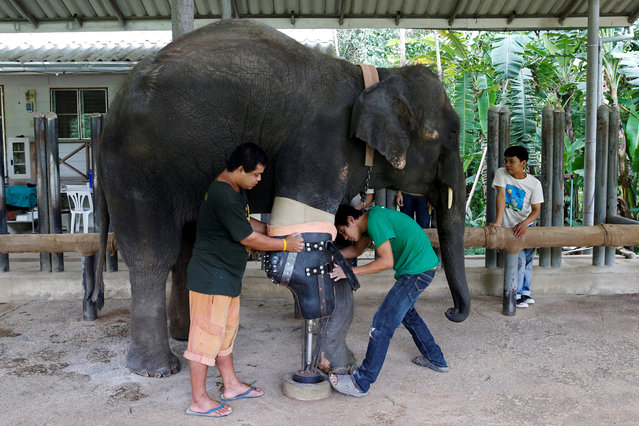
Mosha, the elephant that was injured by a landmine, has her prosthetic leg attached at the Friends of the Asian Elephant Foundation in Lampang, Thailand, June 29, 2016. Mosha was 7 months old when she stepped on a land mine near Thailand’s border with Myanmar and lost a front leg. That was a decade ago. Mosha is one of more than a dozen elephants who have been wounded by land mines in the border region, where rebels have been fighting the Myanmar government for decades. She was the first elephant to be fitted with a prosthetic limb at the hospital near Lampang. Mosha weighed about 1,300 pounds (590 kg) when she was wounded. (Photo by Athit Perawongmetha/Reuters)

Mosha, the elephant that was injured by a landmine, has her prosthetic leg attached at the Friends of the Asian Elephant Foundation in Lampang, Thailand, June 29, 2016. Mosha was 7 months old when she stepped on a land mine near Thailand’s border with Myanmar and lost a front leg. That was a decade ago... (Photo by Athit Perawongmetha/Reuters)
Details
24 Aug 2016 11:19:00
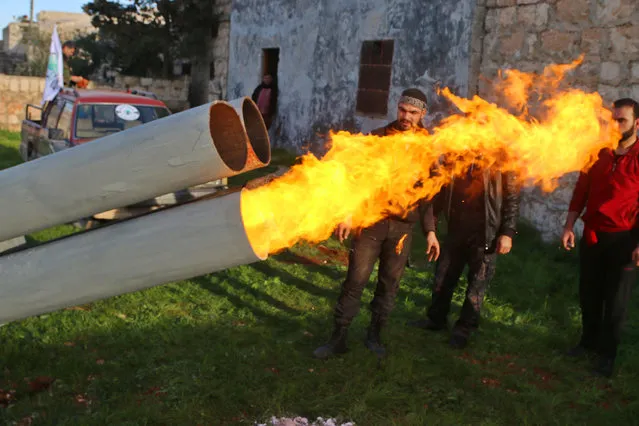
Al-Shamiyah Front fighters inspect a new locally-made cannon named “Borkan” (Volcano) as it was being launched towards forces loyal to Syria's president Bashar Al-Assad located in Aleppo artillery school, March 7, 2015. The “Borkan” is made out of four tubes attached to a loader, which can fire four shells at a time, and have a range of three kilometers (1.86 miles). (Photo by Abdalrhman Ismail/Reuters)

Al-Shamiyah Front fighters inspect a new locally-made cannon named “Borkan” (Volcano) as it was being launched towards forces loyal to Syria's president Bashar Al-Assad located in Aleppo artillery school, March 7, 2015. The “Borkan” is made out of four tubes attached to a loader, which can fire four shells at a time, and have a range of three kilometers (1.86 miles). (Photo by Abdalrhman Ismail/Reuters)
Details
24 Mar 2015 10:11:00
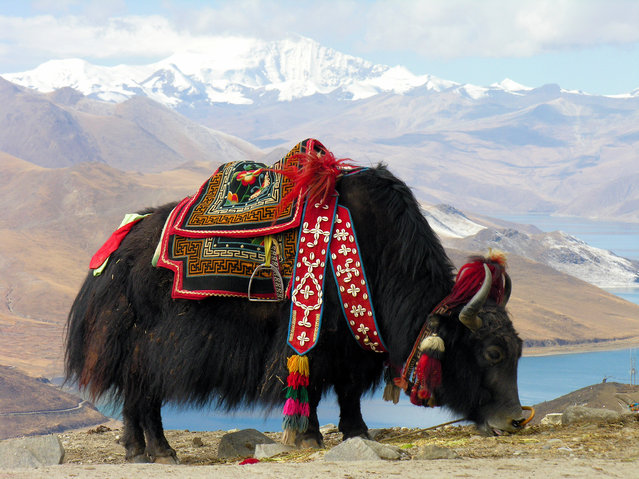
Yak near Yamdrok lake, Tibet. It is a long-haired bovinae found throughout the Himalayan region of south Central Asia, the Tibetan Plateau and as far north as Mongolia and Russia. The Tibetan economy is dominated by subsistence agriculture. Due to limited arable land, the primary occupation of the Tibetan Plateau is raising livestock, such as sheep, cattle, goats, camels, yaks, dzo, and horses. The Tibetan yak is an integral part of Tibetan life. (Photo by Dennis Jarvis)

Yak near Yamdrok lake, Tibet. It is a long-haired bovinae found throughout the Himalayan region of south Central Asia, the Tibetan Plateau and as far north as Mongolia and Russia. The Tibetan economy is dominated by subsistence agriculture. Due to limited arable land, the primary occupation of the Tibetan Plateau is raising livestock, such as sheep, cattle, goats, camels, yaks, dzo, and horses. The Tibetan yak is an integral part of Tibetan life. (Photo by Dennis Jarvis)
Details
10 Jun 2015 10:48:00