Loading...
Done
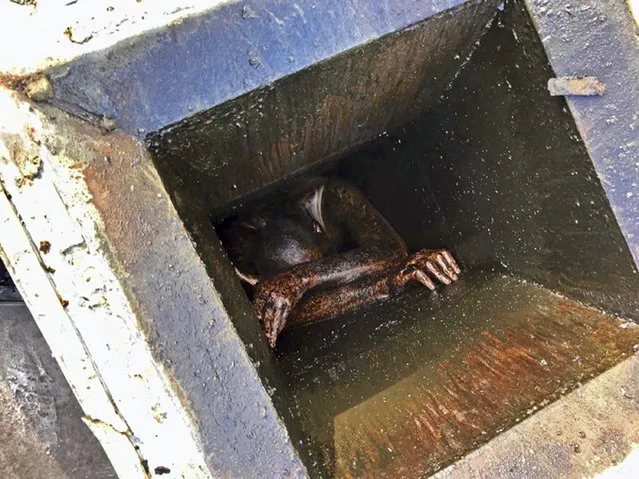
This photo provided by the Alameda County Sheriff's Office shows a man who was possibly trying to burglarize an abandoned Chinese restaurant in San Lorenzo, Calif., trapped in a grease vent before he was rescued Wednesday, December 12, 2018. Officials say he had been trapped for two days. Deputies and firefighters were called to the vacant building on Wednesday after someone heard cries for help. The sheriff tweeted that the man was trespassing and possibly trying to burglarize the empty restaurant. (Photo by Alameda County Sheriff's Office via AP Photo)

This photo provided by the Alameda County Sheriff's Office shows a man who was possibly trying to burglarize an abandoned Chinese restaurant in San Lorenzo, Calif., trapped in a grease vent before he was rescued Wednesday, December 12, 2018. Officials say he had been trapped for two days. Deputies and firefighters were called to the vacant building on Wednesday after someone heard cries for help. The sheriff tweeted that the man was trespassing and possibly trying to burglarize the empty restaurant. (Photo by Alameda County Sheriff's Office via AP Photo)
Details
14 Dec 2018 00:15:00
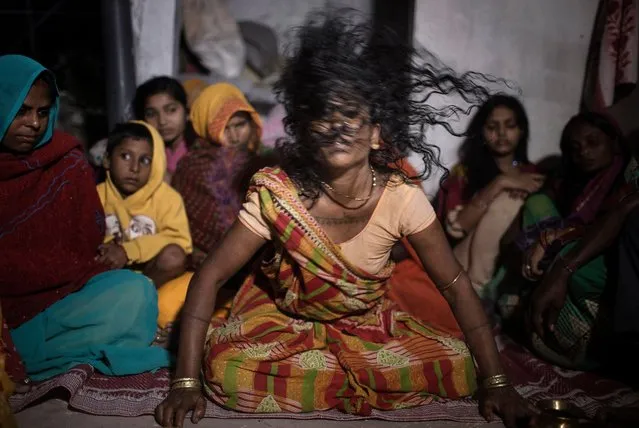
Marani Devi Chaudhary (C), aged 40, performs a ritual in front of shaman Paltan Yadav (unseen) at her home in Rajaur village in Dhanusha district, Nepal, 02 November 2017. The shaman identified Marani Devi to be possessed by their lineage god who was dissatisfied by their worship is thought by the family to have caused them misfortune and is even feared lead to their death. Therefore Marani Devi spent 1,500 USD to perform a healing ritual at the Ghost Festival held at the banks of Kamala River in Dhanusha district two days later. Every family or community has their own sacred god, called 'Kuldevta' in Nepali which means family deity or lineage god. Only family members or people within communities of the same caste can worship to the deity. They have their own rules and regulations of worship which varies from one family and community to another. Being unable to follow the rules and regulations or carry out worship is believed to cause misfortune. (Photo by Narendra Shrestha/EPA/EFE)

Marani Devi Chaudhary (C), aged 40, performs a ritual in front of shaman Paltan Yadav (unseen) at her home in Rajaur village in Dhanusha district, Nepal, 02 November 2017. The shaman identified Marani Devi to be possessed by their lineage god who was dissatisfied by their worship is thought by the family to have caused them misfortune and is even feared lead to their death. (Photo by Narendra Shrestha/EPA/EFE)
Details
17 Nov 2017 06:53:00
Students of Yuba Pratibha School, wearing a face shield and masks at school during a coronavirus pandemic in Kathmandu, Nepal, 26 November 2020. The head Teacher of Yuba Pratibha School, Yanga Raj Dahal, started to conduct classes for students, who can’t afford and attend online classes, with strict sanitary regime, providing also free face masks and shields for students. However majority of schools have been conducting online classes in Nepal from 19 March 2020 as part of precautionary measures against the spread of the coronavirus Covid-19. (Photo by Narendra Shrestha/EPA/EFE)

Students of Yuba Pratibha School, wearing a face shield and masks at school during a coronavirus pandemic in Kathmandu, Nepal, 26 November 2020. The head Teacher of Yuba Pratibha School, Yanga Raj Dahal, started to conduct classes for students, who can’t afford and attend online classes, with strict sanitary regime, providing also free face masks and shields for students. However majority of schools have been conducting online classes in Nepal from 19 March 2020 as part of precautionary measures against the spread of the coronavirus Covid-19. (Photo by Narendra Shrestha/EPA/EFE)
Details
16 Dec 2020 00:05:00
A student of the Sri Lankan ancient martial art “Angampora” performs during a practice session at the angam maduwa or fighting field, in Korathota, a suburb of Colombo, Sri Lanka, 07 September 2022. Sri Lanka's ancient martial art, Angampora, is thought to be thousands of years old. Anga translates to “body parts” and Angampora is a fighting art that uses body parts. Martial arts practitioners in Angampora were mostly in the king's service, and they were tasked with protecting the king and his kingdom. Angampora was practiced in secret for most centuries because the British, who colonized Sri Lanka, banned it in 1818 after seeing it as a threat. (Photo by Chamila Karunarathne/EPA/EFE)

A student of the Sri Lankan ancient martial art “Angampora” performs during a practice session at the angam maduwa or fighting field, in Korathota, a suburb of Colombo, Sri Lanka, 07 September 2022. Sri Lanka's ancient martial art, Angampora, is thought to be thousands of years old. Anga translates to “body parts” and Angampora is a fighting art that uses body parts. Martial arts practitioners in Angampora were mostly in the king's service, and they were tasked with protecting the king and his kingdom. Angampora was practiced in secret for most centuries because the British, who colonized Sri Lanka, banned it in 1818 after seeing it as a threat. (Photo by Chamila Karunarathne/EPA/EFE)
Details
14 Oct 2022 04:47:00
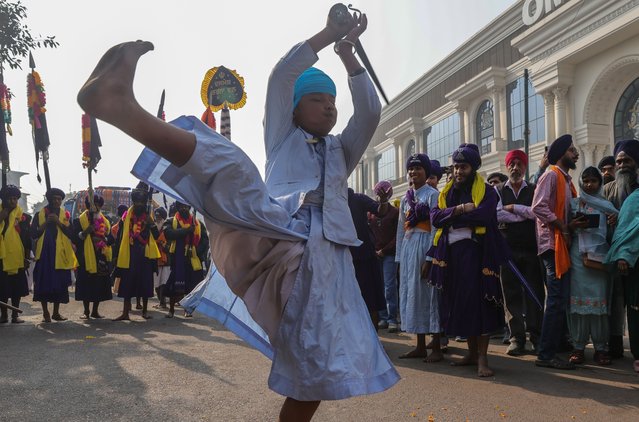
A Nihang Sikh, belonging to the Sikh warrior clan, performs Gatka, a form of Sikh martial arts, during a religious procession marking the 350th martyrdom anniversary of Guru Tegh Bahadur Ji in New Delhi, India, 25 November 2025. The procession commemorates the martyrdom of the 9th Sikh Guru, Sri Guru Tegh Bahadur Ji, who was executed in 1675 AD for refusing to convert to Islam on the orders of Mughal Emperor Aurangzeb. The event is observed at Gurudwara Sis Ganj in Delhi. Guru Tegh Bahadur, the youngest of the five sons of Guru Hargobind, was born in Amritsar in 1621. (Photo by Rajat Gupta/EPA)

A Nihang Sikh, belonging to the Sikh warrior clan, performs Gatka, a form of Sikh martial arts, during a religious procession marking the 350th martyrdom anniversary of Guru Tegh Bahadur Ji in New Delhi, India, 25 November 2025. The procession commemorates the martyrdom of the 9th Sikh Guru, Sri Guru Tegh Bahadur Ji, who was executed in 1675 AD for refusing to convert to Islam on the orders of Mughal Emperor Aurangzeb. The event is observed at Gurudwara Sis Ganj in Delhi. Guru Tegh Bahadur, the youngest of the five sons of Guru Hargobind, was born in Amritsar in 1621. (Photo by Rajat Gupta/EPA)
Details
06 Dec 2025 03:16:00
A thirty-year-old Dutch demonstrator displays a sign that reads: “Glad to be Gay” during a gay people march in Frankfurt, Germany on Saturday, July 28, 1979 which ended a week long homosexual meeting. Hundreds of homosexual converged for a week of movies, theater, rock concerts and workshops on gay rights. (Photo by Rolf Boehm/AP Photo)

A thirty-year-old Dutch demonstrator displays a sign that reads: “Glad to be Gay” during a gay people march in Frankfurt, Germany on Saturday, July 28, 1979 which ended a week long homosexual meeting. Hundreds of homosexual converged for a week of movies, theater, rock concerts and workshops on gay rights. (Photo by Rolf Boehm/AP Photo)
Details
12 Jun 2020 00:05:00
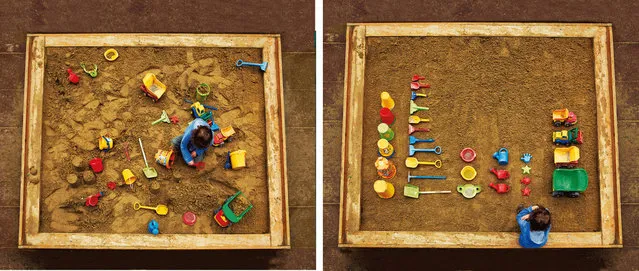
The Art Of Clean Up By Ursus Wehrli

Are you one of those people who like to keep everything in order? If you do, you’re going to love the project The Art of Clean Up, created by Ursus Wehrli. This guy will perfectly organize the most unusual of places! Do you hate how unorganized the parking lots are, or how your haphazardly your grandma hangs the laundry to dry in the sun? Welcome to the perfect world where everything is in its rightful place. Every little detail is kept in check; every color is placed where it belongs, just like you love it. Did you ever think that your Christmas tree is not orderly enough? Well, Ursus will take it apart and put it in near little piles. (Photo by Ursus Wehrli)
Details
15 Dec 2014 11:09:00
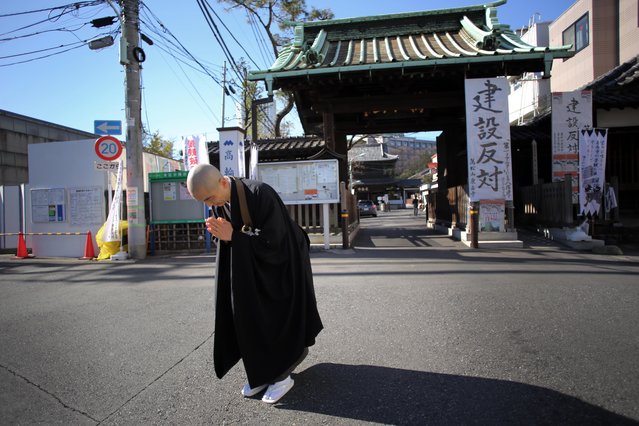
In this January 8, 2015 photo, a monk Kenmyo Muta bows at the condominium construction site and the gate of Sengakuji temple in Tokyo. (Photo by Eugene Hoshiko/AP Photo)

In this January 8, 2015 photo, a monk Kenmyo Muta bows at the condominium construction site and the gate of Sengakuji temple in Tokyo. The “47 ronin” samurai who inspired the long-loved saga of loyalty and honor eulogized in films, books and plays are fighting a new kind of battle in urban Japan. An apartment complex is going up next to the curved tile-roofed Sengakuji temple where the three-century-old graves of the ronin, or masterless samurai, lie. The banner reads: “We only hope to protect landscape of Sengakuji temple”. (Photo by Eugene Hoshiko/AP Photo)
Details
16 Jan 2015 13:01:00