Loading...
Done
A Syrian boy is comforted as he cries next to the body of a relative who died in a reported airstrike on April 27, 2016 in the rebel-held neighbourhood of al-Soukour in the northern city of Aleppo. (Photo by Karam Al-Masri/AFP Photo)

A Syrian boy is comforted as he cries next to the body of a relative who died in a reported airstrike on April 27, 2016 in the rebel-held neighbourhood of al-Soukour in the northern city of Aleppo. The Syrian army was preparing an offensive to retake the whole of Aleppo, as fighting in the divided second city killed 38 civilians in a new blow for a tattered truce. Nearly 200 people have been killed in Aleppo in the past week as rebels have pounded government-held neighbourhoods with rocket and artillery fire and the regime has hit rebel areas with air raids. (Photo by Karam Al-Masri/AFP Photo)
Details
29 Apr 2016 11:37:00
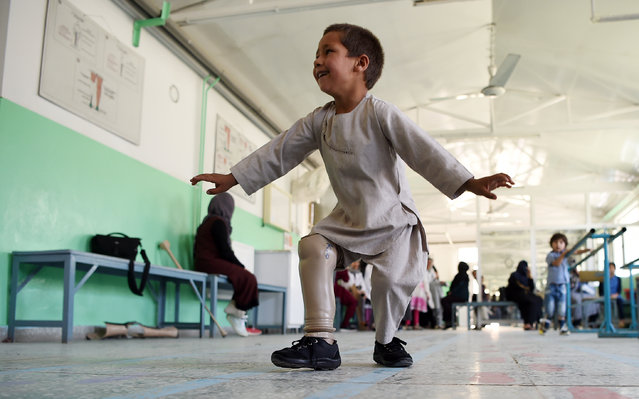
Ahmad Sayed Rahman, a five-year-old Afghan boy who lost his right leg when he was hit by a bullet in the crossfire of a battle, dances with his prosthetic leg at the International Committee of the Red Cross (ICRC) hospital for war victims and the disabled, in Kabul on May 7, 2019. With his hands in the air and an infectious grin spreading from ear to ear, a young Afghan boy whirls around a Kabul hospital room on his new prosthetic leg. The boy, five-year-old Ahmad Sayed Rahman, has become a social media star in Afghanistan and beyond after a short video of him effortlessly dancing on his new limb was published this week on Twitter. (Photo by Wakil Kohsar/AFP Photo)

Ahmad Sayed Rahman, a five-year-old Afghan boy who lost his right leg when he was hit by a bullet in the crossfire of a battle, dances with his prosthetic leg at the International Committee of the Red Cross (ICRC) hospital for war victims and the disabled, in Kabul on May 7, 2019. (Photo by Wakil Kohsar/AFP Photo)
Details
10 Jun 2019 00:03:00
Dancers dressed as futuristic characters perform during a show at The Robot Restaurant on June 29, 2014 in Tokyo, Japan. The now famous Robot Restaurant opened two years ago in Kabukicho area of Shinjuku at an estimated cost of 10 million U.S. dollars. (Photo by Chris McGrath/Getty Images)

Dancers dressed as futuristic characters perform during a show at The Robot Restaurant on June 29, 2014 in Tokyo, Japan. The now famous Robot Restaurant opened two years ago in Kabukicho area of Shinjuku at an estimated cost of 10 million U.S. dollars. Performances are held three times a day and cater mostly to foreign tourists. The cabaret style shows include bikini clad futuristic dancers, performers dressed as robots and a host of large scale robots and vehicles controlled with remotes by stage hands dressed as Ninjas. (Photo by Chris McGrath/Getty Images)
Details
01 Jul 2014 13:16:00
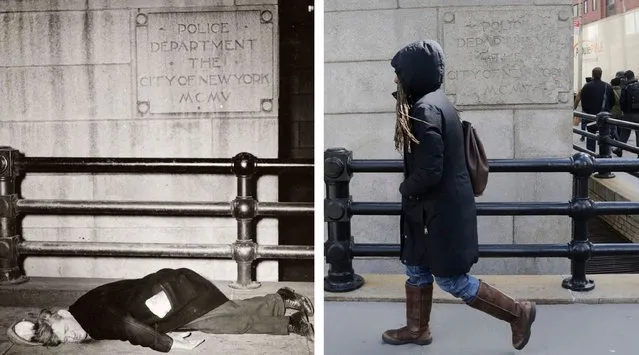
A new book of photos by legendary photographer Weegee shows what industrialized, pre-gentrified New York looked like in the mid-20th century, before the city was crammed with towers and billboards. (Photo by AP Photo/Copyright Weegee/The International Center of Photography, Mark Lennihan)

A new book of photos by legendary photographer Weegee shows what industrialized, pre-gentrified New York looked like in the mid-20th century, before the city was crammed with towers and billboards. Here: this combination shows the 1945 photo “Derelict sleeping on the sidewalk outside police headquarters” by Weegee, provided by the International Center of Photography in New York, and a woman walking on the same spot on Wednesday, March 18, 2015. (Photo by AP Photo/Copyright Weegee/The International Center of Photography, Mark Lennihan)


Details
27 Mar 2015 13:16:00
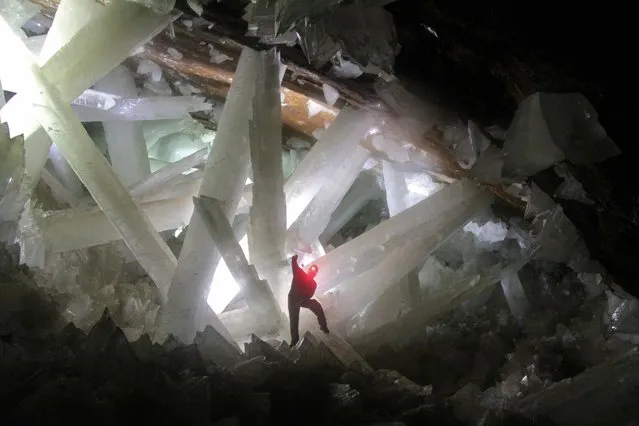
Giant Crystal Cave in Naica, Mexico

Cave of the Crystals or Giant Crystal Cave is a cave connected to the Naica Mine 300 metres (980 ft) below the surface in Naica, Chihuahua, Mexico. The main chamber contains giant selenite crystals (gypsum, CaSO4·2 H2O), some of the largest natural crystals ever found. The cave's largest crystal found to date is 12 m (39 ft) in length, 4 m (13 ft) in diameter and 55 tons in weight. The cave is extremely hot with air temperatures reaching up to 58 °C (136 °F) with 90 to 99 percent humidity. The cave is relatively unexplored due to these factors. Without proper protection people can only endure approximately ten minutes of exposure at a time.
Details
20 May 2014 07:56:00
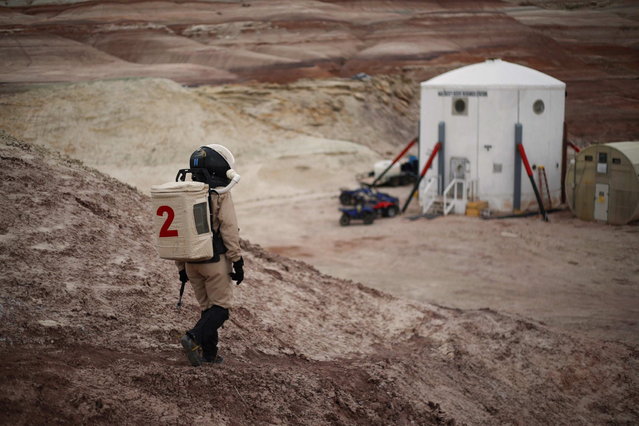
Csilla Orgel, a geologist of Crew 125 EuroMoonMars B mission, makes her way back to the Mars Desert Research Station (MDRS) in the Utah desert March 3, 2013. (Photo by Jim Urquhart/Reuters)

NASA says it could be another 20 years before humans touch down on Mars, but in a sense, the Mars Society has been exploring the red planet for more than a decade – in Utah. Photo: Csilla Orgel, a geologist of Crew 125 EuroMoonMars B mission, makes her way back to the Mars Desert Research Station (MDRS) in the Utah desert March 3, 2013. The MDRS aims to investigate the feasibility of a human exploration of Mars and uses the Utah desert's Mars-like terrain to simulate working conditions on the red planet. Scientists, students and enthusiasts work together developing field tactics and studying the terrain. All outdoor exploration is done wearing simulated spacesuits and carrying air supply packs and crews live together in a small communication base with limited amounts of electricity, food, oxygen and water. Everything needed to survive must be produced, fixed and replaced on site. (Photo by Jim Urquhart/Reuters)
Details
14 Mar 2013 12:11:00
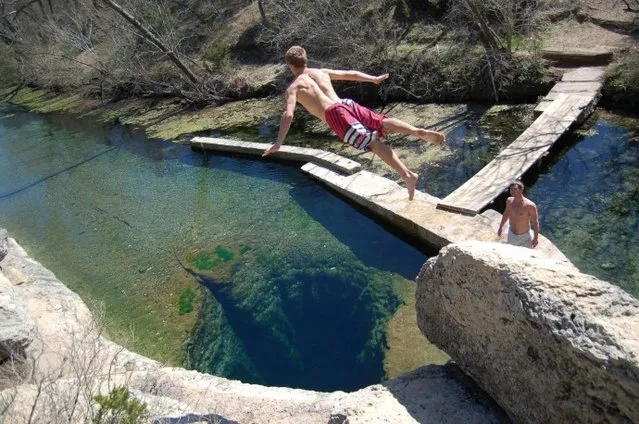
Dive The Deadly Jacob’s Well In Texas

Jacob's Well is a perennial karstic spring in the Texas Hill Country flowing from the bed of Cypress Creek, located northwest of Wimberley, Texas. The twelve foot (four meter) diameter mouth of the spring serves as a popular swimming spot for the local land owners whose properties adjoin Cypress Creek. From the opening in the creek bed, Jacob's Well cave descends vertically for about thirty feet (ten meters), then continues downward at an angle through a series of silted chambers separated by narrow restrictions, finally reaching a depth of one hundred and twenty feet (forty meters). Until the modern era, the Trinity Aquifer-fed natural artesian spring gushed water from the mouth of the cave, with a measured flow in 1924 of one hundred and seventy gallons per second (six hundred and forty liters per second) discharging six feet (two meters) into the air. The spring is the greatest source of water recharging the Edwards Aquifer.
Details
03 Jan 2014 08:20:00
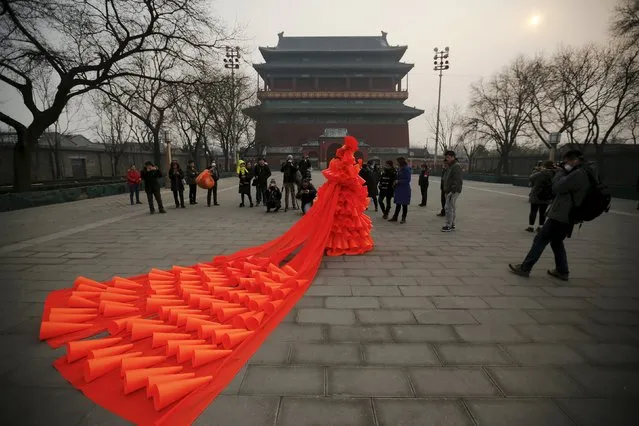
Chinese artist Kong Ning walks in her costume made of hundreds of orange plastic blowing horns during her art performance raising awareness of the hazardous smog in front of the Drum tower in a historical part of Beijing on a very polluted day December 7, 2015. (Photo by Damir Sagolj/Reuters)

Chinese artist Kong Ning walks in her costume made of hundreds of orange plastic blowing horns during her art performance raising awareness of the hazardous smog in front of the Drum tower in a historical part of Beijing on a very polluted day December 7, 2015. Kong, whose works include themes related to China's air pollution problem, named her new performance “The Orange Horns Bride Marries the Blue Sky” and presented it dressed in orange, the colour of the second highest pollution alert level issued again in Beijing as hazardous smog blankets the capital. (Photo by Damir Sagolj/Reuters)
Details
09 Dec 2015 08:05:00