Loading...
Done
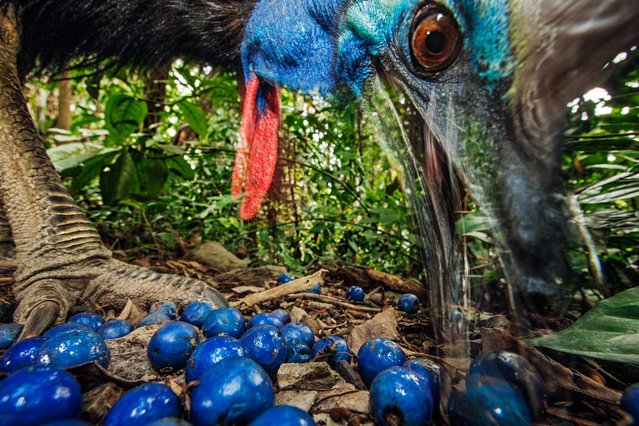
“Cassowaries are large, flightless birds related to emus and (more distantly) to ostriches, rheas, and kiwis”, writes Olivia Judson in the September issue of National Geographic magazine. (Photo by Christian Ziegler/National Geographic)

“Cassowaries are large, flightless birds related to emus and (more distantly) to ostriches, rheas, and kiwis”, writes Olivia Judson in the September issue of National Geographic magazine. How large? People-size: Adult males stand well over five foot five and top 110 pounds. Females are even taller, and can weigh more than 160 pounds. Dangerous when roused, they’re shy and peaceable when left alone. But even birds this big and tough are prey to habitat loss. The dense New Guinea and Australia rain forests where they live have dwindled. Today cassowaries might number 1,500 to 2,000. And because they help shape those same forests – by moving seeds from one place to another – “if they vanish”, Judson writes, “the structure of the forest would gradually change” too. (Photo by Christian Ziegler/National Geographic)
Details
06 Jan 2014 12:21:00
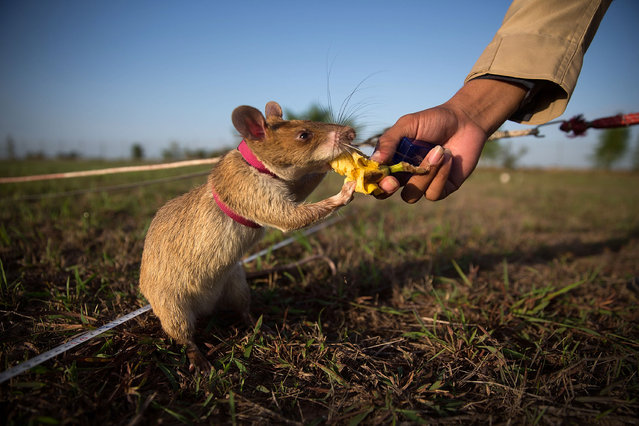
A mine detection rat is given banana as a reward after successfully identifying an inactive mine on July 2, 2015 in Siem Reap, Cambodia. (Photo by Taylor Weidman/Getty Images)

A mine detection rat is given banana as a reward after successfully identifying an inactive mine on July 2, 2015 in Siem Reap, Cambodia. The Cambodian Mine Action Center (CMAC) working with the Belgian NGO APOPO has recently begun testing the feasability of using large mine detection rats from Tanzania to help clear fields of mines and unexploded ordnance in one of the most bombed and mined countries in the world. (Photo by Taylor Weidman/Getty Images)
Details
03 Jul 2015 13:31:00
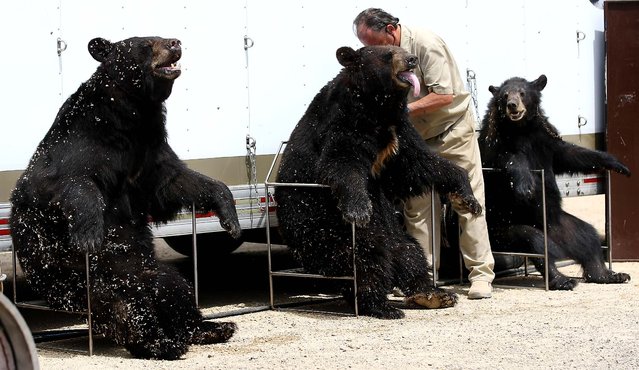
Bob Steele, of Jefferson, Texas, positions his bears during The Great Bear Show at the Dubuque (Iowa) County Fair on July 25, 2012. (Photo by Jessica Reilly/Telegraph Herald)

Bob Steele, of Jefferson, Texas, positions his bears during The Great Bear Show at the Dubuque (Iowa) County Fair on July 25, 2012. (Photo by Jessica Reilly/Telegraph Herald)
Details
28 Jul 2012 08:43:00
A man stands beside the Philippine flag as colorful umbrellas adorn a village hall in suburban San Juan, east of Manila, Philippines, on June 27, 2013. (Photo by Aaron Favila/Associated Press)

A man stands beside the Philippine flag as colorful umbrellas adorn a village hall in suburban San Juan, east of Manila, Philippines, on June 27, 2013. (Photo by Aaron Favila/Associated Press)
Details
29 Jun 2013 12:02:00
The Blue Man Group performs on stage during a media preview ahead of their show in Singapore on March 31, 2016. Blue Man Group was started by three friends in New York in 1991 as a way to celebrate the human spirit through music, science, art and theater. (Photo by Roslan Rahman/AFP Photo)

The Blue Man Group performs on stage during a media preview ahead of their show in Singapore on March 31, 2016. Blue Man Group was started by three friends in New York in 1991 as a way to celebrate the human spirit through music, science, art and theater. (Photo by Roslan Rahman/AFP Photo)
Details
01 Apr 2016 12:50:00
Robot couple Xiaolan (L) and Xiaotao carry trays of food at a restaurant in Jinhua, Zhejiang province, China, May 18, 2015. (Photo by Reuters/Stringer)

Robot couple Xiaolan (L) and Xiaotao carry trays of food at a restaurant in Jinhua, Zhejiang province, China, May 18, 2015. The restaurant, which opened on Monday, has two robots delivering food for customers. The robots were designed as a couple, Xiaolan and Xiaotao, according to local media. (Photo by Reuters/Stringer)
Details
23 May 2015 10:58:00
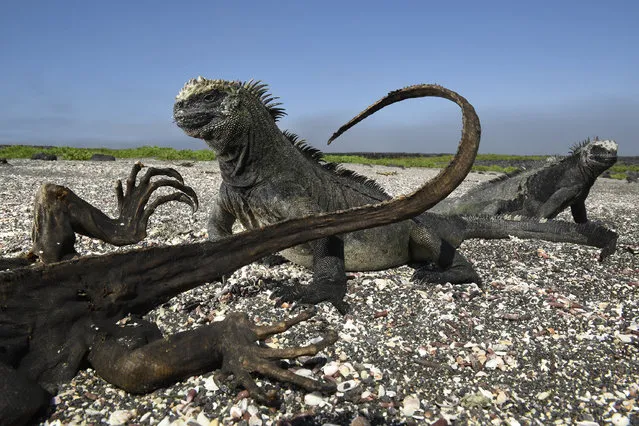
Galapagos – Rocking the Cradle: Four major ocean currents converge along the Galapagos archipelago, creating the conditions for an extraordinary diversity of animal life, April 25, 2016. The islands are home to at least 7,000 flora and fauna species, of which 97 percent of the reptiles, 80 percent of the land birds, 50 percent of the insects and 30 percent of the plants are endemic. The local ecosystem is highly sensitive to the changes in temperature, rainfall and ocean currents that characterize the climatic events known as El Niño and La Niña. These changes cause marked fluctuations in weather and food availability. Many scientists expect the frequency of El Niño and La Niña to increase as a result of climate change, making the Galapagos a possible early-warning location for its effects. (Photo by Thomas P. Peschak for National Geographic/World Press Photo)

Galapagos – Rocking the Cradle: Four major ocean currents converge along the Galapagos archipelago, creating the conditions for an extraordinary diversity of animal life, April 25, 2016. The islands are home to at least 7,000 flora and fauna species, of which 97 percent of the reptiles, 80 percent of the land birds, 50 percent of the insects and 30 percent of the plants are endemic. (Photo by Thomas P. Peschak for National Geographic/World Press Photo)
Details
16 Apr 2018 00:01:00