Loading...
Done


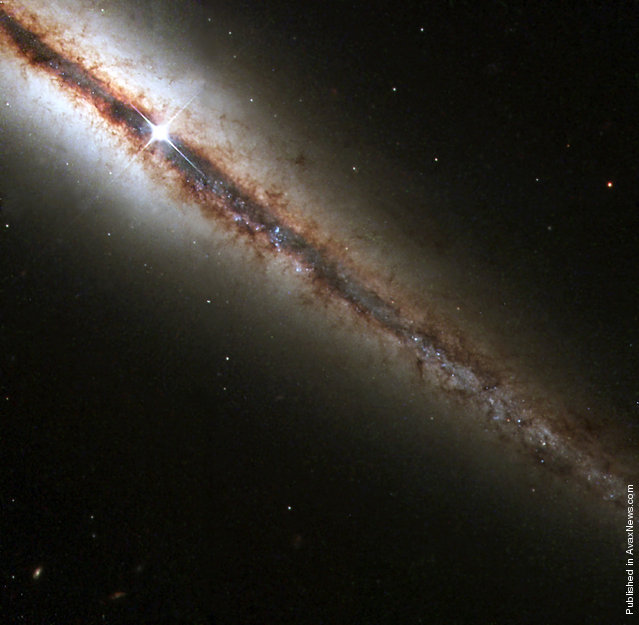
An image produced by the Hubble telescope of the perfectly “edge-on” galaxy, or NGC 4013, March 1, 2001. This new Hubble picture reveals, with great detail, huge clouds of dust and gas extending along, as well as far above, the galaxy's main disk. NGC 4013 is a spiral galaxy, similar to the Milky Way, lying some 55 million light-years from Earth in the direction of the constellation Ursa Major. Viewed face-on, it would look like a nearly circular pinwheel, but NGC 4013 happens to be seen edge-on from our vantage point. Even at 55 million light-years, the galaxy is larger than Hubble's field of view, and the image shows only a little more than half of the object, albeit with unprecedented detail. (Photo Courtesy of NASA/Newsmakers)
Details
28 Feb 2015 22:33:00
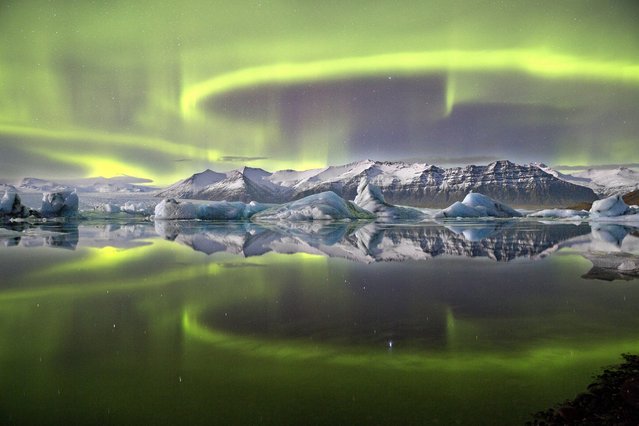
“Aurora over a glacier lagoon”. A vivid green overheaded aurrora pictured in Iceland's Vatnajokull National Park reflected almost symetrically in Jokulsrlon Glacier lagoon. A complete lack of wind and currrent combin in this sheltred lagoon scene to crete an arresting mirror effect giving the image a sensation of utter stillness. Despite theis there is motion on a suprising scale, as the loops and arcs of the aurora are shaped by the shifting forces of the Earth's magnetic field. (Photo by  James Woodend/The Astronomy Photographer of the Year 2014 Contest)

“Aurora over a glacier lagoon”. A vivid green overheaded aurrora pictured in Iceland's Vatnajokull National Park reflected almost symetrically in Jokulsrlon Glacier lagoon. A complete lack of wind and currrent combin in this sheltred lagoon scene to crete an arresting mirror effect giving the image a sensation of utter stillness. Despite theis there is motion on a suprising scale, as the loops and arcs of the aurora are shaped by the shifting forces of the Earth's magnetic field. James Woodend of Great Britain won the grand prize with the image, beating out more than 2,500 other entries. The Astronomy Photographer of the Year 2014 contest is judged by the Royal Observatory Greenwich and BBC Sky at Night magazine. (Photo by James Woodend/The Astronomy Photographer of the Year 2014 Contest)
Details
26 Sep 2014 13:39:00
Iranian Arabs who are members of the paramilitary Basij force march in a military parade marking the 35th anniversary of Iraq's 1980 invasion of Iran, in front of the shrine of late revolutionary founder Ayatollah Khomeini, just outside Tehran, Iran, Tuesday, September 22, 2015. (Photo by Vahid Salemi/AP Photo)

Iranian Arabs who are members of the paramilitary Basij force march in a military parade marking the 35th anniversary of Iraq's 1980 invasion of Iran, in front of the shrine of late revolutionary founder Ayatollah Khomeini, just outside Tehran, Iran, Tuesday, September 22, 2015. (Photo by Vahid Salemi/AP Photo)
Details
24 Sep 2015 08:01:00
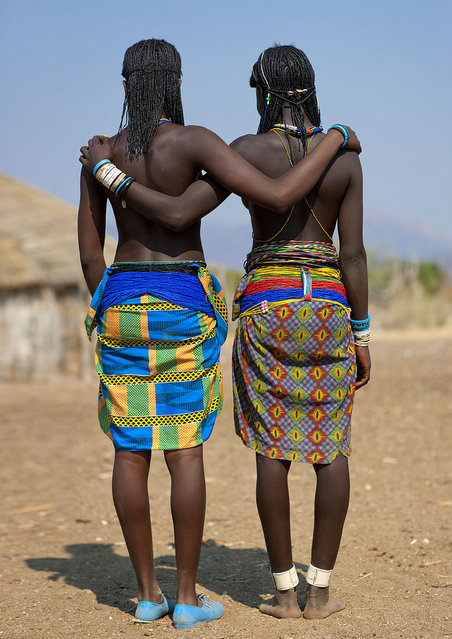
“Show us our butts! Mucawana tribe – Angola. In Soba village, the Muhacaona (Mucawana) tribe, perhaps the best place i have visited. They use cow dung and fat to make this so nice haircut, and love the beads. They asked me to make pictures of their backs... and butts to see on the camera screen if everything was perfect!”. (Eric Lafforgue)

“Show us our butts! Mucawana tribe – Angola. In Soba village, the Muhacaona (Mucawana) tribe, perhaps the best place i have visited. They use cow dung and fat to make this so nice haircut, and love the beads. They asked me to make pictures of their backs... and butts to see on the camera screen if everything was perfect!”. (Photo and comments by Eric Lafforgue)
Details
09 Nov 2012 15:04:00
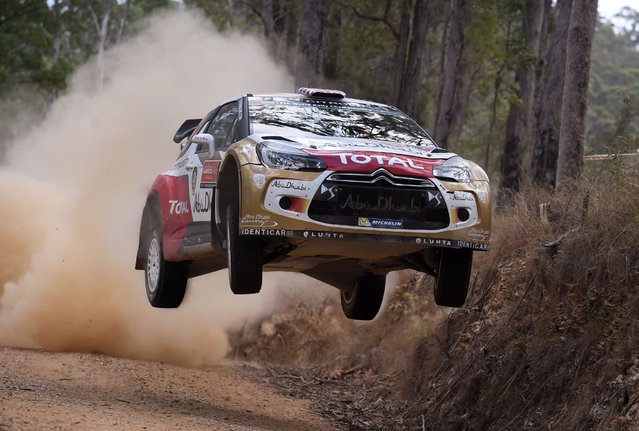
British rally driver Kris Meeke jumps his Citroen over a brow during the fifth special stage of the World Rally Championship (WRC) Rally of Australia, near Bellingen on the New South Wales central coast on September 12, 2014. (Photo by William West/AFP Photo)

British rally driver Kris Meeke jumps his Citroen over a brow during the fifth special stage of the World Rally Championship (WRC) Rally of Australia, near Bellingen on the New South Wales central coast on September 12, 2014. (Photo by William West/AFP Photo)
Details
13 Sep 2014 12:01:00
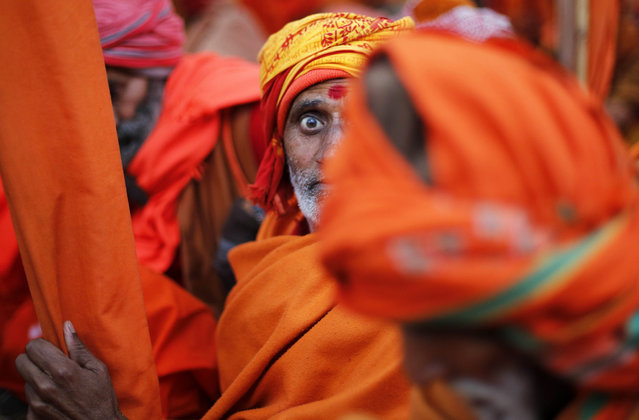
An Indian Sadhu, or Hindu holy man, sits for a community feast at the Sangam, the confluence of the Rivers Ganges, Yamuna and mythical Saraswati, during the annual month-long Magh Mela religious fair in Allahabad, India, Friday, January 16, 2015. (Photo by Rajesh Kumar Singh/AP Photo)

An Indian Sadhu, or Hindu holy man, sits for a community feast at the Sangam, the confluence of the Rivers Ganges, Yamuna and mythical Saraswati, during the annual month-long Magh Mela religious fair in Allahabad, India, Friday, January 16, 2015. Hundreds of thousands of devout Hindus are expected to take holy dips at the confluence during the astronomically auspicious period of over 45 days celebrated as Magh Mela. (Photo by Rajesh Kumar Singh/AP Photo)
Details
17 Jan 2015 11:54:00
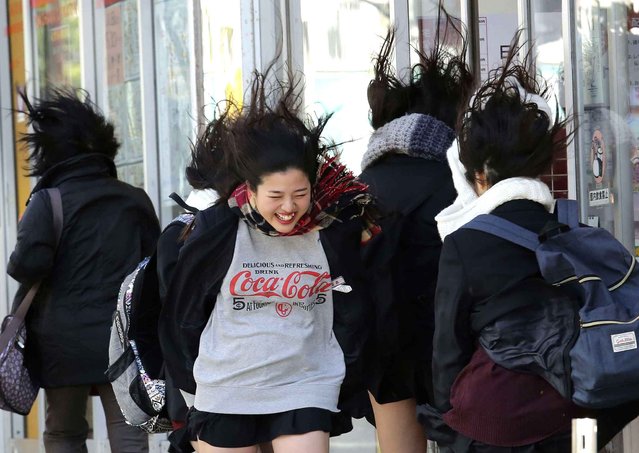
A girl smiles as her hair is blown by a strong wind in the Chinatown area in Yokohama, near Tokyo, Friday, January 27, 2017. (Photo by Koji Sasahara/AP Photo)

A girl smiles as her hair is blown by a strong wind in the Chinatown area in Yokohama, near Tokyo, Friday, January 27, 2017. (Photo by Koji Sasahara/AP Photo)
Details
29 Jan 2017 11:49:00
An aerial view shows a sinkhole 3.5 km (2 miles) to the east of Solikamsk-2 mine in Perm region, November 20, 2014. Shares in Russia's Uralkali, the world's top potash producer, fell sharply for a second day on Wednesday after a mine accident that could reduce global supplies and push up prices of the crop nutrient worldwide. (Photo by Reuters/Press service of Uralkali company)

An aerial view shows a sinkhole 3.5 km (2 miles) to the east of Solikamsk-2 mine in Perm region, November 20, 2014. Shares in Russia's Uralkali, the world's top potash producer, fell sharply for a second day on Wednesday after a mine accident that could reduce global supplies and push up prices of the crop nutrient worldwide. Uralkali shares have fallen 28 percent since Tuesday when it suspended work at its Solikamsk-2 mine, which accounts for a fifth of the company's output and 3.5 percent of global capacity, following an inflow of water. A sinkhole, stretching 30 by 40 metres (yards), found at an abandoned mine 3.5 km (2 miles) to the east, increased concern about the future of the mine because an inflow of water and the resulting sinkhole in 2006 forced another Uralkali operation to shut permanently. (Photo by Reuters/Press service of Uralkali company)
Details
22 Nov 2014 13:51:00