Loading...
Done
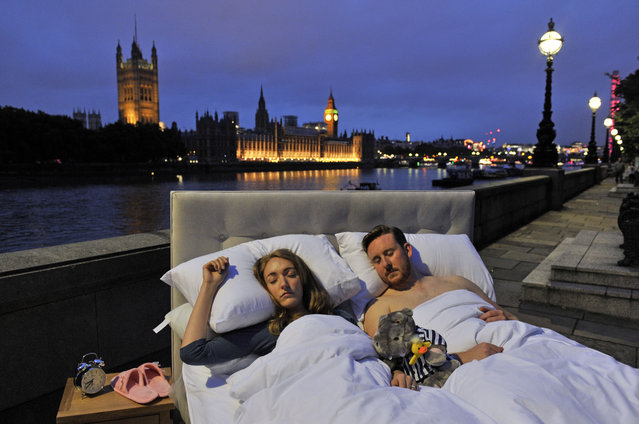
Londoners enjoy a “Silent Night” as Big Ben falls silent, London, UK on August 21, 2017. Londoners snuggle up to enjoy the city's first silent night as Big Ben chimed its last for four years. As the sun set over London last night the city bid a temporary farewell to the chimes of its beloved Big Ben. Londoners were testing out the new quiet of the Southbank in an unusual fashion. A luxurious bed, courtesy of bed firm, Silentnight, complete with fluffy white duvet, plump pillows, a hot water bottle and a cuddly toy, emerged in the heart of the city, just in time for bed. It didn't take local residents and workers long to make the most of the peace and quiet with the city's tired workers climbing in for a nap. Rose Allerston from Clapham, London said “After a stressful day in the office, I couldn't think of anything better than going home and climbing into bed - but when I saw this bed opposite Big Ben I just couldn't resist getting in for a snuggle”. (Photo by Imagewise Ltd/Rex Features/Shutterstock)

Londoners enjoy a “Silent Night” as Big Ben falls silent, London, UK on August 21, 2017. ose Allerston from Clapham, London said “After a stressful day in the office, I couldn't think of anything better than going home and climbing into bed – but when I saw this bed opposite Big Ben I just couldn't resist getting in for a snuggle”. (Photo by Imagewise Ltd/Rex Features/Shutterstock)
Details
23 Aug 2017 08:44:00
Belgian yoga teacher Dorien Dierckx, 29 from Brussels enjoys a beer while relaxing in a jacuzzi full of hot water and a mixture of ingredients used to make beer, and where customers can serve their own beer from the tap at the Good Beer Spa in Brussels, Belgium on May 12, 2021. (Photo by Yves Herman/Reuters)

Belgian yoga teacher Dorien Dierckx, 29 from Brussels enjoys a beer while relaxing in a jacuzzi full of hot water and a mixture of ingredients used to make beer, and where customers can serve their own beer from the tap at the Good Beer Spa in Brussels, Belgium on May 12, 2021. (Photo by Yves Herman/Reuters)
Details
17 May 2021 07:47:00
A truffle is seen on a table in Alba, north-western Italy November 11, 2013. Located in the heart of the Langhe – the hilly southern area of Italy's northwestern Piedmont region – Alba is the country's capital of white truffles, a variety of the prized fungus which grows underground. Truffles are found two to eight inches (5-20cm) below the ground near the roots of trees. (Photo by Stefano Rellandini/Reuters)

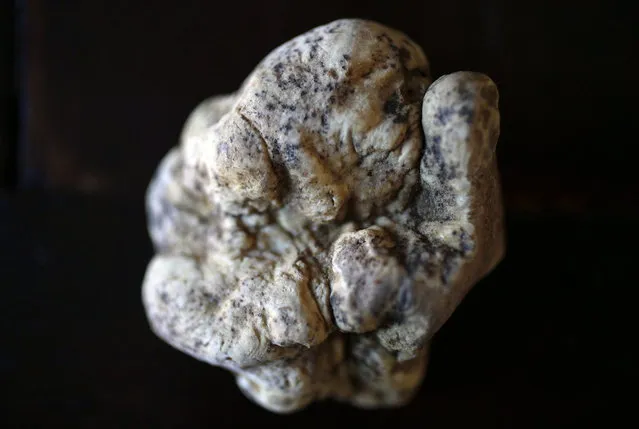
A truffle is seen on a table in Alba, north-western Italy November 11, 2013. Located in the heart of the Langhe – the hilly southern area of Italy's northwestern Piedmont region – Alba is the country's capital of white truffles, a variety of the prized fungus which grows underground. Truffles are found two to eight inches (5-20cm) below the ground near the roots of trees. They give off an odour which lasts for a limited period of time and can be detected with the assistance of well-trained dogs and experienced hunters. Output of white truffles, which are not cultivated and only grow naturally in forests, has fallen in Italy over the past few years, largely because climate change has brought a damaging mix of drought and torrential rains. (Photo by Stefano Rellandini/Reuters)
Details
31 Dec 2013 11:22:00
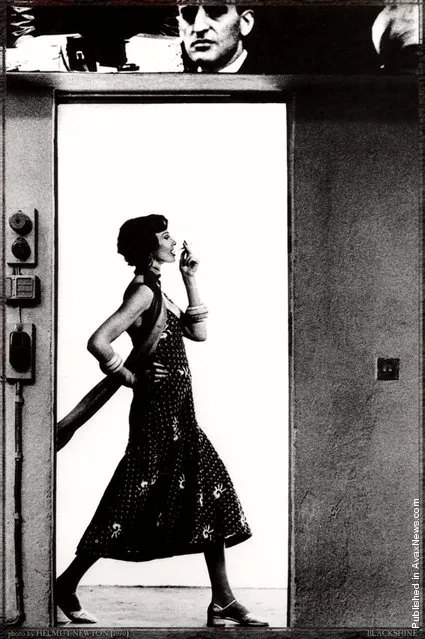
Photographers: Helmut Newton

“Newton was born in Berlin, the son of Klara “Claire” (Marquis) and Max Neustädter, a button factory owner. His family was Jewish. Newton attended the Heinrich-von-Treitschke-Realgymnasium and the American School in Berlin. Interested in photography from the age of 12 when he purchased his first camera, he worked for the German photographer Yva (Elsie Neulander Simon) from 1936. The increasingly oppressive restrictions placed on Jews by the Nuremberg laws meant that his father lost control of the factory in which he manufactured buttons and buckles; he was briefly interned in a concentration camp on “Kristallnacht”, November 9, 1938, which finally compelled the family to leave Germany. Newton's parents fled to South America. He was issued with a passport just after turning 18, and left Germany on December 5, 1938. At Trieste he boarded the “Conte Rosso” (along with about 200 others escaping the Nazis) intending to journey to China. After arriving in Singapore he found he was able to remain there, first and briefly as a photographer for the Straits Times and then as a portrait photographer”. – Wikipedia

Photo: Sigourney Weaver by Helmut Newton, 1995.
Details
08 Apr 2012 13:49:00
Trick rider Kendel Sampson performs during the trick riding session of the RAM Rodeo in Warkworth, Ontario, on August 1, 2013. The teenage Encore Presentation Trick Riders perform daring stunts every rodeo season in towns throughout Canada. (Photo by Norm Betts/Barcroft Media)

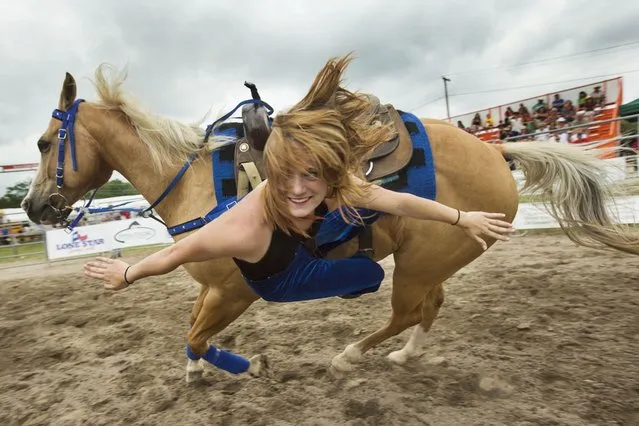
Trick rider Kendel Sampson performs during the trick riding session of the RAM Rodeo in Warkworth, Ontario, on August 1, 2013. The teenage Encore Presentation Trick Riders perform daring stunts every rodeo season in towns throughout Canada. (Photo by Norm Betts/Barcroft Media)
Details
03 Aug 2013 11:38:00
Indian Naga Sadhus, or naked holy men, participate in a procession before taking a “shahi snans”, or holy bath, at the Sangam river, the confluence of three of the holiest rivers in Hindu mythology, the Ganga, the Yamuna and the Saraswati, during Kumbh Mela festival in Allahabad, Uttar Pradesh, India, 15 January 2019. The Hindu festival is one of the biggest in India and will be held from 15 January to 04 March 2019 in Allahabad. (Photo by Rajat Gupta/EPA/EFE)

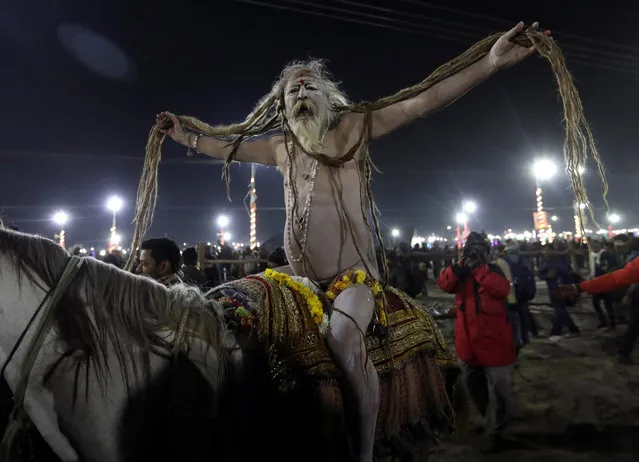
Indian Naga Sadhus, or naked holy men, participate in a procession before taking a “shahi snans”, or holy bath, at the Sangam river, the confluence of three of the holiest rivers in Hindu mythology, the Ganga, the Yamuna and the Saraswati, during Kumbh Mela festival in Allahabad, Uttar Pradesh, India, 15 January 2019. The Hindu festival is one of the biggest in India and will be held from 15 January to 04 March 2019 in Allahabad. (Photo by Rajat Gupta/EPA/EFE)
Details
26 Jan 2019 00:01:00
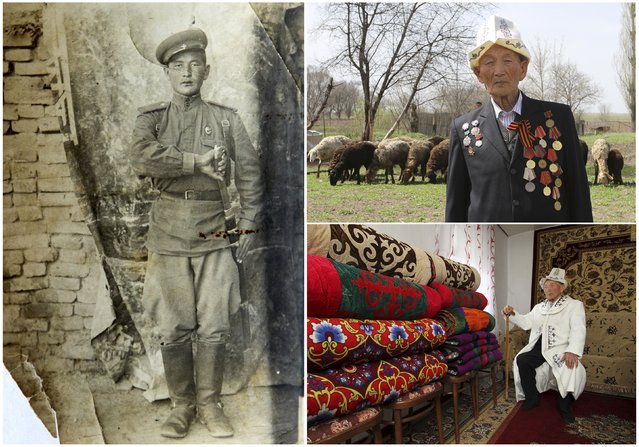
World War Two veteran Abla Begaliyev, 91, is seen in an undated handout picture (L), poses for a picture in Arashan (Top R) and at home in Kyrgyzstan April 14, 2015. Begaliyev served in the border guard cavalry from February 1942 until April 1947. Originally from Kyrgyzstan, he fought on the Ukrainian front and relocated to the border with Afghanistan at the end of World War Two. (Photo by Vladimir Pirogov/Reuters/Family handout (L))

World War Two veteran Abla Begaliyev, 91, is seen in an undated handout picture (L), poses for a picture in Arashan (Top R) and at home in Kyrgyzstan April 14, 2015. Begaliyev served in the border guard cavalry from February 1942 until April 1947. Originally from Kyrgyzstan, he fought on the Ukrainian front and relocated to the border with Afghanistan at the end of World War Two. As the world marks the 70th anniversary of the end of World War Two, Reuters photographers the length and breadth of the former Soviet republics (CCCP) captured portraits of Red Army veterans, mostly now in their 80s and 90s, today and through archive pictures at the time. More than 20 million Soviet citizens were killed in the war. (Photo by Vladimir Pirogov/Reuters/Family handout (L))
Details
08 May 2015 14:22:00
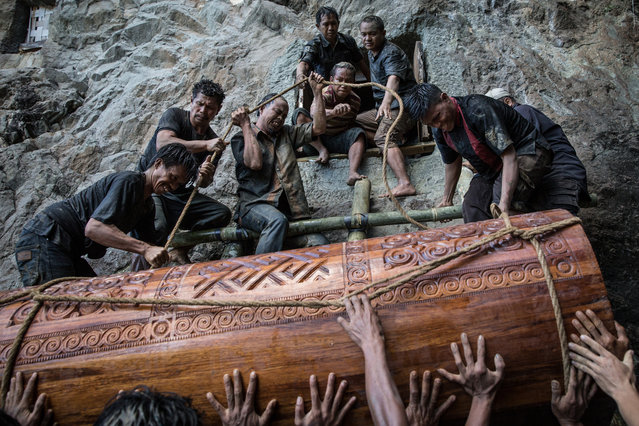
It is said that Torajans are people who “live to die”. For this Indonesian ethnic group, funerals are such extravagant events that they sometimes attract tourists. Families can postpone burials years (and the deceased are considered sick and hosted at home until the funeral) until the family can raise enough money and gather as many relatives as possible. And then it’s a jubilant multiday social event with a parade, dances and animal sacrifices. Agung Parameswara photographed these funerary practices when he traveled to South Sulawesi province, where the Torajans live. But often, their funeral isn’t the last time the dead are seen. In August, crypts are opened, coffins are slid back out and bodies delicately unsheathed. This tender ritual is known as Ma’Nene, which is customarily performed every few years. (Photo by Agung Parameswara/The Washington Post)

It is said that Torajans are people who “live to die”. For this Indonesian ethnic group, funerals are such extravagant events that they sometimes attract tourists. Families can postpone burials years (and the deceased are considered sick and hosted at home until the funeral) until the family can raise enough money and gather as many relatives as possible. And then it’s a jubilant multiday social event with a parade, dances and animal sacrifices. Agung Parameswara photographed these funerary practices when he traveled to South Sulawesi province, where the Torajans live. (Photo by Agung Parameswara/The Washington Post)
Details
06 Oct 2016 09:15:00