Loading...
Done
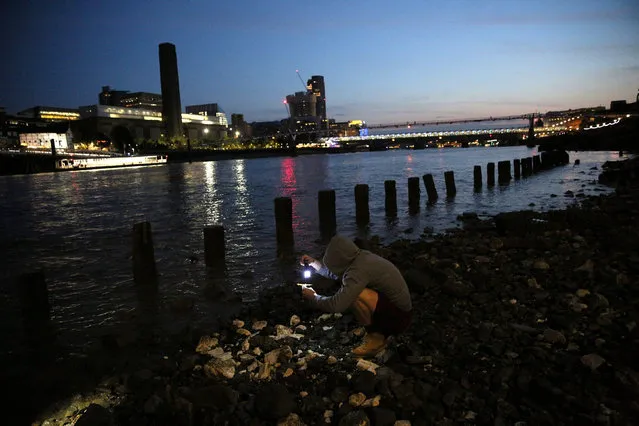
A mudlark uses a torch to look for items on the bank of the River Thames in London, Britain June 06, 2016. Mudlarking is believed to trace its origins to the 18th and 19th century, when scavengers searched the Thames' shores for items to sell. These days, history and archaeology fans are the ones hoping to find old relics such as coins, ceramics, artifacts or everyday items from across centuries. They wait for the low tide and then scour specific areas of exposed shores. "If you're in a field you could be out all day long, with the river you're restricted to about two or three hours," mudlark Nick Stevens said. While many just use the naked eye for their searches, others rely on metal detectors for which a permit from the Port of London Authority is needed. Digging also requires consent. (Photo by Neil Hall/Reuters)

A mudlark uses a torch to look for items on the bank of the River Thames in London, Britain June 06, 2016. Mudlarking is believed to trace its origins to the 18th and 19th century, when scavengers searched the Thames' shores for items to sell. These days, history and archaeology fans are the ones hoping to find old relics such as coins, ceramics, artifacts or everyday items from across centuries. their finds with the Portable Antiquities Scheme. Any item over 300 years old must be recorded. (Photo by Neil Hall/Reuters)
Details
27 Aug 2016 10:43:00
Jenna carefully watches two giant boa constrictors that their owner, a street performer she barely knows, entrusted to her. She is careful to keep the one snake wrapped around exercise bars to prevent a wound in the animal’s mouth from touching the sand and getting infected. Jenna is a single mom on disability. She suffers from failed back surgery syndrome, acquired from a violent car accident she had as a teenager. She and her young son Jackson can be found most afternoons on the beach. Originally from South Carolina, Jenna came to Venice in 2010 and describes herself as “an open-minded Christian who loves everyone for who they are”. Nowadays Jenna sometimes has trouble reconciling her inclusive progressive values with her family’s conservative political stance, especially in today’s toxic political climate. (Photo by Dotan Saguy)

Over the past three years, Los Angeles-based photographer Dotan Saguy has spent hundreds of hours documenting the diverse culture, people and pageantry of the iconic Venice Beach boardwalk. He was irresistibly drawn to the free-spirited, anti-materialistic and inclusive nature of the world-famous location, which he found to be a breath of fresh air in contrast to Los Angeles’s sometimes homogenized, celebrity-obsessed culture. (Photo by Dotan Saguy)
Details
01 Aug 2018 00:03:00
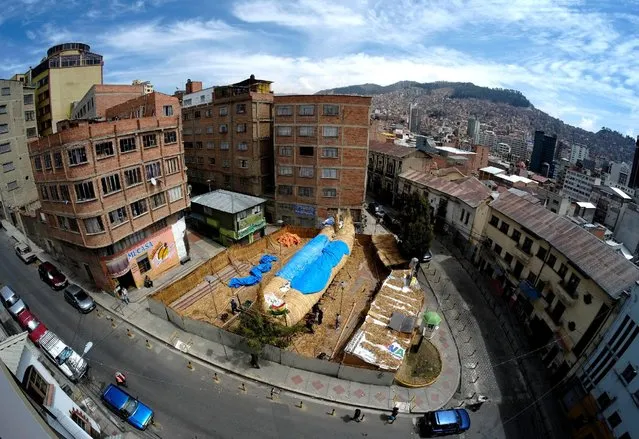
Aerial view of the “Viracocha III”, a boat made only from the totora reed, as it is being prepared to cross the Pacific from Chile to Australia on an expected six-month journey, La Paz, Bolivia, October 19, 2016. An expedition in a boat made only of reeds crafted by indigenous Bolivians is getting ready to cross the Pacific from South America to Australia, in a fresh attempt to prove that ancient mariners were capable of making the journey. Phil Buck, a 51-year-old explorer from the United States, already has led two similar expeditions and will captain the “Viracocha III” set to depart from northern Chile in February on an expected six-month journey. (Photo by David Mercado/Reuters)

Aerial view of the “Viracocha III”, a boat made only from the totora reed, as it is being prepared to cross the Pacific from Chile to Australia on an expected six-month journey, La Paz, Bolivia, October 19, 2016. An expedition in a boat made only of reeds crafted by indigenous Bolivians is getting ready to cross the Pacific from South America to Australia, in a fresh attempt to prove that ancient mariners were capable of making the journey. (Photo by David Mercado/Reuters)
Details
20 Oct 2016 10:53:00
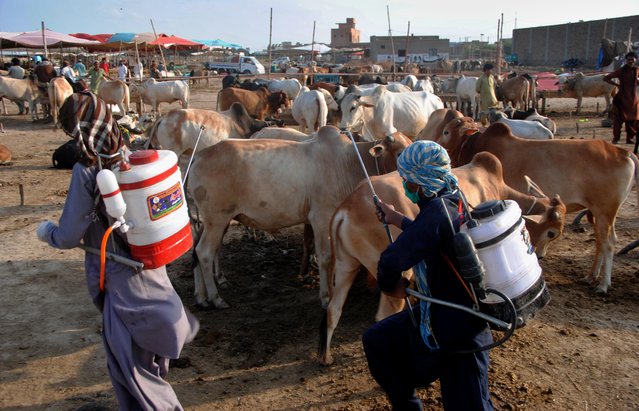
Health workers wearing face masks spray disinfectant liquid on sacrificial animals amid concerns over the spread of the SARS-CoV-2 coronavirus that causes the pandemic COVID-19 disease ahead of the Muslim festival of Eid al-Adha at an animal market in Hyderabad, southern Pakistan, 21 July 2020. Eid al-Adha, also known as the Festival of the Sacrifice, is the second and holiest of the two main Islamic holidays celebrated each year (the other one being Eid al-Fitr). Every year, on the 10th day of the Islamic lunar month of Dhu al-Hijjah, Muslims around the world ritually slaughter a sacrificial animal and split the meat into three parts: one is reserved for the family, another for friends and relatives, and the third is given to the poor and needy. The Saudi Supreme Court has declared that the first day of Eid al-Adha this year falls on 31 July. (Photo by Nadeem Khawar/EPA/EFE)

Health workers wearing face masks spray disinfectant liquid on sacrificial animals amid concerns over the spread of the SARS-CoV-2 coronavirus that causes the pandemic COVID-19 disease ahead of the Muslim festival of Eid al-Adha at an animal market in Hyderabad, southern Pakistan, 21 July 2020. (Photo by Nadeem Khawar/EPA/EFE)
Details
23 Jul 2020 00:07:00
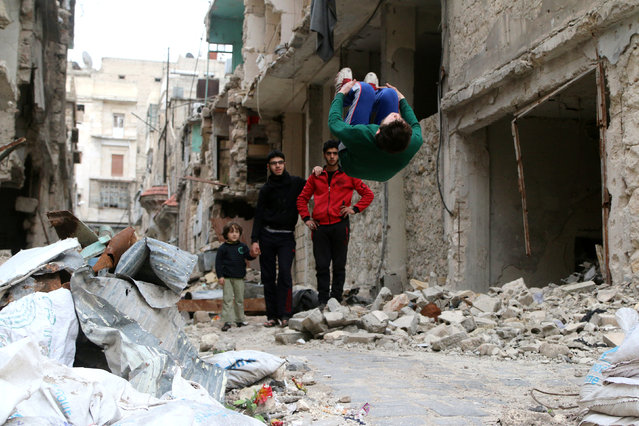
Gymnast Ahmad al-Sawas performs gymnastic moves near damaged buildings in the rebel-held Bustan al-Qasr neighbourhood of Aleppo, Syria March 26, 2016. As Syrian gymnast Ahmad al-Sawas watched his country fall apart, his Olympic dream collapsed too. The last national champion before the fighting began, he knew that supporting the anti-government side in the five-year-old civil war would prevent him from being selected for the Rio Games. “I chose to be an athlete who participates in the revolution”, said Ahmad, who trains where he can for two hours a day – be it on a mattress on a soccer field, in a local hall or somersaulting off a wall. (Photo by Abdalrhman Ismail/Reuters)

Gymnast Ahmad al-Sawas performs gymnastic moves near damaged buildings in the rebel-held Bustan al-Qasr neighbourhood of Aleppo, Syria March 26, 2016. As Syrian gymnast Ahmad al-Sawas watched his country fall apart, his Olympic dream collapsed too. The last national champion before the fighting began, he knew that supporting the anti-government side in the five-year-old civil war would prevent him from being selected for the Rio Games. (Photo by Abdalrhman Ismail/Reuters)
Details
05 Aug 2016 13:25:00


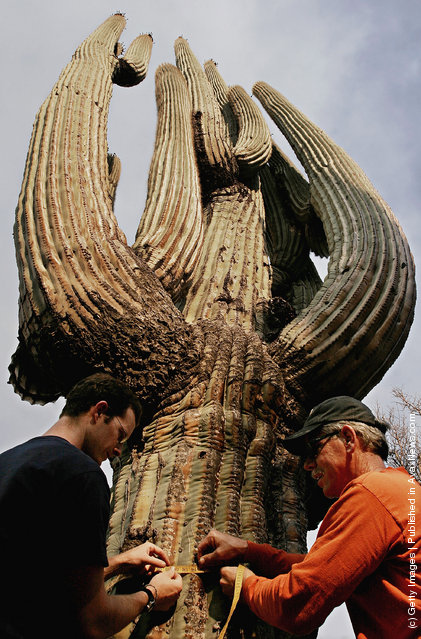
“The saguaro (scientific name Carnegiea gigantea) is a large, tree-sized cactus species in the monotypic genus Carnegiea. It is native to the Sonoran Desert in the U.S. state of Arizona, the Mexican state of Sonora, a small part of Baja California in the San Felipe Desert and an extremely small area of California, U.S. The saguaro blossom is the State Wildflower of Arizona”. – Wikipedia

Photo: Daniel Appel (L), a firefighter with Engine 84 from the Lassen National Forest in California and Mike Hallen, (R), Arizona representative of the National Register of Big Trees, measure the circumference of this Saguaro cactus called the "Grand One," in the Tonto National Forest on July 1, 2005 35 miles north of Phoenix, near Carefree, Arizona. The cactus, estimated to be more than 200 years old, measures a circumference of 7 feet, 10 inches (2.4 meters) and stands 46 feet high (14 meters). The cactus was burned in the Cave Creek Complex fire and may not survive. It was once the largest Saguaro in the world, two others have been found recently that have tied it's measurements. The fire has burned more than 214,000 acres of the Sonoran desert. (Photo by Jeff Topping/Getty Images)

Details
26 Jul 2011 12:27:00
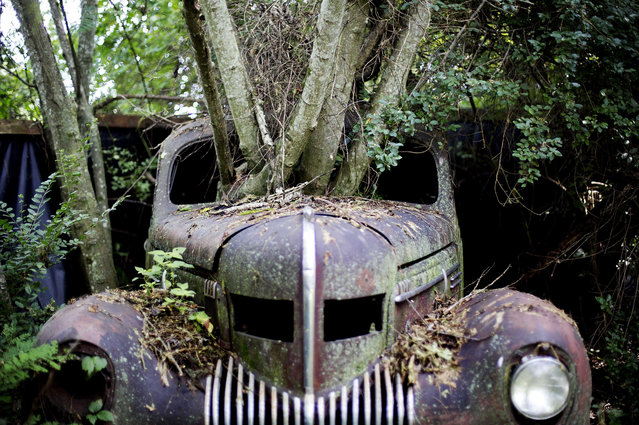
Trees grow through the windshield of a 1937 Chrysler Imperial as it sits at Old Car City, the world's largest known classic car junkyard Thursday, July 16, 2015, in White, Ga. Many of the cars have never moved in over 30 years and in some cases, trees now grow through them, even lifting some off the ground. (Photo by David Goldman/AP Photo)

Trees grow through the windshield of a 1937 Chrysler Imperial as it sits at Old Car City, the world's largest known classic car junkyard Thursday, July 16, 2015, in White, Ga. Over 4,000 classic cars decorate 32 acres of forest which have been turned into a junkyard museum by owner Walter Dean Lewis. The two grew up playing in the cars on the lot which started as a general store selling auto parts in 1931 by Lewis' parents. Lewis stopped selling parts about six years ago when he realized he could sustain the business more as a museum, charging $15 for visitors just looking, and $25 for photographers. Many of the cars have never moved in over 30 years and in some cases, trees now grow through them, even lifting some off the ground. (Photo by David Goldman/AP Photo)
Details
17 Jul 2015 13:14:00
A pro-Russian armed man secures crash site wreckage of the Malaysia Airlines Boeing 777 plane (flight MH17) at the site of the plane crash near the settlement of Grabovo in the Donetsk region November 16, 2014. Local emergency services have begun collecting parts of the wreckage from its crash site in the middle of the conflict zone, Dutch air accident investigators said on Sunday. (Photo by Antonio Bronic/Reuters)

A pro-Russian armed man secures crash site wreckage of the Malaysia Airlines Boeing 777 plane (flight MH17) at the site of the plane crash near the settlement of Grabovo in the Donetsk region November 16, 2014. Local emergency services have begun collecting parts of the wreckage from its crash site in the middle of the conflict zone, Dutch air accident investigators said on Sunday. Dutch inspectors had hoped to collect the parts themselves, following the downing of the flight on July 17 that killed 298 people, two thirds of them Dutch citizens. But they remain concerned about the safety of their staff in the rebel-held conflict zone, and so have decided to work with local services following an initial focus on finding human remains and belongings. (Photo by Antonio Bronic/Reuters)
Details
17 Nov 2014 12:47:00