Loading...
Done
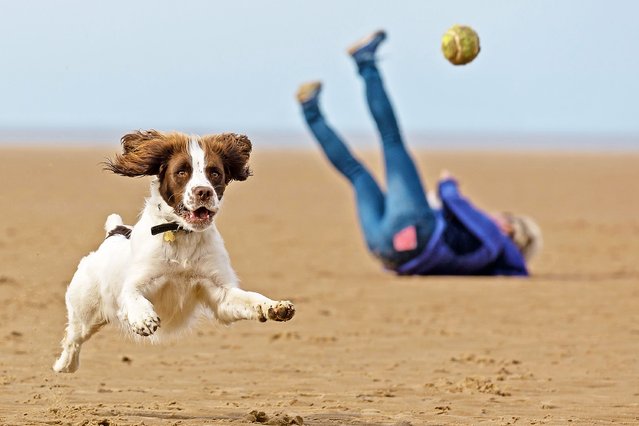
Tia the springer spaniel chases after the ball as owner Monika Burton falls over in the background. The funny scene was captured by husband, Vince Burton at Wells Next The Sea, Norfolk, on Easter Monday, April 18, 2022. (Photo by Vince Burton/Animal News Agency)

Tia the springer spaniel chases after the ball as owner Monika Burton falls over in the background. The funny scene was captured by husband, Vince Burton at Wells Next The Sea, Norfolk, on Easter Monday, April 18, 2022. (Photo by Vince Burton/Animal News Agency)
Details
08 May 2022 06:44:00
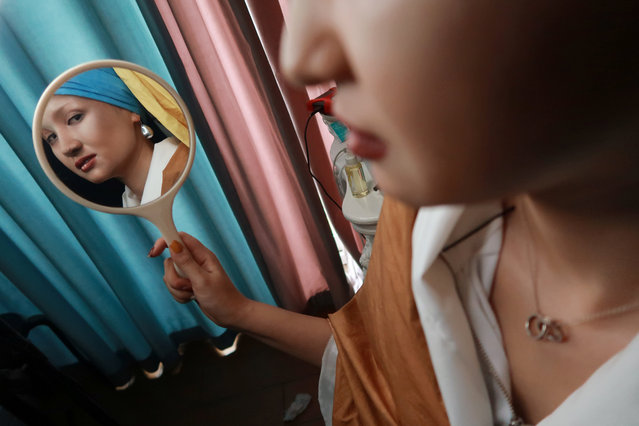
Makeup artist He Yuhong, also known as “Yuya”, checks herself in the mirror during a photo shoot following her transformation into the “Girl with a Pearl Earring”, the 17th century oil painting by Dutch painter Johannes Vermeer, at her house in Chongqing, China on August 14, 2018. (Photo by Thomas Suen/Reuters)

Makeup artist He Yuhong, also known as “Yuya”, checks herself in the mirror during a photo shoot following her transformation into the “Girl with a Pearl Earring”, the 17th century oil painting by Dutch painter Johannes Vermeer, at her house in Chongqing, China on August 14, 2018. (Photo by Thomas Suen/Reuters)
Details
07 Oct 2018 00:05:00
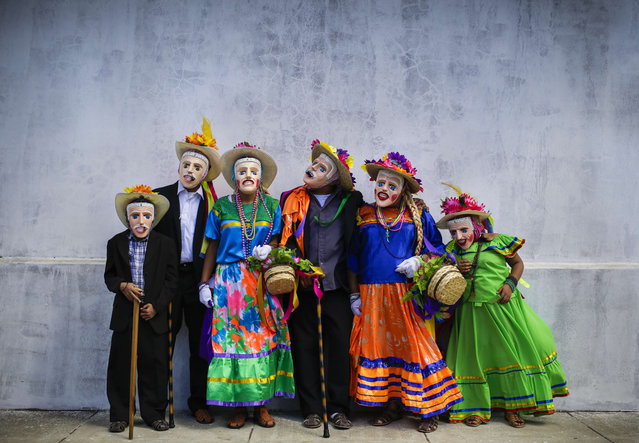
Dancers pose after performing “El Macho Raton”, “El Toro Huaco” and “El Gueguense” traditional dances during San Sebastian festivity in Diriamba, province of Carazo, some 50 km south of Managua on January 19, 2016. Devotees of Saint Sebastian dance in traditional costumes between the cities of Diriamba and Dolores, which are some three kilometers away. (Photo by Inti Ocon/AFP Photo)

Dancers pose after performing “El Macho Raton”, “El Toro Huaco” and “El Gueguense” traditional dances during San Sebastian festivity in Diriamba, province of Carazo, some 50 km south of Managua on January 19, 2016. Devotees of Saint Sebastian dance in traditional costumes between the cities of Diriamba and Dolores, which are some three kilometers away. (Photo by Inti Ocon/AFP Photo)
Details
21 Jan 2016 12:08:00
A man walks past a mural along a street in New Delhi on June 30, 2023. (Photo by Arun Sankar/AFP Photo)

A man walks past a mural along a street in New Delhi on June 30, 2023. (Photo by Arun Sankar/AFP Photo)
Details
22 Aug 2023 03:30:00


A Galapagos Tortoise shell is used as a foot rest at Heathrow Airport's Animal Reception Centre on January 25, 2011 in London, England. Many animals pass through the centre's doors ranging from exotic animals such as snow leopards and elephants, snakes and crocodiles, to the more common such as cats and dogs. In 2010 alone the centre processed approximately 10,500 cats and dogs, 1,300 birds, 105,000 day old chicks, 246,000 reptiles, 230 horses and 29 million fish. Most animals are part of zoo transfer schemes, the pet trade, or are pets in transit. (Photo by Dan Kitwood/Getty Images)
Details
21 Mar 2011 12:30:00
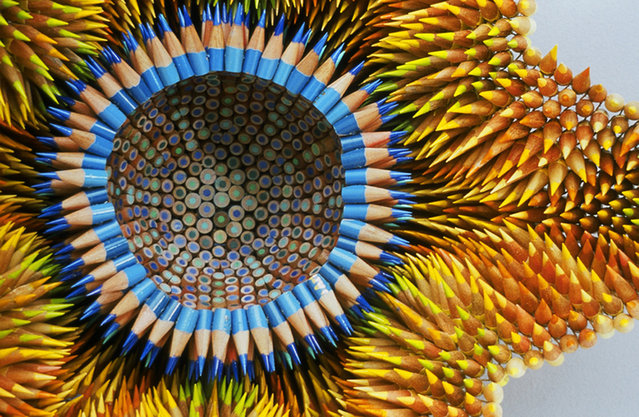
Pencil Sculptures - by Jennifer Maestre

Jennifer Maestre (born 1959 in Johannesburg, South Africa) is a Massachusetts-based artist, internationally known for her unique pencil sculptures.
She derives most of her inspiration from the form and texture of the sea urchin. To make the pencil sculptures, Jennifer makes use of a variety pencils, nails and stitching. She takes hundreds of pencils, cuts them into small 1-inch sections, drills a hole in each section, sharpens them all and sews them together.
Details
22 Aug 2012 13:16:00
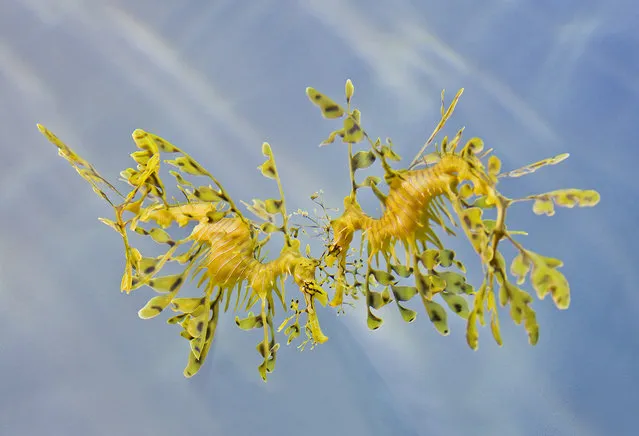
Leafy sea dragon

The leafy seadragon or Glauert's seadragon, Phycodurus eques, is a marine fish in the family Syngnathidae, which also includes the seahorses. It is the only member of the genus Phycodurus. It is found along the southern and western coasts of Australia. The name is derived from the appearance, with long leaf-like protrusions coming from all over the body. These protrusions are not used for propulsion; they serve only as camouflage. The leafy seadragon propels itself by means of a pectoral fin on the ridge of its neck and a dorsal fin on its back closer to the tail end. These small fins are almost completely transparent and difficult to see as they undulate minutely to move the creature sedately through the water, completing the illusion of floating seaweed.
Details
05 Sep 2012 08:51:00
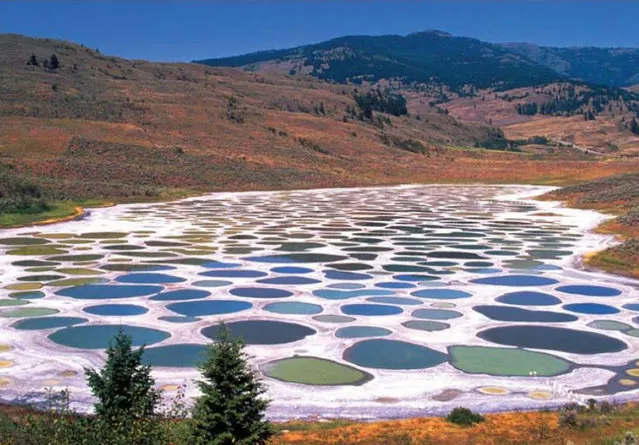
Kliluk, the Spotted Lake, Canada

Originally known to the First Nations of the Okanagan Valley as Khiluk, which was- and remains today revered as a sacred site producing therapeutic waters. During World War I the minerals of Spotted Lake were used in manufacturing ammunition. Later the area came under the control of the Ernest Smith Family, for a term of about 40 years. In 1979 Smith attempted to create interest in a spa at the lake. The First Nations responded with an effort to buy the lake; in October 2001 they finally struck a deal. First Nations arranged the purchase of 22 hectares of land for a total of $720,000, and contributed about 20% of the cost. The Indian Affairs Department paid the remainder.
Details
06 Mar 2015 12:59:00