Loading...
Done
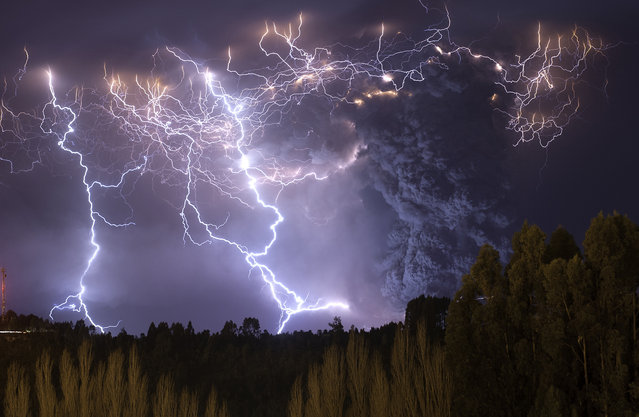
The eruption of Cordon Caulle began on June 4, 2011, located in the Region of Los Rios in Chile. For about 12 months, people and animals became accustomed to living with the daily fall of ash, which also caused problems in the air traffic in South America. The explosions and lightning during first days of the eruption could be seen from hundreds of miles around. This photograph was taken on the second night of eruption from the town of Lago Ranco. (Photo and caption by Francisco Negroni/National Geographic Traveler Photo Contest)

The eruption of Cordon Caulle began on June 4, 2011, located in the Region of Los Rios in Chile. For about 12 months, people and animals became accustomed to living with the daily fall of ash, which also caused problems in the air traffic in South America. The explosions and lightning during first days of the eruption could be seen from hundreds of miles around. This photograph was taken on the second night of eruption from the town of Lago Ranco. (Photo and caption by Francisco Negroni/National Geographic Traveler Photo Contest)

ATTENTION! All pictures are presented in high resolution. To see Hi-Res images – just TWICE click on any picture. In other words, click small picture – opens the BIG picture. Click BIG picture – opens VERY BIG picture.
Details
23 Jun 2013 11:24:00
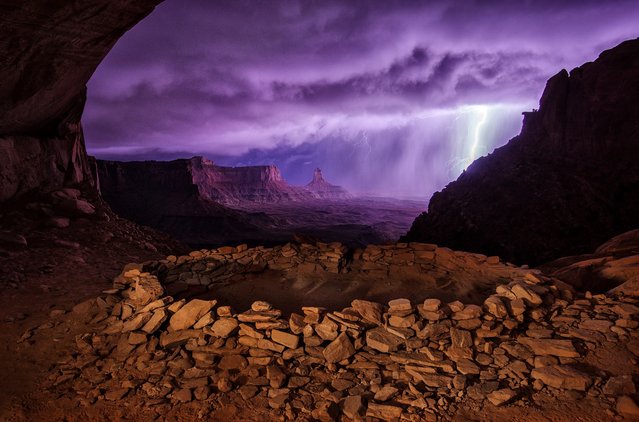
Second Place Winner: “Thunderstorm at False Kiva”. I hiked out to these ruins at night hoping to photograph them with the Milky Way, but instead a thunderstorm rolled through, creating this dramatic image. – Max Seigal. (Photo and caption by Max Seigal/National Geographic Traveler Photo Contest)

Second Place Winner: “Thunderstorm at False Kiva”. I hiked out to these ruins at night hoping to photograph them with the Milky Way, but instead a thunderstorm rolled through, creating this dramatic image. – Max Seigal. National Geographic Traveler Director of Photography Dan Westergren, one of this year's judges, shares his thoughts on the second place winner: “This photo combines two different scenes into one: the small kiva in a cliff dwelling and the grand vista of Canyonlands National Park across the valley. I really like the two different color palettes – warm inside and purple outside. This two-for-one scene was caused by the lightning storm outside the dwelling, which lit up the landscape like it was a huge electronic flash. Looking at this picture I can imagine what a wonderful sight it must have been for the ancient people who lived here. It doesn't seem too amazing now in our modern world, but might have been mind-blowing for the prehistoric residents”. Location: Utah. (Photo and caption by Max Seigal/National Geographic Traveler Photo Contest)
Details
02 Aug 2013 06:16:00
A protester stands against Turkish soldiers during clashes near Silivri, where a hearing on people charged with attempting to overthrow Prime Minister Tayyip Erdogan's Islamist-rooted government is due to take place August 5, 2013. (Photo by Murad Sezer/Reuters)

A protester stands against Turkish soldiers during clashes near Silivri, where a hearing on people charged with attempting to overthrow Prime Minister Tayyip Erdogan's Islamist-rooted government is due to take place August 5, 2013. A Turkish court on Monday sentenced a former military commander to life in prison and dozens of others including opposition members of parliament to long terms for plotting against the government, in a case that has exposed deep divisions in the country. Retired military chief of staff General Ilker Basbug was sentenced to life for his role in the “Ergenekon” conspiracy to overthrow the government of Erdogan. (Photo by Murad Sezer/Reuters)

P.S. All pictures are presented in high resolution. To see Hi-Res images – just TWICE click on any picture. In other words, click small picture – opens the BIG picture. Click BIG picture – opens VERY BIG picture (if available; this principle works anywhere on the site AvaxNews)
Details
10 Aug 2013 13:51:00
Palestinian barber Ramadan Odwan styles and straightens the hair of a customer with fire at his salon in Rafah, in the southern Gaza Strip February 2, 2017. In Ramadan Odwan's barbershop in Gaza, hair isn't just blow-dried, it's blowtorch-dried. “People have gone crazy about it, many people are curious to go through the experience and they are not afraid”, he told Reuters. “People here love adventures”. Odwan, 37, is not the first stylist in the world to use flame to straighten hair, but his craft is unique in the Gaza Strip. In his salon in the southern Gaza town of Rafah, Odwan applied what he described as a protective liquid coating to a customer's hair – he declined to disclose its contents – before aiming for the head and pressing the button on a small blowtorch. “I control how long I apply fire, I keep it on and off for 10 seconds or 15 seconds. It is completely safe and I have not encountered any accident since I started it two months ago”, Odwan added. Odwan charges 20 shekels ($5.20) for a haircut and fire-straightening. A barber for the past 18 years, he said part of the reason he uses the technique is to show that Palestinian barbers are as “professional as those out there around the world”. (Photo by Ibraheem Abu Mustafa/Reuters)

Palestinian barber Ramadan Odwan styles and straightens the hair of a customer with fire at his salon in Rafah, in the southern Gaza Strip February 2, 2017. In Ramadan Odwan's barbershop in Gaza, hair isn't just blow-dried, it's blowtorch-dried. “People have gone crazy about it, many people are curious to go through the experience and they are not afraid”, he told Reuters. “People here love adventures”. (Photo by Ibraheem Abu Mustafa/Reuters)
Details
11 Feb 2017 00:05:00
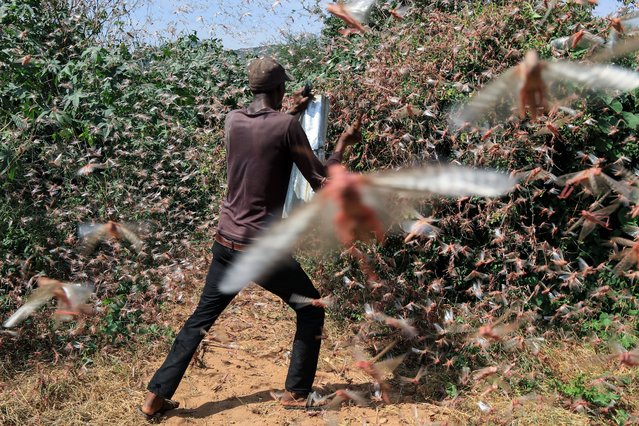
A man uses iron sheet to make noises, as a way of trying to disperse desert locusts that had invaded their farms during the second wave invasion in Kakongo village, in Nuu-Mwingi East, in Kitui, Kenya, 06 February 2021. The second wave invasion of the desert locusts in the country comes at a time where most famers are expecting to harvest their farm produce in the country. According to the United Nations Food and Agriculture Organization (FAO), on 04 February, warned numerous immature desert locust swarms persist in southern Ethiopia and Kenya. Some of the swarms are in community areas and therefore cannot be treated. In Kenya, immature swarms continue to spread westwards across northern and central counties where there are currently about 20 small swarms present, mostly about 50 hectares in size, it said. (Photo by Daniel Irungu/EPA/EFE)

A man uses iron sheet to make noises, as a way of trying to disperse desert locusts that had invaded their farms during the second wave invasion in Kakongo village, in Nuu-Mwingi East, in Kitui, Kenya, 06 February 2021. The second wave invasion of the desert locusts in the country comes at a time where most famers are expecting to harvest their farm produce in the country. (Photo by Daniel Irungu/EPA/EFE)
Details
25 Feb 2021 08:17:00
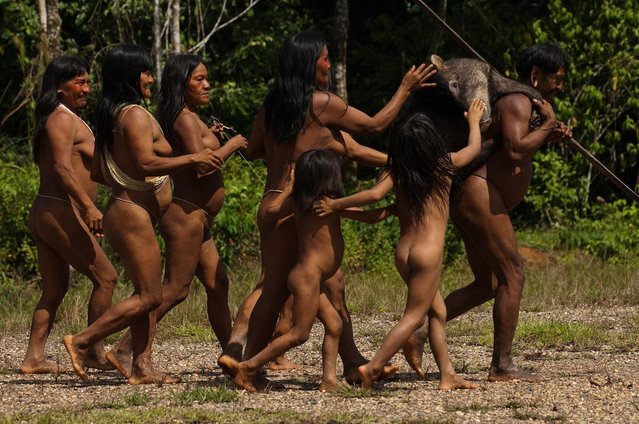
Spectacular images offering insight into the lives of the Huaorani people in the Ecuadorian Amazon have been revealed showing how they use traditional methods to hunt monkeys for food. The stunning pictures were taken by conservation photographer Pete Oxford from Torquay, Devon in the Ecuadorian Amazon. “The Huaorani Indians are a forest people highly in tune with their environment. Many are now totally acculturated since the 1950s by missionaries”, said Pete. “Today they face radical change to their culture to the proximity of oil exploration within their territory and the Yasuni National Park and Biosphere Reserve, they are vastly changed. Some still live very traditionally and for this shoot, through my Huaorani friend, a direct relative of those photographed he wanted to depict them as close to their original culture as possible. They still largely hunt with blow pipes and spears eating a lot of monkeys and peccaries”. The Huaorani are also known as the Waorani, Waodani or the Waos and are native Amerindians. Their lands are located between the Curaray and Napo rivers and speak the Huaorani language. Pete says that during his visit he was welcomed into the group and hopes that ancient cultures can be saved. Here: The tribe were seen celebrating after a hunter returned to camp with a wild pig. (Photo by Pete Oxford/Mediadrumworld.com)

Spectacular images offering insight into the lives of the Huaorani people in the Ecuadorian Amazon have been revealed showing how they use traditional methods to hunt monkeys for food. The stunning pictures were taken by conservation photographer Pete Oxford from Torquay, Devon in the Ecuadorian Amazon. Here: The tribe were seen celebrating after a hunter returned to camp with a wild pig. (Photo by Pete Oxford/Mediadrumworld.com)
Details
20 Jan 2017 07:58:00
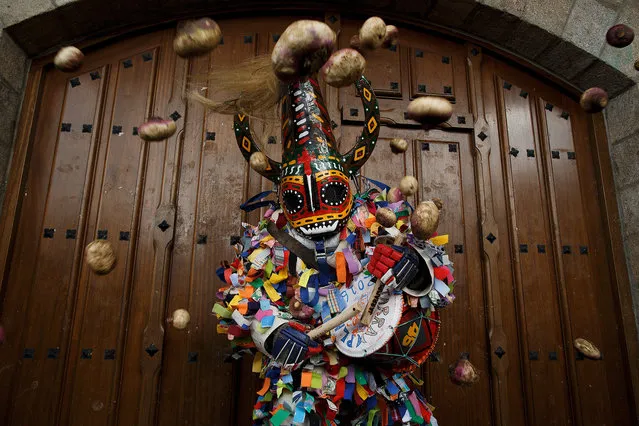
People throw turnips at the Jarramplas as he comes out from the church beating his drum during the Jarramplas Festival on January 20, 2016 in Piornal, Caceres province, Spain. The centuries old Jarramplas festival takes place annually every January 19-20 on Saint Sebastian Day and this year they expect to use more than 20 thousand kilogrames of turnips. Even though the exact origins of the festival are not known, various theories exist including the mythological punishment of Caco by Hercules. (Photo by Pablo Blazquez Dominguez/Getty Images)

People throw turnips at the Jarramplas as he comes out from the church beating his drum during the Jarramplas Festival on January 20, 2016 in Piornal, Caceres province, Spain. The centuries old Jarramplas festival takes place annually every January 19-20 on Saint Sebastian Day and this year they expect to use more than 20 thousand kilogrames of turnips. Even though the exact origins of the festival are not known, various theories exist including the mythological punishment of Caco by Hercules, a relation to ceremonies celebrated by the American Indians that were seen by the first conquerors, to a cattle thief ridiculed and expelled by his village neighbours. It is generally believed to symbolize the expulsion of everything bad. (Photo by Pablo Blazquez Dominguez/Getty Images)
Details
21 Jan 2016 13:21:00
Nature – first prize, stories. Pandemic Pigeons – A Love Story. The photographer’s daughter, Merel, cowers after Dollie flies past and perches on the balcony before entering the house in Vlaardingen in the Netherlands on 6 April 2020. “She’s still frightened when Dollie suddenly lands on the balcony railing. I hide my smile behind the camera, as I try to comfort her by saying they won’t hurt you. “I thought he was going to attack me”, she replies. As the nesting pigeons keep coming back to our place, slowly my girls have started to appreciate them – perhaps not as much as I do, but it’s a start”. (Photo by Jasper Doest/World Press Photo 2021)

Nature – first prize, stories. Pandemic Pigeons – A Love Story. The photographer’s daughter, Merel, cowers after Dollie flies past and perches on the balcony before entering the house in Vlaardingen in the Netherlands on 6 April 2020. “She’s still frightened when Dollie suddenly lands on the balcony railing. I hide my smile behind the camera, as I try to comfort her by saying they won’t hurt you. “I thought he was going to attack me”, she replies. As the nesting pigeons keep coming back to our place, slowly my girls have started to appreciate them – perhaps not as much as I do, but it’s a start”. (Photo by Jasper Doest/World Press Photo 2021)
Details
17 Apr 2021 09:30:00