Loading...
Done
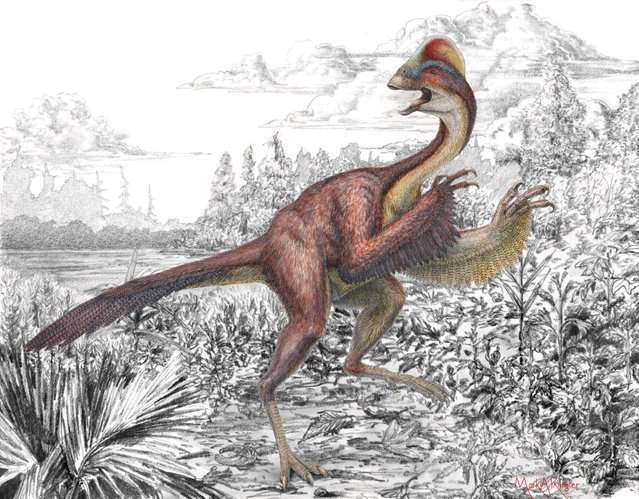
Life reconstruction of the new oviraptorosaurian dinosaur species Anzu wyliei in its 66 million-year-old environment in western North America as seen in an undated handout illustration by Mark A. Klinger, Carnegie Museum of Natural History. Some 18,000 species, great and small, were discovered in 2014, adding to the 2 million already known, scientists said on May 21, 2015 as they released a “Top 10” list that highlights the diversity of life. (Photo by Mark A. Klingler/Reuters/Carnegie Museum of Natural History)

Life reconstruction of the new oviraptorosaurian dinosaur species Anzu wyliei in its 66 million-year-old environment in western North America as seen in an undated handout illustration by Mark A. Klinger, Carnegie Museum of Natural History. Some 18,000 species, great and small, were discovered in 2014, adding to the 2 million already known, scientists said on May 21, 2015 as they released a “Top 10” list that highlights the diversity of life. Anzu wyliei, one of the top 10, dubbed “the chicken from hell”, is extinct. The feathered dinosaur whose partial skeletons were unearthed in the Dakotas was a contemporary of T. rex and Triceratops. (Photo by Mark A. Klingler/Reuters/Carnegie Museum of Natural History)
Details
22 May 2015 12:31:00
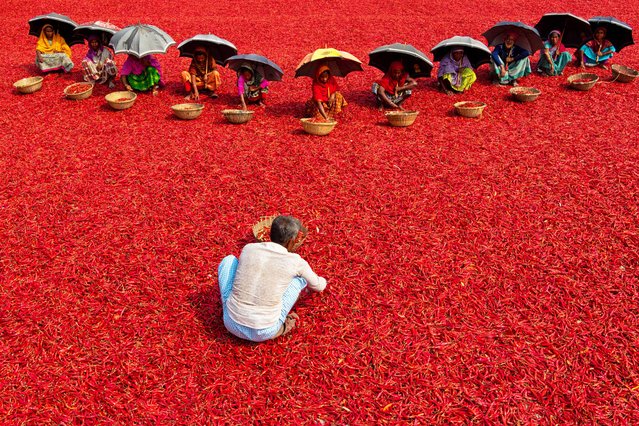
Rows of workers shelter under umbrellas from the scorching heat as they painstakingly sort through a red carpet of millions of chilli peppers in Bogra, Bangladesh on October 3, 2023. They sort the rotten and broken chilli peppers out to separate the poor quality ones which won't sell. In a line, the pickers who are paid less than £3 for a 10-hour shift slowly move forward with their baskets to separate the bad from the good after the chilies have been dried in the sun for a week. The dried & sorted chillies are then packaged and taken to the local market where they are brought mainly by companies to be made into chilli powder. The workers sort them in a warm environment, with temperatures reaching up to 45°C. More than 5,000 people work in almost 100 chilli farms in the Bogra district of Bangladesh to supply local spice companies with chillies for their recipes. Known as “Lal Morich” to the locals, chilli peppers are a major part of Bengali cuisine and are used as part of a combination of spices for various meat dishes, including chicken and beef. (Photo by Joy Saha/Rex Features/Shutterstock)

Rows of workers shelter under umbrellas from the scorching heat as they painstakingly sort through a red carpet of millions of chilli peppers in Bogra, Bangladesh on October 3, 2023. They sort the rotten and broken chilli peppers out to separate the poor quality ones which won't sell. In a line, the pickers who are paid less than £3 for a 10-hour shift slowly move forward with their baskets to separate the bad from the good after the chilies have been dried in the sun for a week. (Photo by Joy Saha/Rex Features/Shutterstock)
Details
21 Oct 2023 04:04:00
A performer wearing a lion mask performs the Ise Daikagura lion dance at the remote village of Yamanawa on February 08, 2021 in Ryuo, Japan. Ise Daikagura is a group of traditional Lion Dance performers who pray in front of farmers houses and businesses for good grain harvests and disease-free lives. Performers play sacred music using drums and flutes with two lion mask dancers. A lion mask is considered a symbol of God, who enters the house and performs in front of the Shinto God, a statue placed inside the house, mostly in the kitchen. These prayers are called “Kamodo Barai”. After the prayers, they are gifted with money, rice, sake and Japanese sweets from the householders. A group can travel for more than one hundred days to thousands of households and businesses throughout rural-villages in western Japan, and pray to those who are unable to visit the country’s most sacred shrine, the Grand Ise Shrine in Mie Prefecture. The group started its performance in the Edo era between 1603 to 1868 according to Japanese history. The Japanese government designated it as an important folk cultural national property in 1981. (Photo by Buddhika Weerasinghe/Getty Images)

A performer wearing a lion mask performs the Ise Daikagura lion dance at the remote village of Yamanawa on February 08, 2021 in Ryuo, Japan. Ise Daikagura is a group of traditional Lion Dance performers who pray in front of farmers houses and businesses for good grain harvests and disease-free lives. (Photo by Buddhika Weerasinghe/Getty Images)
Details
18 Feb 2021 09:27:00
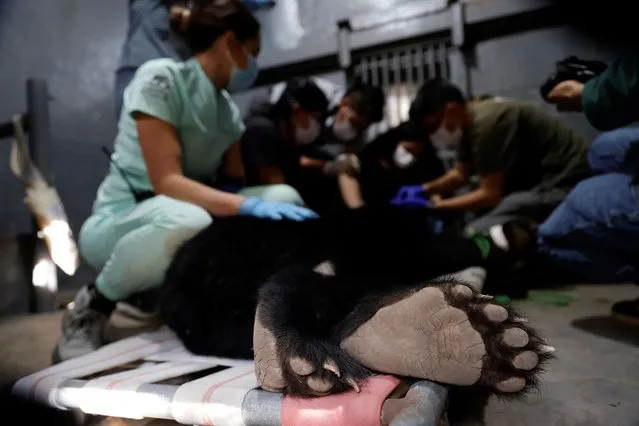
Veterinarians and biologists from the Quito Zoo and the Andean Condor Foundation fit a tracking collar that juvenile Andean bear Tupak will wear for the next four years, prior to his reintroduction into the wild, after the bear's life was deemed in danger due to proximity to humans, in Quito, Ecuador on March 31, 2024. (Photo by Karen Toro/Reuters)

Veterinarians and biologists from the Quito Zoo and the Andean Condor Foundation fit a tracking collar that juvenile Andean bear Tupak will wear for the next four years, prior to his reintroduction into the wild, after the bear's life was deemed in danger due to proximity to humans, in Quito, Ecuador on March 31, 2024. (Photo by Karen Toro/Reuters)
Details
07 Apr 2024 02:58:00
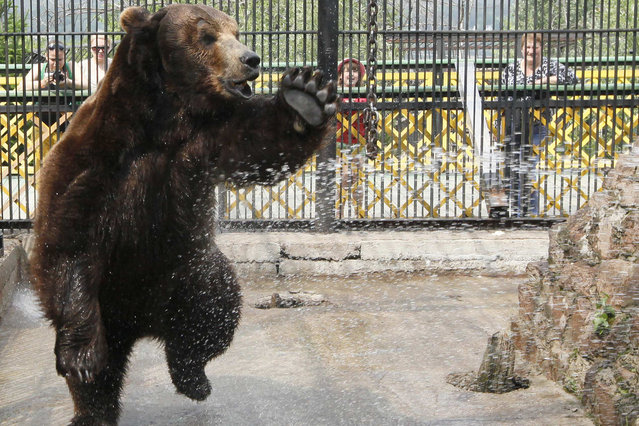
Buyan, a male Siberian brown bear, is given a shower by a zoo employee in his enclosure at the Royev Ruchey zoo in Russia's Siberian city of Krasnoyarsk June 24, 2014. The Siberian city has been experiencing temperatures of around 30 degrees Celsius over the last week. (Photo by Ilya Naymushin/Reuters)

Buyan, a male Siberian brown bear, is given a shower by a zoo employee in his enclosure at the Royev Ruchey zoo in Russia's Siberian city of Krasnoyarsk June 24, 2014. The Siberian city has been experiencing temperatures of around 30 degrees Celsius over the last week. (Photo by Ilya Naymushin/Reuters)
Details
28 Jun 2014 14:01:00
Kawakanih Yawalapiti, 9, Upper Xingu region of Mato Grosso, Brazil, 2018: Kawakanih lives with her tribe, the Yawalapiti, in Xingu national park, a preserve in the Amazon basin of Brazil. The Yawalapiti collect seeds to preserve species unique to their ecosystem, which lies between the rain forest and savannah. Kawakanih’s diet is simple, consisting mainly of fish, cassava, porridge, fruit and nuts. “It takes five minutes to catch dinner”, says Kawakanih. “When you’re hungry, you just go to the river with your net”. (Photo by Gregg Segal/The Guardian)

Photographer Gregg Segal travelled the world to document children and the food they eat in a week. Partly inspired by the increasing problems of childhood obesity, he tracked traditional regional diets as yet unaffected by globalisation, and ironically, found that the healthiest diets were often eaten by the least well off. (Photo by Gregg Segal/The Guardian)
Details
03 Jul 2019 00:03:00
Nick Franklin, in action during the FMX competition at the 23rd edition of Free4Style this Saturday, July 2, 2016 in Estavayer-le-Lac,Switzerland. (Photo by Jean-Christophe Bott/Keystone/APA)

Nick Franklin, in action during the FMX competition at the 23rd edition of Free4Style this Saturday, July 2, 2016 in Estavayer-le-Lac,Switzerland. (Photo by Jean-Christophe Bott/Keystone/APA)
Details
04 Jul 2016 08:50:00
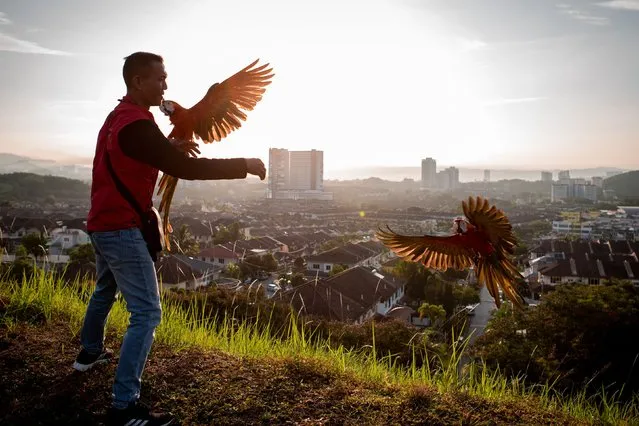
A parrot breeder and his parrots are seen at the Damai Perdana hill in the Cheras region ahead of the May 31 World Parrot Day in Kuala Lumpur, Malaysia on May 29, 2022. A group of parrot breeders in the capital Kuala Lumpur performed a “free flight” performance with different species of parrots. (Photo by Syaiful Redzuan/Anadolu Agency via Getty Images)

A parrot breeder and his parrots are seen at the Damai Perdana hill in the Cheras region ahead of the May 31 World Parrot Day in Kuala Lumpur, Malaysia on May 29, 2022. A group of parrot breeders in the capital Kuala Lumpur performed a “free flight” performance with different species of parrots. (Photo by Syaiful Redzuan/Anadolu Agency via Getty Images)
Details
23 Jul 2022 05:01:00