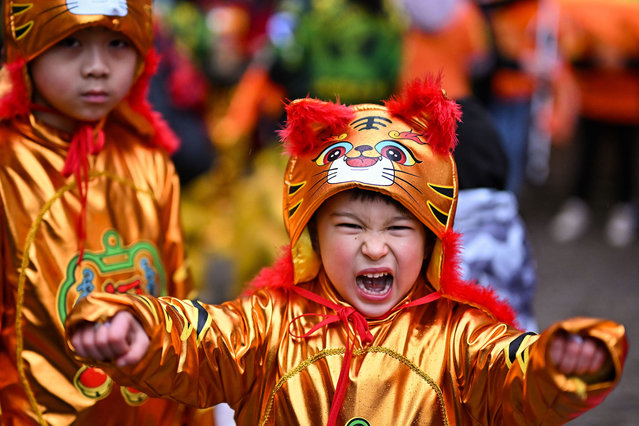
Members of the Scottish Chinese community take part in Edinburgh Chinese New Year Festival on January 30, 2022 in Edinburgh, Scotland. 2022 marks the Chinese Year of the Tiger, Chinese New Year in Edinburgh has become one of the largest celebrations of its kind in Scotland. (Photo by Jeff J. Mitchell/Getty Images)
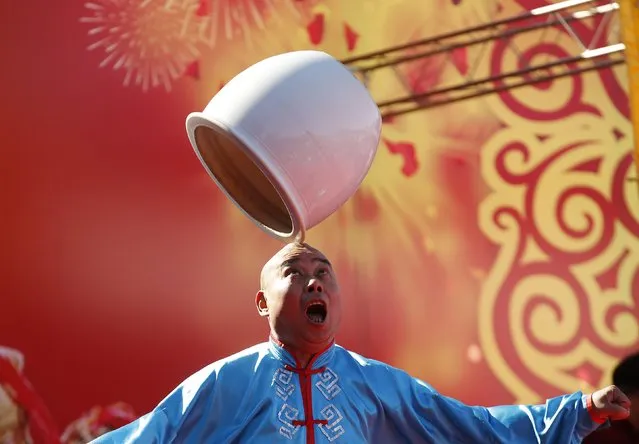
A performer takes part in the opening of the Temple Fair, part of Chinese New Year celebrations at Ditan Park, also known as the Temple of Earth, in Beijing, February 18, 2015. (Photo by Kim Kyung-Hoon/Reuters)
A dog poses in traditional Chinese dress on Yaowarat Road in Chinatown on the eve of Lunar New Year on January 20, 2023 in Bangkok, Thailand. The Chinese diaspora of Southeast Asia is celebrating a lively Lunar New Year as COVID-19 restrictions have been removed. It is traditionally a time for people to meet their relatives and take part in celebrations with families. In Thailand, which has a sizeable population of Chinese lineage, people gather with family and celebrate with feasts and visits to temples. (Photo by Lauren DeCicca/Getty Images)
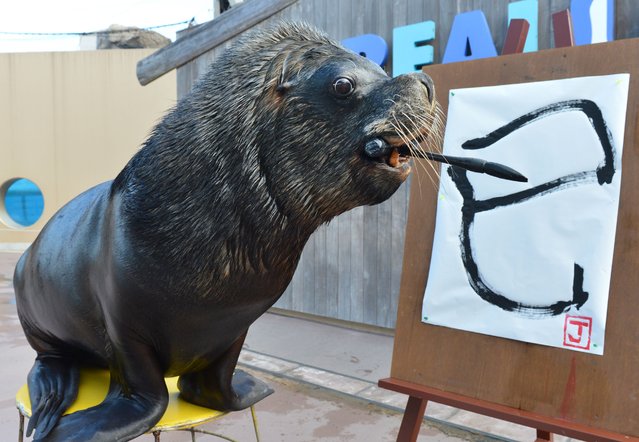
Sea lion “Jay” paints a Chinese character reading “the Serpent” at the Hakkeijima Sea Paradise aquarium in Yokohama, suburban Tokyo on January 3, 2013. The event, marking the forthcoming Chinese lunar calender year of the snake was held as part of a New Year's attraction. (Photo by Kazuhiro Nogi/AFP Photo)
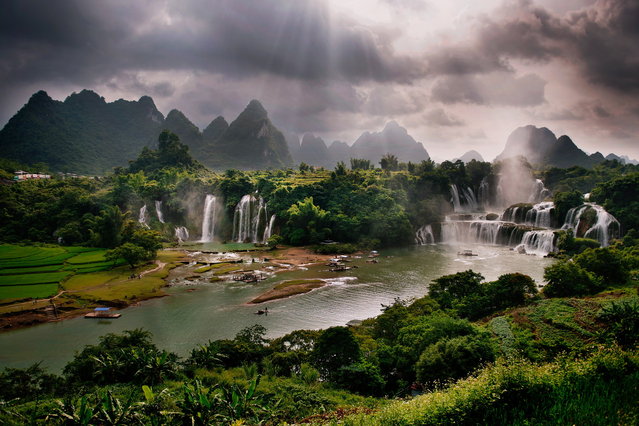
Ban Gioc – Detian Falls are two waterfalls on the Quây Sơn River, in Chinese Guichun River, straddling the Sino-Vietnamese border, located in the Karst hills of Daxin County, Guangxi (Chinese side), and in Trùng Khánh District, Cao Bằng province on the Vietnamese side, 272 km (169 mi) north of Hanoi. In Vietnamese, the two falls are considered as two parts of one waterfall with the sole name Bản Giốc. The two parts are called as: thác chính (Main waterfall) and thác phụ (Subordinate waterfall). Chinese texts sometimes name both falls from the Détiān falls on the Chinese side. During the summer rains the two waterfalls may join together.