Loading...
Done


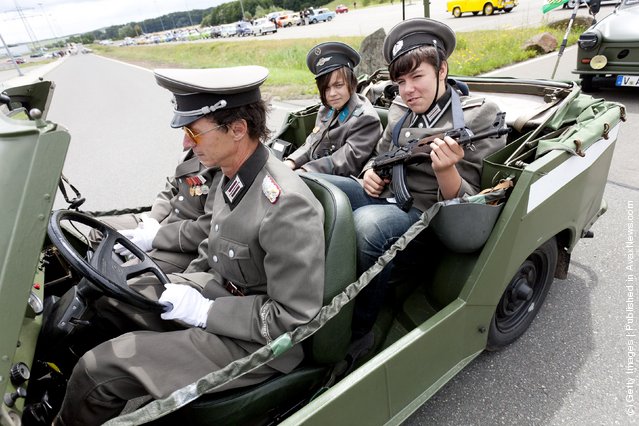
“The Trabant is a car that was produced by former East German auto maker VEB Sachsenring Automobilwerke Zwickau in Zwickau, Sachsen. It was the most common vehicle in East Germany, and was also exported to countries both inside and outside the communist bloc. The main selling points was that it had room for four adults and luggage in a compact, light and durable shell and that it was fast (when introduced) and durable. With its mediocre performance, smoky two-stroke engine, and production shortages, the Trabant is often cited as an example of the disadvantages of centralized planning; on the other hand, it is regarded with derisive affection as a symbol of the failed former East Germany and of the fall of communism (in former West Germany, as many East Germans streamed into West Berlin and West Germany in their Trabants after the opening of the Berlin Wall in 1989). It was in production without any significant changes for nearly 30 years with 3,096,099 Trabants produced in total”. – Wikipedia

Photo: Enthusiasts weared in uniforms of the former eastern german army trive in a military Trabant car as fans and owners of East German-era Trabant cars gather at the 2011 International Trabantfahrer Treffen (International Trabant Drivers Meeting) on June 26, 2011 in Zwickau, Germany. The Trabant, also known as the Trabi, was among the main cars produced in communist East Germany and built by VEB Sachsenring Automobilwerke in Zwickau for 30 years until 1989. Today the car has cult status for many followers and one company, IndiKar, is even seeking to revive the brand in a modern, electric version. (Photo by Carsten Koall/Getty Images)
Details
27 Jun 2011 12:21:00
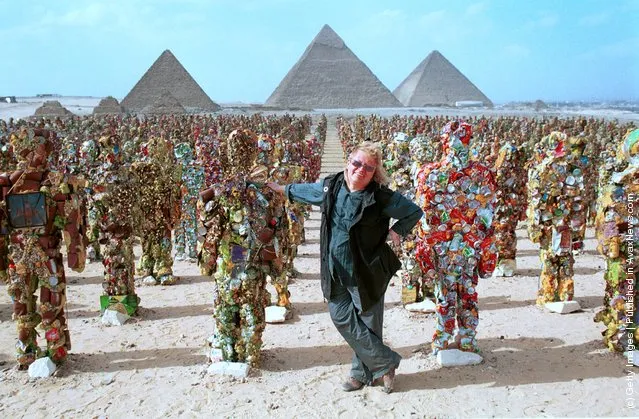
German artist Ha Schult stands with his trash people below the pyramids May 15, 2002 in Giza, Egypt

“HA Schult, born Hans-Jürgen Schult on June 24, 1939 in Parchim, Mecklenburg is a German installation, happening and conceptual artist known primarily for his object and performance art and more specifically his work with garbage”. – Wikipedia

Photo: German artist Ha Schult stands with his “trash people” below the pyramids May 15, 2002 in Giza, Egypt. Inspired by the statues of the terracotta army of Chinese Emperor Quin Shi Huangdi (247–206 B.C.), the thousand piece sulpture has stood in Red Square in Moscow, La Defense in Paris and the Great Wall in China. Schult, born in 1939 wants to bring the “trash war” to the world's attention beause trash is the greatest battle facing mankind. (Photo by Norbert Schiller/Getty Images)
Details
31 Jul 2011 13:37:00
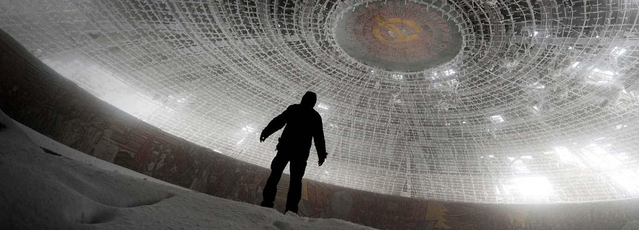
Monument of Buzludja

Buzludzha is a historical peak in the Central Stara Planina, Bulgaria and is 1441 metres high. In 1868 it was the place of the final battle between Bulgarian rebels led by Hadji Dimitar and Stefan Karadzha and the Ottoman Empire. The Buzludzha Monument on the peak was built by the Bulgarian communist regime to commemorate the events in 1891 when the socialists led by Dimitar Blagoev assembled secretly in the area to form an organised socialist movement with the founding of the Bulgarian Social Democratic Party, a fore-runner of the Bulgarian Communist Party. The Monument was opened in 1981. No longer maintained by the Bulgarian government, it has fallen into disuse. Buzludzha is reached by a 12 km side road from the Shipka Pass.
Details
12 Nov 2013 08:16:00
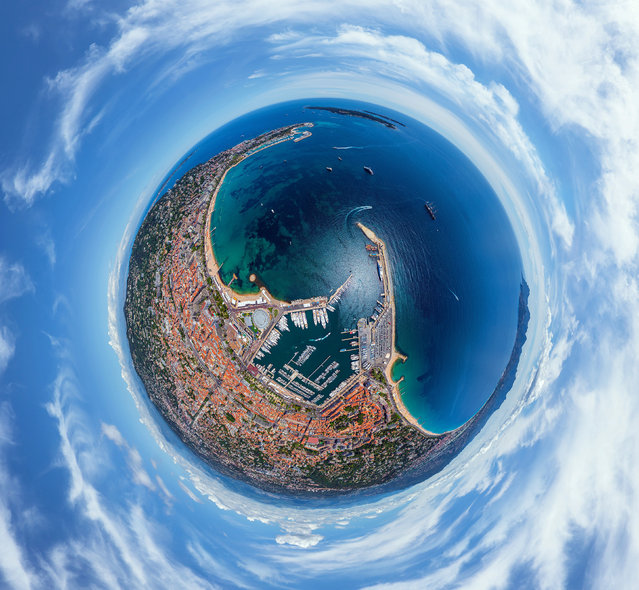
The French Riveria of Cannes, France. (Photo by Airpano/Caters News)

Some of the worlds most iconic cities have been photographed as youve never seen them before in the shape of tiny round planets. By using a pioneering method of aerial photography, each location can be now seen at a full 360 degree angle. After some skilful manipulation on Photoshop known technically as stereographic projection, each sweeping panorama is then turned into a small circular shaped image. Whether its the Eiffel Tower, The Empire State Building or the Shanghai Skyline, each image manages to show hundreds of miles of city landscape. Here: the French Riveria of Cannes, France. (Photo by Airpano/Caters News)
Details
25 Mar 2015 12:14:00


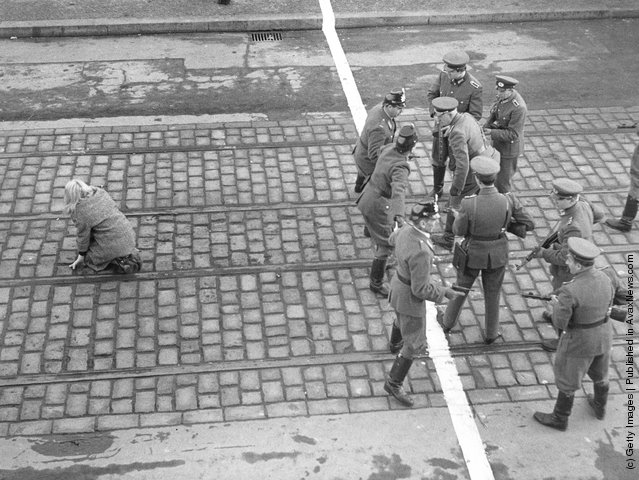
“The Berlin Wall (German: Berliner Mauer) was a barrier constructed by the German Democratic Republic (GDR, East Germany) starting on 13 August 1961, that completely cut off West Berlin from surrounding East Germany and from East Berlin. The barrier included guard towers placed along large concrete walls, which circumscribed a wide area (later known as the “death strip”) that contained anti-vehicle trenches, “fakir beds” and other defenses. The Soviet-dominated Eastern Bloc officially claimed that the wall was erected to protect its population from fascist elements conspiring to prevent the “will of the people” in building a socialist state in East Germany. However, in practice, the Wall served to prevent the massive emigration and defection that marked Germany and the communist Eastern Bloc during the post-World War II period”. – Wikipedia

Photo: West Berlin policemen and East German Volkspolizei face each other across the border in Berlin, circa 1955. (Photo by Three Lions/Hulton Archive/Getty Images)
Details
22 May 2011 10:49:00


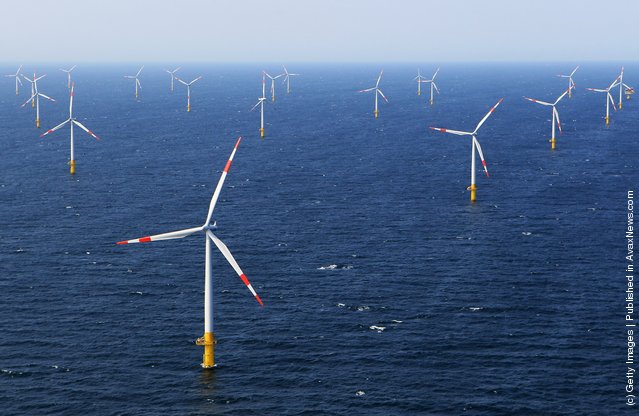
Wind turbines stand in the Baltic 1 offshore wind farm on April 29, 2011 in the Baltic Sea near Zingst, Germany. Baltic 1, a project of German energy utility EnBW that includes 21 turbines rated at 2.3 megawatts each, will be Germany's first commercial offshore wind farm once it officially begins operation on May 2. Germany has thus far lagged in offshore wind farm construction when compared to neighbors like Great Britain and Denmark, though German Chancellor Angela Merkel has vowed to invest heavily into offshore wind farms as part of an overall policy to encourage renewable energy production. (Photo by Joern Pollex/Getty Images)
Details
30 Apr 2011 12:54:00
Unstrut Valley high-speed railway bridge near Karsdorf, Germany

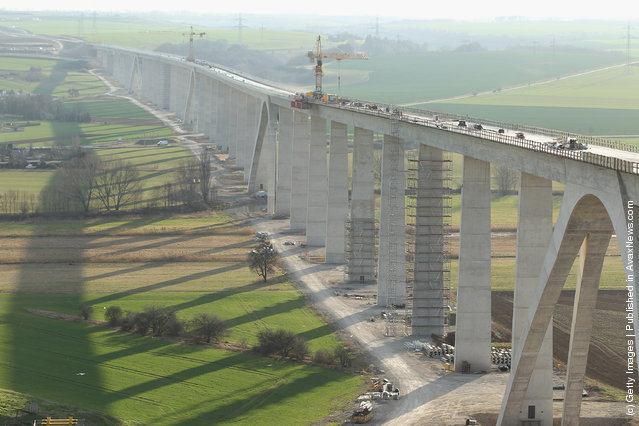
Construction cranes stand on the Unstrut Valley high-speed railway bridge on March 19, 2012 near Karsdorf, Germany. The Unstrut bridge, which is 2,668m long (about 1.6 miles), is among 38 bridges and 26 tunnels German state rail carrier Deutsche Bahn is building along a new ICE high-speed railroad connection between Nuremberg, Erfurt, Halle, Leipzig and Berlin in a multi-billion Euro project across eastern Germany called the German Unity Transportation Project (Verkehrsprojekt der Deutschen Einheit). (Photo by Sean Gallup/Getty Images)
Details
22 Mar 2012 10:53:00
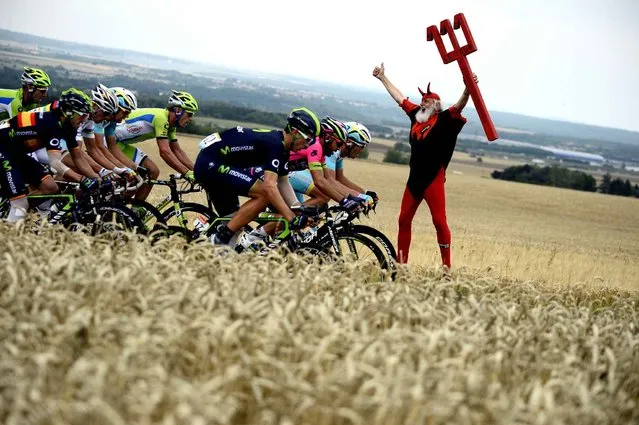
German fan Didi Senft known as El Diablo cheers as the pack rides past during the 234.5 km seventh stage of the 101st edition of the Tour de France cycling race on July 11, 2014 between Epernay and Nancy, northeastern France. (Photo by Lionel Bonaventure/AFP Photo)

German fan Didi Senft known as El Diablo cheers as the pack rides past during the 234.5 km seventh stage of the 101st edition of the Tour de France cycling race on July 11, 2014 between Epernay and Nancy, northeastern France. (Photo by Lionel Bonaventure/AFP Photo)
Details
20 Jul 2014 11:07:00