Loading...
Done
Nightjars And Pooto Bird

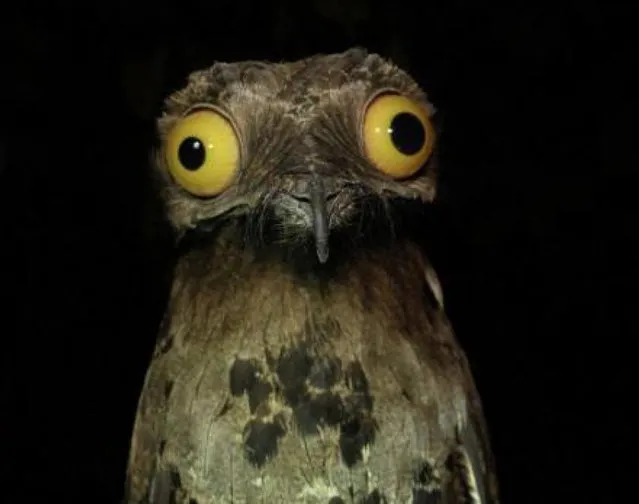
Potoos (family Nyctibiidae) are a group of near passerine birds related to the nightjars and frogmouths. They are sometimes called Poor-me-ones, after their haunting calls. There are seven species in one genus, Nyctibius, in tropical Central and South America.
These are nocturnal insectivores which lack the bristles around the mouth found in the true nightjars. They hunt from a perch like a shrike or flycatcher. During the day they perch upright on tree stumps, camouflaged to look like part of the stump. The single spotted egg is laid directly on the top of a stump.
Details
20 Jan 2014 14:34:00
In this May 24, 2017, photo, DriveTanks.com customers drive on a tank course at Ox Ranch  in Uvalde, Texas. (Photo by Michael Ciaglo/Houston Chronicle via AP Photo)

In this May 24, 2017, photo, DriveTanks.com customers drive on a tank course at Ox Ranch in Uvalde, Texas. The ranch is a free-roaming range filled with exotic animals, some to hunt, and home to DriveTanks.com, where tourists pay to transport themselves into another era and another life. (Photo by Michael Ciaglo/Houston Chronicle via AP Photo)
Details
09 Jun 2017 06:28:00
Stainless Steel Sculptures By Kevin Stone

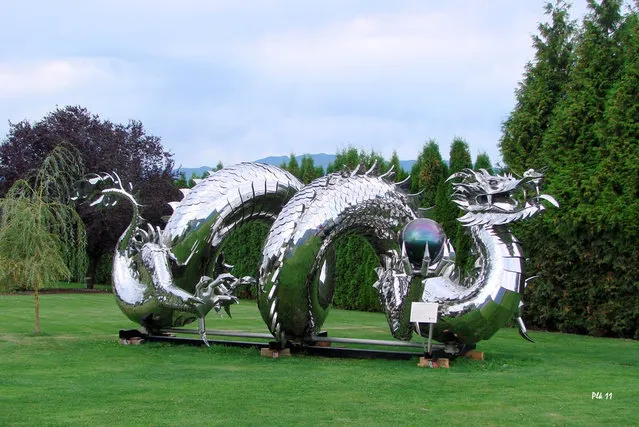
Chilliwack, British Columbia-based Kevin Stone specializes in creating gargantuan, one-of-a-kind stainless steel sculptures. His towering bald eagle, called "Power and Authority," stands an astounding 20 ft high and has a massive 31 ft wingspan. He also completed an 85 feet long mirror polished stainless steel sculpture, the "Imperial Water Dragon." For almost two years, working seven days a week, he designed and created this 6000 lb, 12 ft high, 14 ft wide and 35 ft long dragon with two massive coils. It was made for River Rock Casino Resort in Richmond to celebrate the Year of the Dragon.
Details
20 Mar 2014 14:34:00
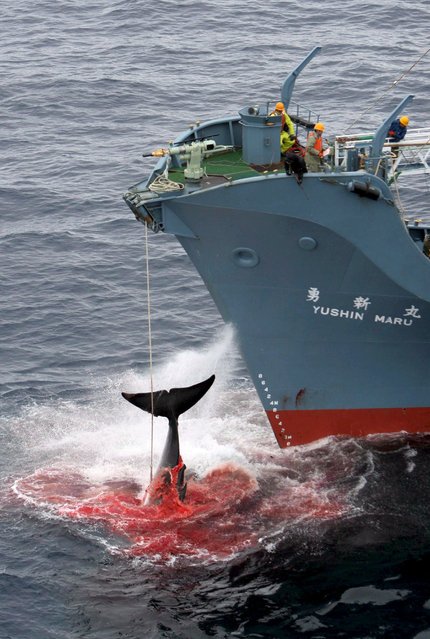
A file photograph dated 07 January 2006 and released by Greenpeace, showing the Yushin Maru, a factory ship in a Japanese whaling fleet, injuring a whale with it's first harpoon attempt. A UN court in The Hague on 31 March 2014 halted Japan's much-criticized whaling programme, ruling that it contravenes a 1986 moratorium on whale hunting. Japan must end its 'research whaling' programme, the International Court of Justice (ICJ) said. (Photo by Kate Davison/EPA)

A file photograph dated 07 January 2006 and released by Greenpeace, showing the Yushin Maru, a factory ship in a Japanese whaling fleet, injuring a whale with it's first harpoon attempt. A UN court in The Hague on 31 March 2014 halted Japan's much-criticized whaling programme, ruling that it contravenes a 1986 moratorium on whale hunting. Japan must end its 'research whaling' programme, the International Court of Justice (ICJ) said. Japan said the programme was for scientific research and permitted under international conventions. Australia had brought the case to the ICJ in 2010, charging that Japan was breaching international law by killing hundreds of whales every year for commercial purposes. Japan was “deeply disappointed” by the ruling, an unnamed government official was quoted by the Kyodo News agency as saying. But the official said Japan would stand by the ruling. (Photo by Kate Davison/EPA)
Details
01 Apr 2014 08:38:00
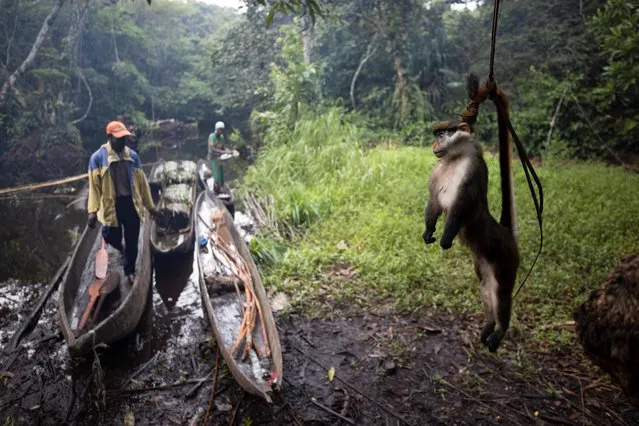
A dead red-tailed monkey hangs by its tail above the ground, in order to keep it away from ants, in the forest near the city of Mbandaka, Democratic Republic of the Congo, April 5, 2019. Bushmeat hunters are emptying Central Africa's forests at a high rate, researchers say. A growing appetite for wild meat in cities has ramped up the scale of hunting. Research shows around 6 million tonnes of bushmeat are sourced annually from the Congo Basin, whose forest spans across six countries and is second in size only to the Amazon. (Photo by Thomas Nicolon/Reuters)

A dead red-tailed monkey hangs by its tail above the ground, in order to keep it away from ants, in the forest near the city of Mbandaka, Democratic Republic of the Congo, April 5, 2019. Bushmeat hunters are emptying Central Africa's forests at a high rate, researchers say. A growing appetite for wild meat in cities has ramped up the scale of hunting. Research shows around 6 million tonnes of bushmeat are sourced annually from the Congo Basin, whose forest spans across six countries and is second in size only to the Amazon. (Photo by Thomas Nicolon/Reuters)
Details
14 Oct 2019 00:03:00
The newest Victoria's Secret “Angels” models pose for photographers in New York's Times Square during the launch of the new “Body by Victoria” campaign July 28, 2015. From L-R front row are Elsa Hosk, Martha Hunt, Sara Sampaio, Jasmine Tookes and Stella Maxwell. From L-R back row are Kate Grigorieva, Taylor Hill, Rommee Strijd, Jac Jagaciak and Lais Ribeiro. (Photo by Mike Segar/Reuters)

The newest Victoria's Secret “Angels” models pose for photographers in New York's Times Square during the launch of the new “Body by Victoria” campaign July 28, 2015. From L-R front row are Elsa Hosk, Martha Hunt, Sara Sampaio, Jasmine Tookes and Stella Maxwell. From L-R back row are Kate Grigorieva, Taylor Hill, Rommee Strijd, Jac Jagaciak and Lais Ribeiro. (Photo by Mike Segar/Reuters)
Details
29 Jul 2015 11:23:00
“A Snail's Life”. Photographer Vyacheslav Mischenko captures gorgeous macro photographs of snails near his hometown of Berdichev, Ukraine. After being taught to hunt for mushrooms as a child, Vyacheslav has grown up with a keen eye for spotting critters on the forest floor. Here, a snail takes shelter while perching on a leaf. (Photo by Vyacheslav Mischenko/Caters News)

“A Snail's Life”. Photographer Vyacheslav Mischenko captures gorgeous macro photographs of snails near his hometown of Berdichev, Ukraine. After being taught to hunt for mushrooms as a child, Vyacheslav has grown up with a keen eye for spotting critters on the forest floor. Here, a snail takes shelter while perching on a leaf. (Photo by Vyacheslav Mischenko/Caters News)
Details
21 Apr 2014 09:53:00
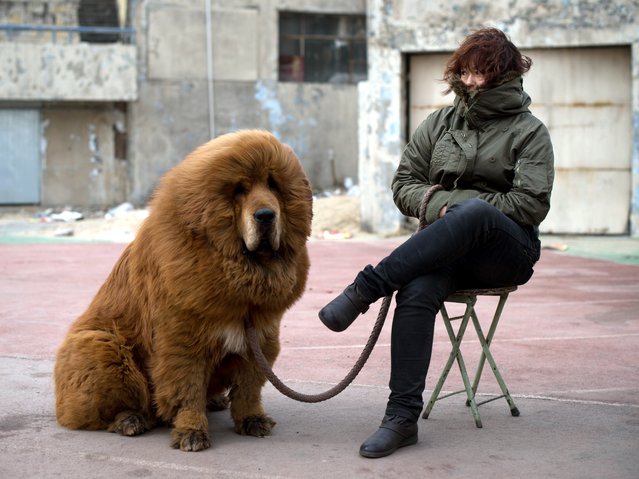
A Tibetan mastiff dog is displayed for sale at a mastiff show in Baoding, Hebei province, south of Beijing on March 9, 2013. Fetching prices up to around 750,000 USD, mastiffs have become a prized status-symbol amongst China's wealthy, with rich buyers across the country sending prices skyrocketing. Owners say the mastiffs, descendents of dogs used for hunting by nomadic tribes in central Asia and Tibet are fiercely loyal and protective. (Photo by Ed Jones/AFP Photo)

A Tibetan mastiff dog is displayed for sale at a mastiff show in Baoding, Hebei province, south of Beijing on March 9, 2013. Fetching prices up to around 750,000 USD, mastiffs have become a prized status-symbol amongst China's wealthy, with rich buyers across the country sending prices skyrocketing. Owners say the mastiffs, descendents of dogs used for hunting by nomadic tribes in central Asia and Tibet are fiercely loyal and protective. Breeders still travel to the Himalayan plateau to collect young puppies, although many are unable to adjust to the low altitudes and die during the journey. (Photo by Ed Jones/AFP Photo)
Details
02 May 2014 09:40:00