Loading...
Done
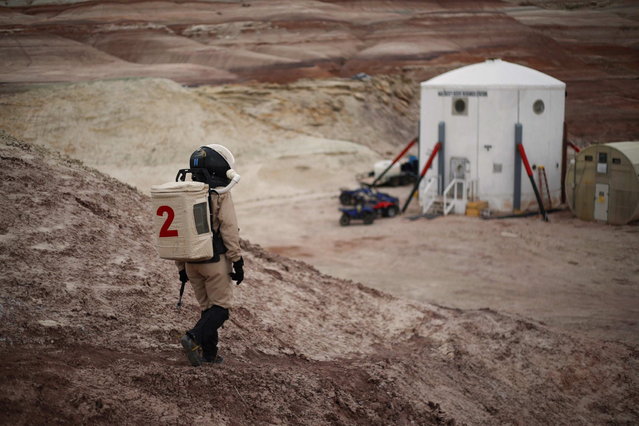
Csilla Orgel, a geologist of Crew 125 EuroMoonMars B mission, makes her way back to the Mars Desert Research Station (MDRS) in the Utah desert March 3, 2013. (Photo by Jim Urquhart/Reuters)

NASA says it could be another 20 years before humans touch down on Mars, but in a sense, the Mars Society has been exploring the red planet for more than a decade – in Utah. Photo: Csilla Orgel, a geologist of Crew 125 EuroMoonMars B mission, makes her way back to the Mars Desert Research Station (MDRS) in the Utah desert March 3, 2013. The MDRS aims to investigate the feasibility of a human exploration of Mars and uses the Utah desert's Mars-like terrain to simulate working conditions on the red planet. Scientists, students and enthusiasts work together developing field tactics and studying the terrain. All outdoor exploration is done wearing simulated spacesuits and carrying air supply packs and crews live together in a small communication base with limited amounts of electricity, food, oxygen and water. Everything needed to survive must be produced, fixed and replaced on site. (Photo by Jim Urquhart/Reuters)
Details
14 Mar 2013 12:11:00
No food after midnight

No food after midnight. (Photo by Patrick Hayes)
Details
18 Aug 2012 12:11:00
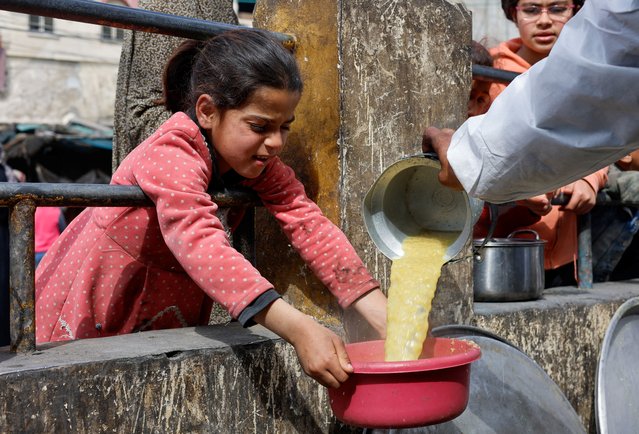
A Palestinian child receives food cooked by a charity kitchen amid shortages of food supplies in Rafah, in the southern Gaza Strip on February 20, 2024. (Photo by Mohammed Salem/Reuters)

A Palestinian child receives food cooked by a charity kitchen amid shortages of food supplies in Rafah, in the southern Gaza Strip on February 20, 2024. (Photo by Mohammed Salem/Reuters)
Details
04 Mar 2024 07:55:00
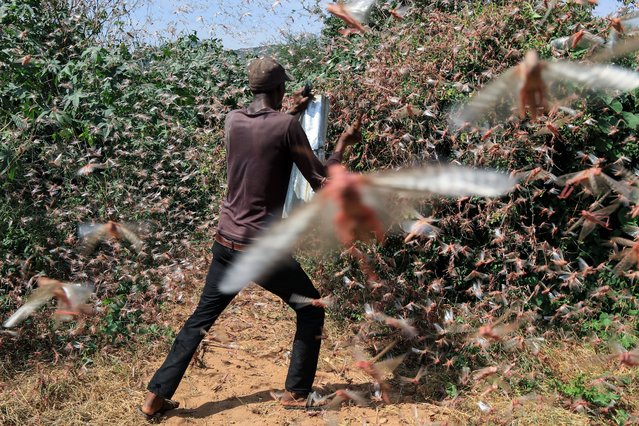
A man uses iron sheet to make noises, as a way of trying to disperse desert locusts that had invaded their farms during the second wave invasion in Kakongo village, in Nuu-Mwingi East, in Kitui, Kenya, 06 February 2021. The second wave invasion of the desert locusts in the country comes at a time where most famers are expecting to harvest their farm produce in the country. According to the United Nations Food and Agriculture Organization (FAO), on 04 February, warned numerous immature desert locust swarms persist in southern Ethiopia and Kenya. Some of the swarms are in community areas and therefore cannot be treated. In Kenya, immature swarms continue to spread westwards across northern and central counties where there are currently about 20 small swarms present, mostly about 50 hectares in size, it said. (Photo by Daniel Irungu/EPA/EFE)

A man uses iron sheet to make noises, as a way of trying to disperse desert locusts that had invaded their farms during the second wave invasion in Kakongo village, in Nuu-Mwingi East, in Kitui, Kenya, 06 February 2021. The second wave invasion of the desert locusts in the country comes at a time where most famers are expecting to harvest their farm produce in the country. (Photo by Daniel Irungu/EPA/EFE)
Details
25 Feb 2021 08:17:00
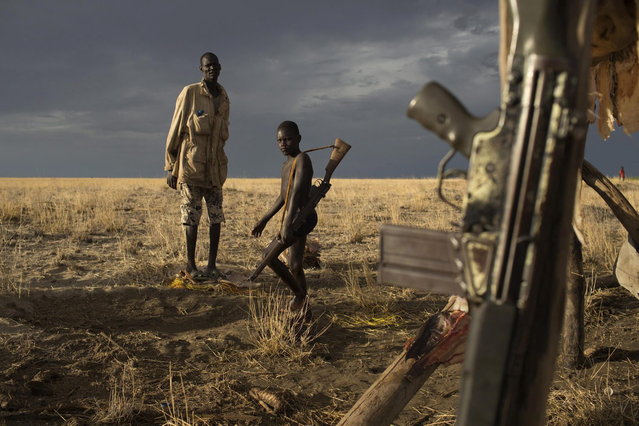
A Turkana man and a boy carrying a gun look on as a G3 battle rifle hangs from a structure used to dry fish at a fishing camp on the shores of Lake Turkana, some kilometres from Todonyang near the Kenya-Ethiopia border in northwestern Kenya October 12, 2013. (Photo by Siegfried Modola/Reuters)

A Turkana man and a boy carrying a gun look on as a G3 battle rifle hangs from a structure used to dry fish at a fishing camp on the shores of Lake Turkana, some kilometres from Todonyang near the Kenya-Ethiopia border in northwestern Kenya October 12, 2013The Turkana are traditionally nomadic pastoralists, but they have seen the pasture that they need to feed their herds suffer from recurring droughts and many have turned to fishing. However, Lake Turkana is overfished, and scarcity of food and pastureland is fuelling long-standing conflict with Ethiopian indigenous Dhaasanac, who have seen grazing grounds squeezed by large-scale government agricultural schemes in southern Ethiopia. The Dhaasanac now venture ever deeper into Kenyan territory in search of fish and grass, clashing with neighbours. Fighting between the communities has a long history, but the conflict has become ever more fatal as automatic weapons from other regional conflicts seep into the area. While the Turkana region is short of basics like grass and ground-water, it contains other resources including oil reserves and massive, newly discovered underground aquifers. (Photo by Siegfried Modola/Reuters)
Details
05 Dec 2013 12:08:00
Robot couple Xiaolan (L) and Xiaotao carry trays of food at a restaurant in Jinhua, Zhejiang province, China, May 18, 2015. (Photo by Reuters/Stringer)

Robot couple Xiaolan (L) and Xiaotao carry trays of food at a restaurant in Jinhua, Zhejiang province, China, May 18, 2015. The restaurant, which opened on Monday, has two robots delivering food for customers. The robots were designed as a couple, Xiaolan and Xiaotao, according to local media. (Photo by Reuters/Stringer)
Details
23 May 2015 10:58:00
Things Cut in Half

HalfPics is a Twitter feed pointing to things cut in half like a bowl of ramen, a Mini Cooper, and toothpaste. Their tagline: “Ever wonder what stuff looks like when it’s cut in half?” Yes. We previously posted about “Cut Food,” a photo series of foods cut neatly in half by food photographer Beth Galton and food stylist Charlotte Omnès.

See also:Things Cut in Half Part1
Details
09 Sep 2013 10:05:00
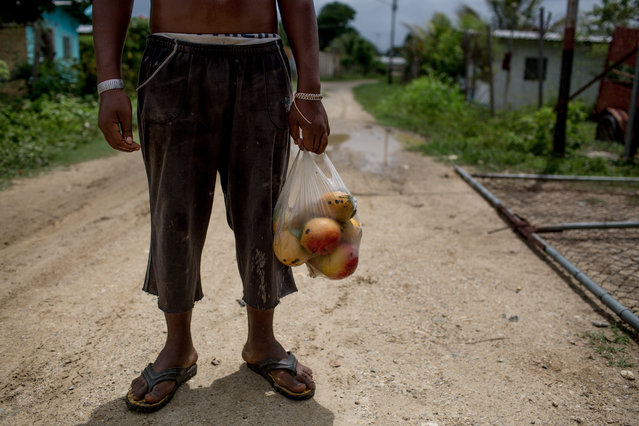
A teenager holds a bag of Mangos, a tropical fruit who grow up in threes in Caracas, Venezuela on June 22, 2016. The shortage of food especially in areas in extreme poverty had made Mangos the daily food. (Photo by Alejandro Cegarra/The Washington Post)

A teenager holds a bag of Mangos, a tropical fruit who grow up in threes in Caracas, Venezuela on June 22, 2016. The shortage of food especially in areas in extreme poverty had made Mangos the daily food. (Photo by Alejandro Cegarra/The Washington Post)
Details
11 Jul 2016 12:23:00