Loading...
Done
An Orthodox priest conducts a blessing in front of the Soyuz TMA-20M for the next International Space Station (ISS) crew, comprised of Jeff Williams of the U.S. and Oleg Skriprochka and Alexey Ovchinin of Russia, at the launchpad at the Baikonur cosmodrome, Kazakhstan, March 17, 2016, ahead of its launch scheduled on March 19. (Photo by Shamil Zhumatov/Reuters)

An Orthodox priest conducts a blessing in front of the Soyuz TMA-20M for the next International Space Station (ISS) crew, comprised of Jeff Williams of the U.S. and Oleg Skriprochka and Alexey Ovchinin of Russia, at the launchpad at the Baikonur cosmodrome, Kazakhstan, March 17, 2016, ahead of its launch scheduled on March 19. (Photo by Shamil Zhumatov/Reuters)
Details
18 Mar 2016 12:13:00
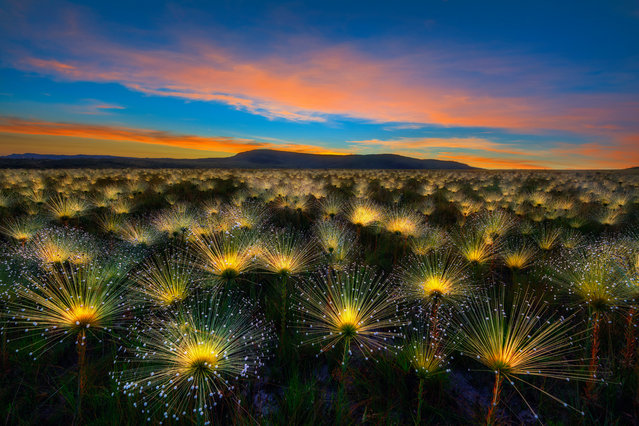
Winner, Wildflower Landscapes category. Alto Paraíso de Goiás, Goiás, Brazil. (Photo by Marcio Cabral/The Guardian)

The International Garden Photographer of the Year is one of the world’s premier competitions specialising in botanical photography. There are 11 main categories and numerous special awards including Young Garden Photographer of the Year, and the mobile-only category Gardens on the Go. Here: Winner, Wildflower Landscapes category. Alto Paraíso de Goiás, Goiás, Brazil. (Photo by Marcio Cabral/The Guardian)
Details
17 Feb 2018 00:02:00
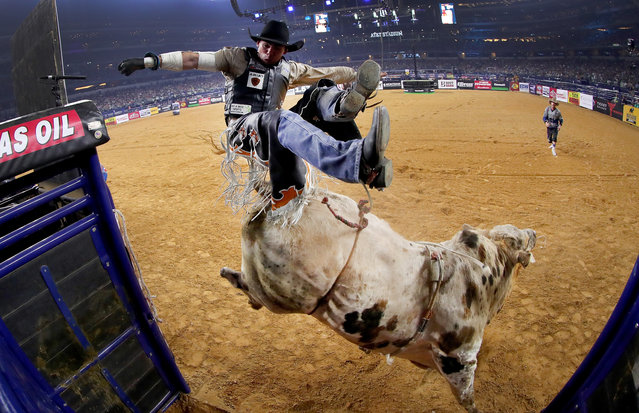
Marco Antonio Eguchi of Brazil gets bucked off of Bottoms Up in the first round of the PBR Frontier Communications Iron Cowboy at AT& T Stadium on February 18, 2017 in Arlington, Texas. (Photo by Tom Pennington/Getty Images)

Marco Antonio Eguchi of Brazil gets bucked off of Bottoms Up in the first round of the PBR Frontier Communications Iron Cowboy at AT& T Stadium on February 18, 2017 in Arlington, Texas. (Photo by Tom Pennington/Getty Images)
Details
20 Feb 2017 08:37:00
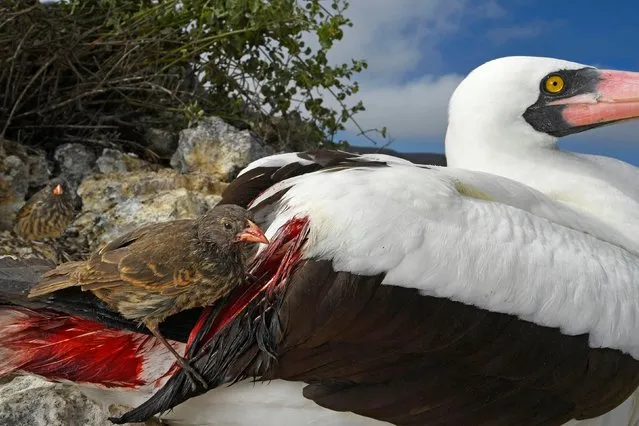
Bloodthirsty by Thomas P Peschak, Germany/South Africa — winner, Behaviour: birds. When rations run short on Wolf Island, in the remote northern Galápagos, the sharp-beaked ground finches become vampires. Their sitting targets are Nazca boobies and other large birds. The finches rely on a scant diet of seeds and insects, which regularly dries up, so they drink blood to survive. ‘I’ve seen more than half a dozen finches drinking from a single Nazca booby,’ says Tom. Rather than leave their nests the boobies tolerate the vampires, and the blood loss doesn’t seem to cause permanent harm. (Photo by Thomas P Peschak/2018 Wildlife Photographer of the Year)

Bloodthirsty by Thomas P. Peschak, Germany/South Africa — winner, Behaviour: birds. When rations run short on Wolf Island, in the remote northern Galápagos, the sharp-beaked ground finches become vampires. Their sitting targets are Nazca boobies and other large birds. The finches rely on a scant diet of seeds and insects, which regularly dries up, so they drink blood to survive. ‘I’ve seen more than half a dozen finches drinking from a single Nazca booby,’ says Tom. Rather than leave their nests the boobies tolerate the vampires, and the blood loss doesn’t seem to cause permanent harm. (Photo by Thomas P. Peschak/2018 Wildlife Photographer of the Year)
Details
19 Oct 2018 00:05:00
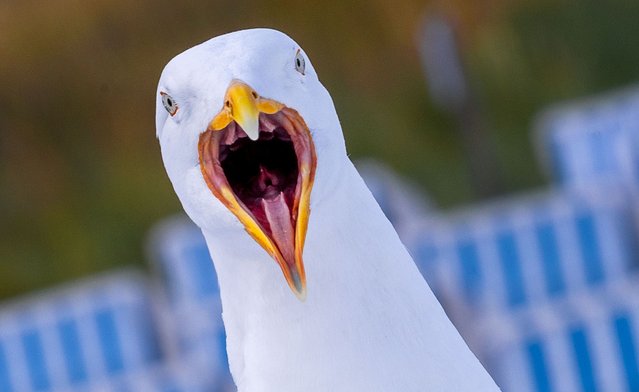
A gull gives its familiar cry on the roof of a beach bar on the Baltic coast on July 16, 2024. (Photo by Jens Büttner/dpa)

A gull gives its familiar cry on the roof of a beach bar on the Baltic coast on July 16, 2024. (Photo by Jens Büttner/dpa)
Details
28 Jul 2024 04:59:00
This photo taken on February 10, 2025 shows a captured green iguana being held by hunters after it was brought down by a slingshot in Pingtung. Taiwan's iguana population has exploded since the spikey-backed giant lizards were introduced from Central and South America more than 20 years ago as exotic pets. Many escaped or were dumped by their owners and have bred rapidly in the warm climate of southern Taiwan, invading neighbourhoods and ravaging farmers' crops. (Photo by I-Hwa Cheng/AFP Photo)

This photo taken on February 10, 2025 shows a captured green iguana being held by hunters after it was brought down by a slingshot in Pingtung. Taiwan's iguana population has exploded since the spikey-backed giant lizards were introduced from Central and South America more than 20 years ago as exotic pets. Many escaped or were dumped by their owners and have bred rapidly in the warm climate of southern Taiwan, invading neighbourhoods and ravaging farmers' crops. (Photo by I-Hwa Cheng/AFP Photo)
Details
02 Mar 2025 04:03:00
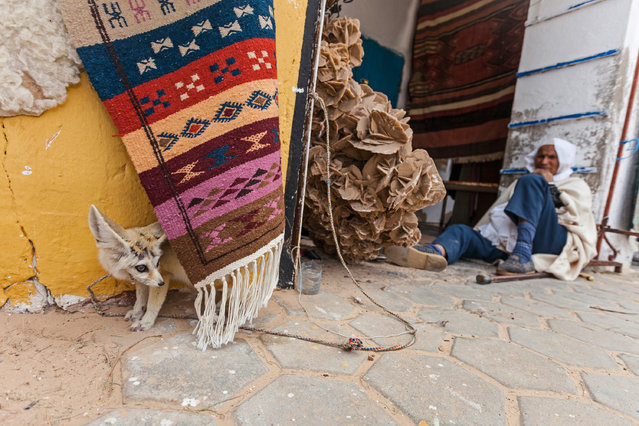
Sultan, a famous captive fennec that is displayed tied on a rope in front of a tourist shop, is the main attraction in the souk of Douz, a desert town in Tunisia. By the display of such a charismatic animal, tourists are often lured to buy things or pay for pictures. On inquiry, although Sultan has been caught as a pup in the wild, the owners of the shop reassure the foreigners stating that the animal is ‘domestic’. (Photo by Bruno D’Amicis/Fritz Pölking Prize/GDT EWPY 2015)

Sultan, a famous captive fennec that is displayed tied on a rope in front of a tourist shop, is the main attraction in the souk of Douz, a desert town in Tunisia. By the display of such a charismatic animal, tourists are often lured to buy things or pay for pictures. On inquiry, although Sultan has been caught as a pup in the wild, the owners of the shop reassure the foreigners stating that the animal is ‘domestic’. (Photo by Bruno D’Amicis/Fritz Pölking Prize/GDT EWPY 2015)
Details
23 Nov 2015 08:02:00
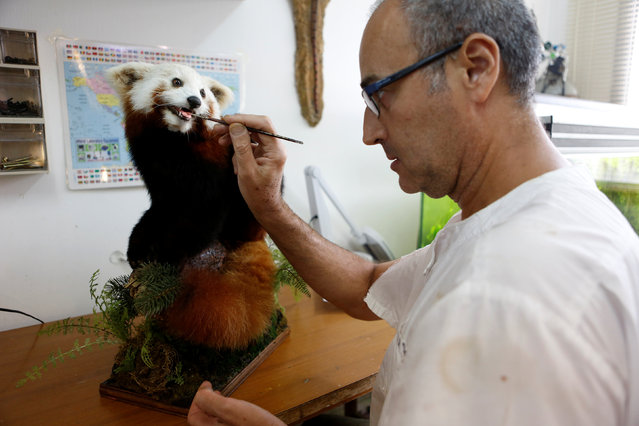
Igor Gavrilov, the main taxidermist of the Zoological centre at Tel Aviv University, works on a taxidermied animal, part of a collection which will be housed at the Steinhardt Museum of Natural History, a new Israeli natural history museum set to open next year in Tel Aviv, Israel June 8, 2016. Legions of insects, sea creatures and ancient fossils are lining up in a new museum shaped liked a giant Noah's Ark, telling the story of a crucial evolutionary byway across Israel. Experts say all humans and other animals had to pass through Israel on their first journey out of Africa into Europe and Asia. (Photo by Nir Elias/Reuters)

Igor Gavrilov, the main taxidermist of the Zoological centre at Tel Aviv University, works on a taxidermied animal, part of a collection which will be housed at the Steinhardt Museum of Natural History, a new Israeli natural history museum set to open next year in Tel Aviv, Israel June 8, 2016. Legions of insects, sea creatures and ancient fossils are lining up in a new museum shaped liked a giant Noah's Ark, telling the story of a crucial evolutionary byway across Israel. (Photo by Nir Elias/Reuters)
Details
25 Aug 2016 09:42:00