Loading...
Done
Kawakanih Yawalapiti, 9, Upper Xingu region of Mato Grosso, Brazil, 2018: Kawakanih lives with her tribe, the Yawalapiti, in Xingu national park, a preserve in the Amazon basin of Brazil. The Yawalapiti collect seeds to preserve species unique to their ecosystem, which lies between the rain forest and savannah. Kawakanih’s diet is simple, consisting mainly of fish, cassava, porridge, fruit and nuts. “It takes five minutes to catch dinner”, says Kawakanih. “When you’re hungry, you just go to the river with your net”. (Photo by Gregg Segal/The Guardian)

Photographer Gregg Segal travelled the world to document children and the food they eat in a week. Partly inspired by the increasing problems of childhood obesity, he tracked traditional regional diets as yet unaffected by globalisation, and ironically, found that the healthiest diets were often eaten by the least well off. (Photo by Gregg Segal/The Guardian)
Details
03 Jul 2019 00:03:00
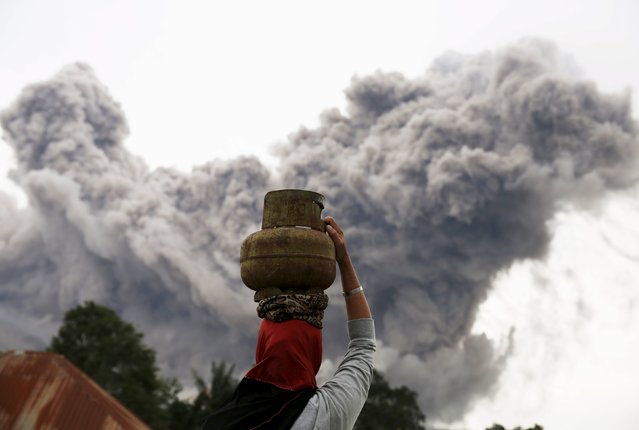
A resident carries a gas canister as an ash cloud hovers above during an eruption of Mount Sinabung volcano at Tiga Serangkai village in Karo Regency, North Sumatra province, Indonesia June 24, 2015. More than 10,000 people from 12 villages, who are living around the slopes of Mount Sinabung, left their homes and moved to refugee camps, local media reported. (Photo by Reuters/Beawiharta)

A resident carries a gas canister as an ash cloud hovers above during an eruption of Mount Sinabung volcano at Tiga Serangkai village in Karo Regency, North Sumatra province, Indonesia June 24, 2015. More than 10,000 people from 12 villages, who are living around the slopes of Mount Sinabung, left their homes and moved to refugee camps, local media reported. (Photo by Reuters/Beawiharta)
Details
27 Jun 2015 13:30:00
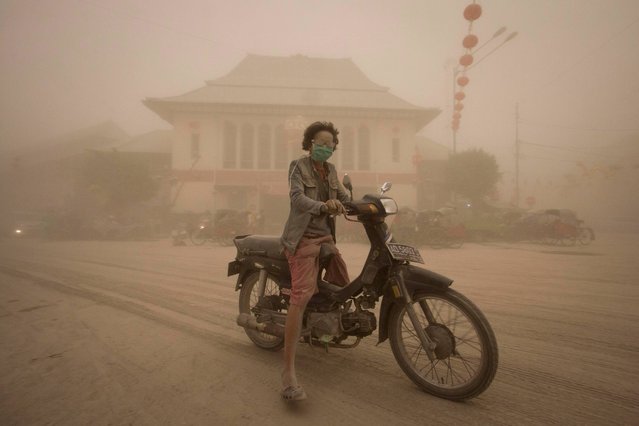
A women rides a motor bike on a street covered with volcanic ash from an eruption of Mount Kelud, in Solo, Indonesia, Friday, February 14, 2014. A major volcanic eruption in Indonesia blasted clouds of ash and debris 18 kilometers (12 miles) into the air on Friday, forcing authorities to close six airports, cancel flights elsewhere in Southeast Asia and evacuate more than 100,000 people from the mountain. (Photo by Hafidz Novalsyah/AP Photo)

A women rides a motor bike on a street covered with volcanic ash from an eruption of Mount Kelud, in Solo, Indonesia, Friday, February 14, 2014. A major volcanic eruption in Indonesia blasted clouds of ash and debris 18 kilometers (12 miles) into the air on Friday, forcing authorities to close six airports, cancel flights elsewhere in Southeast Asia and evacuate more than 100,000 people from the mountain. (Photo by Hafidz Novalsyah/AP Photo)
Details
15 Feb 2014 07:38:00
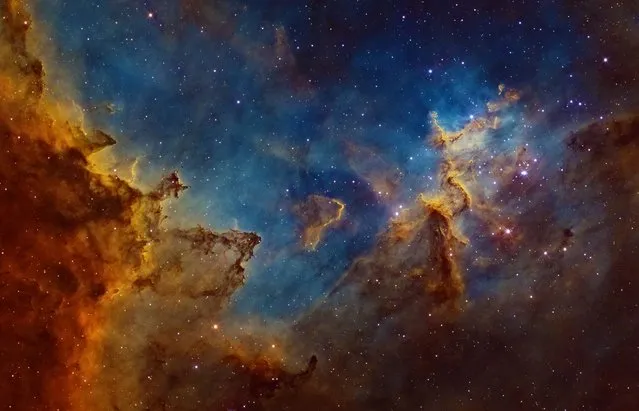
Centre of the Heart Nebula by Ivan Eder (Hungary). Situated 7500 light years away in the ‘W’-shaped constellation of Cassiopeia, the Heart Nebula is a vast region of glowing gas, energized by a cluster of young stars at its centre. The image depicts the central region, where dust clouds are being eroded and moulded into rugged shapes by the searing cosmic radiation. (Photo by Ivan Eder)

The competition, which is run by the Royal Observatory Greenwich in association with BBC Sky at Night Magazine, is now in its sixth year and has received over 2,500 entries. Photo: Centre of the Heart Nebula by Ivan Eder (Hungary). Situated 7500 light years away in the “W”-shaped constellation of Cassiopeia, the Heart Nebula is a vast region of glowing gas, energized by a cluster of young stars at its centre. The image depicts the central region, where dust clouds are being eroded and moulded into rugged shapes by the searing cosmic radiation. (Photo by Ivan Eder)
Details
03 Jul 2014 11:59:00
The rotating updraft base of a supercell thunderstorm, and a rear flank downdraft containing rain and hail, backlit by the setting sun, on May 10, 2014, in Climax, Kansas, United States. To most of us, dark clouds on the horizon usually means rain – but here in Kansas, they can also signal the start of a supercell. The huge formations, also known as rotating thunderstorms, are among the most powerful weather phenomenon found over land. (Photo by Stephen Locke/Barcroft Media)

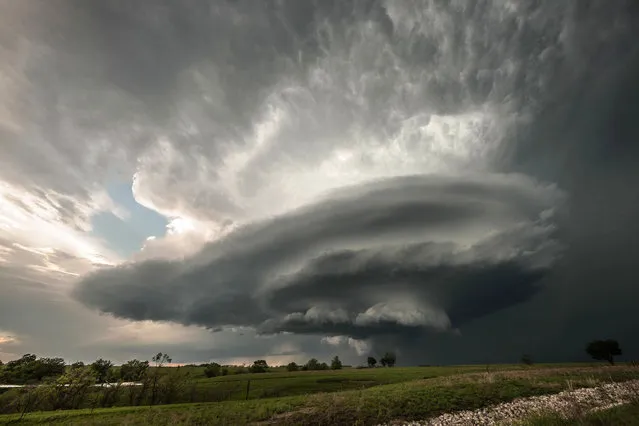
The rotating updraft base of a supercell thunderstorm, and a rear flank downdraft containing rain and hail, backlit by the setting sun, on May 10, 2014, in Climax, Kansas, United States. To most of us, dark clouds on the horizon usually means rain – but here in Kansas, they can also signal the start of a supercell. The huge formations, also known as rotating thunderstorms, are among the most powerful weather phenomenon found over land. They can occur anywhere where the conditions are right, but are normally found in more arid climates. These awe-inspiring supercells were captured south of Climax city by storm chaser Stephen Locke. (Photo by Stephen Locke/Barcroft Media)
Details
18 Jul 2014 12:01:00
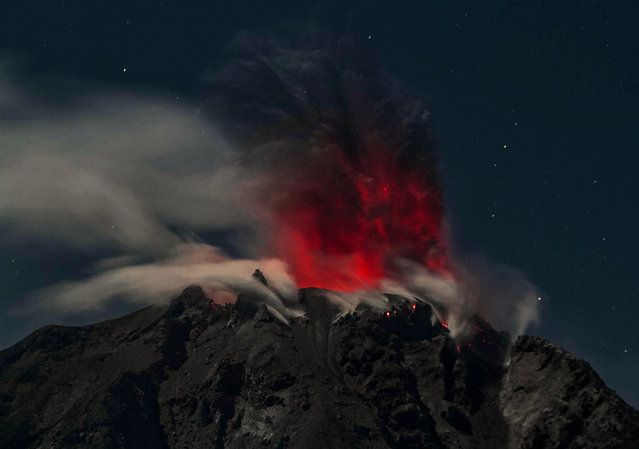
In this timed-exposure night photo taken early on February 12, 2017, Mount Sinabung volcano spews reddish smoke and ash, as seen from the Karo district in North Sumatra province. Activity levels have increased in the past week, with Sinabung shooting hot ash clouds into the sky dozens of times, according to the local volcano monitoring agency. (Photo by AFP Photo/Stringer)

In this timed-exposure night photo taken early on February 12, 2017, Mount Sinabung volcano spews reddish smoke and ash, as seen from the Karo district in North Sumatra province. Activity levels have increased in the past week, with Sinabung shooting hot ash clouds into the sky dozens of times, according to the local volcano monitoring agency. (Photo by AFP Photo/Stringer)
Details
13 Feb 2017 10:02:00
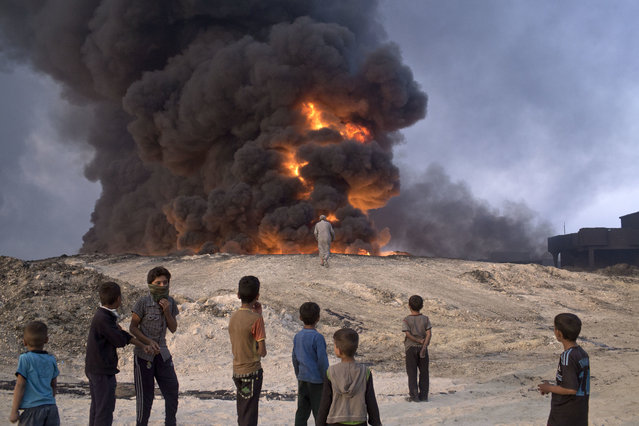
in Qayyarah, about 31 miles (50 km) south of Mosul, Iraq, Sunday, October 23, 2016.in Qayyarah, some 50 kilometers south of Mosul, Iraq, Sunday, Oct. 23, 2016. Islamic State fighters torched a sulfur plant south of Mosul, sending a cloud of toxic fumes into the air that mingled with oil wells the militants had lit on fire to create a smoke screen. (Photo by Marko Drobnjakovic/AP Photo)

in Qayyarah, about 31 miles (50 km) south of Mosul, Iraq, Sunday, October 23, 2016.in Qayyarah, some 50 kilometers south of Mosul, Iraq, Sunday, Oct. 23, 2016. Islamic State fighters torched a sulfur plant south of Mosul, sending a cloud of toxic fumes into the air that mingled with oil wells the militants had lit on fire to create a smoke screen. (Photo by Marko Drobnjakovic/AP Photo)
Details
24 Oct 2016 12:56:00
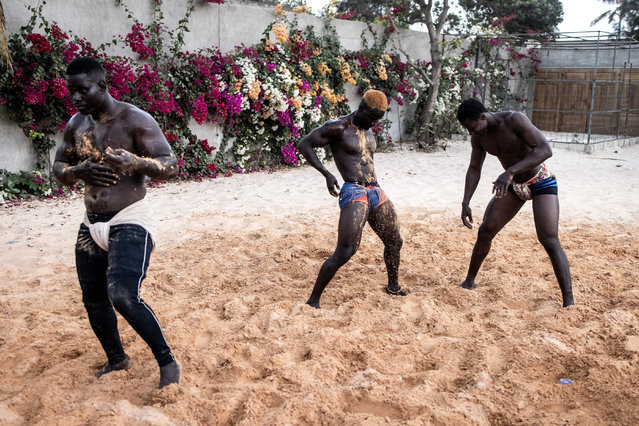
Senegalese wrestlers cover themselves in sand as they prepare to start their training program in Petit Mbao on March 29, 2021. As Covid-19 restrictions have been lifted, wrestlers now start prepare themselves for the start of wrestling tournaments. Senegalese wrestling, which has its roots in the ceremonies celebrating the end of harvests in Serer and Diola ethnic groups and remains surrounded by a thick cloud of mystical practice, is still extremely popular in this West African country. (Photo by John Wessels/AFP Photo)

Senegalese wrestlers cover themselves in sand as they prepare to start their training program in Petit Mbao on March 29, 2021. As Covid-19 restrictions have been lifted, wrestlers now start prepare themselves for the start of wrestling tournaments. Senegalese wrestling, which has its roots in the ceremonies celebrating the end of harvests in Serer and Diola ethnic groups and remains surrounded by a thick cloud of mystical practice, is still extremely popular in this West African country. (Photo by John Wessels/AFP Photo)
Details
09 Apr 2021 10:05:00