Loading...
Done
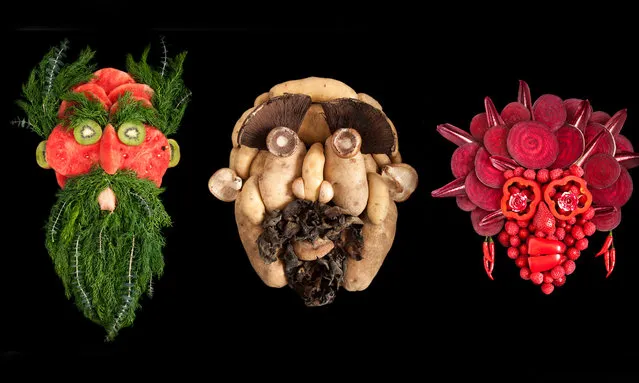
Photographer Emily Dryden and sculptor/actor Zahydé Pietri combine theatricality and organic produce to compose the photographs for their series Fresh Faces. The portraits are made from a wide range of fruit and vegetables and aim to highlight humanity’s diversity – Pietri is from Puerto Rico and Dryden is from New York. Each face has its own name and identity: “We have stories for them, which you can see in the expressions”, says Dryden, “but we decided to keep them to ourselves. We didn’t want to spoil that”. (Photo by Emily Dryden and Zahydé Pietri/The Guardian)

Photographer Emily Dryden and sculptor/actor Zahydé Pietri combine theatricality and organic produce to compose the photographs for their series Fresh Faces. The portraits are made from a wide range of fruit and vegetables and aim to highlight humanity’s diversity – Pietri is from Puerto Rico and Dryden is from New York. Each face has its own name and identity: “We have stories for them, which you can see in the expressions”, says Dryden, “but we decided to keep them to ourselves. We didn’t want to spoil that”. (Photo by Emily Dryden and Zahydé Pietri/The Guardian)
Details
25 Jul 2016 11:08:00
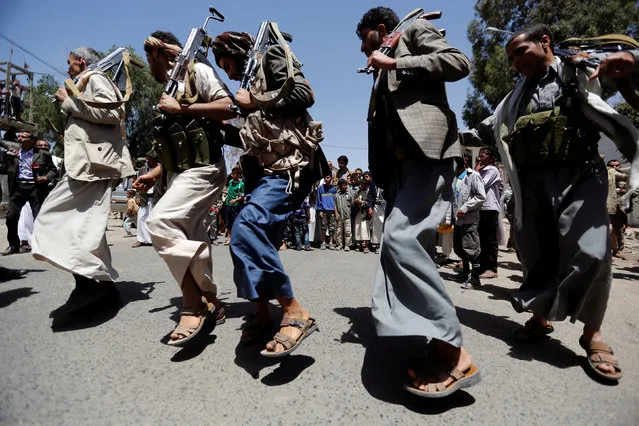
Tribesmen loyal to the Houthi movement perform the Baraa dance during a gathering to show support to the movement in Sanaa, Yemen, May 19, 2016. Bara or Baraa dance is one of the several traditional outdoor dances performed by men in the country of Yemen. Bara dance literally means a dagger dance, where each dancer holds a dagger. The style of the Bara dance differs from tribe to tribe. It is performed on special occasions. (Photo by Khaled Abdullah/Reuters)

Tribesmen loyal to the Houthi movement perform the Baraa dance during a gathering to show support to the movement in Sanaa, Yemen, May 19, 2016. Bara or Baraa dance is one of the several traditional outdoor dances performed by men in the country of Yemen. Bara dance literally means a dagger dance, where each dancer holds a dagger. The style of the Bara dance differs from tribe to tribe. It is performed on special occasions. (Photo by Khaled Abdullah/Reuters)
Details
20 May 2016 12:44:00
Omar Gamal, a 28-year-old pigeon keeper, stands next to his pigeon coop on his rooftop in the Egyptian capital's twin city of Giza on February 21, 2021, with the Pyramids of (R to L) Khufu (Cheops), Khafre (Chephren), and Menkaure (Menkheres) in the background. An ancient tradition handed down through the generations, the practice of domesticating pigeons stretches across borders from the banks of the Nile to north Africa and beyond, with people not only training birds for competitions, but also serving them up as a dining delicacy. (Photo by Khaled Desouki/AFP Photo)

Omar Gamal, a 28-year-old pigeon keeper, stands next to his pigeon coop on his rooftop in the Egyptian capital's twin city of Giza on February 21, 2021, with the Pyramids of (R to L) Khufu (Cheops), Khafre (Chephren), and Menkaure (Menkheres) in the background. An ancient tradition handed down through the generations, the practice of domesticating pigeons stretches across borders from the banks of the Nile to north Africa and beyond, with people not only training birds for competitions, but also serving them up as a dining delicacy. (Photo by Khaled Desouki/AFP Photo)
Details
27 Mar 2021 09:11:00
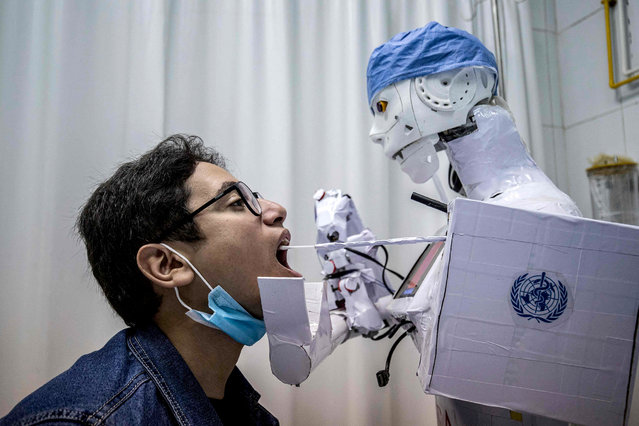
A prong extending from a remote-controlled robot prototype approaches the mouth of a volunteer to extract a throat swab sample, as part of a self-funded project to assist physicians in running tests on suspected COVID-19 coronavirus patients in a bid to limit human exposure to disease-carriers, at a private hospital in Egypt's Nile delta city of Tanta, on March 20, 2021. (Photo by Khaled Desouki/AFP Photo)

A prong extending from a remote-controlled robot prototype approaches the mouth of a volunteer to extract a throat swab sample, as part of a self-funded project to assist physicians in running tests on suspected COVID-19 coronavirus patients in a bid to limit human exposure to disease-carriers, at a private hospital in Egypt's Nile delta city of Tanta, on March 20, 2021. (Photo by Khaled Desouki/AFP Photo)
Details
24 Apr 2021 08:47:00
Egrets stand on a field as an Egyptian farmer plants rice seedling in Egypt's fertile Delta in Tanta, Algharbeya governorate, 100 km from Cairo, Egypt, 22 June 2022.  Egyptian Government reduced the planting of some crops that need a massive amount of irrigation water, while the government said it will reduce the rice agriculture area in Egypt, amid fear the Renaissance Dam project in Ethiopia could affect the amount of River Nile water reaching Egypt. (Photo by Khaled Elfiqi/EPA/EFE)

Egrets stand on a field as an Egyptian farmer plants rice seedling in Egypt's fertile Delta in Tanta, Algharbeya governorate, 100 km from Cairo, Egypt, 22 June 2022. Egyptian Government reduced the planting of some crops that need a massive amount of irrigation water, while the government said it will reduce the rice agriculture area in Egypt, amid fear the Renaissance Dam project in Ethiopia could affect the amount of River Nile water reaching Egypt. (Photo by Khaled Elfiqi/EPA/EFE)
Details
23 Jul 2022 04:52:00
Female female male threesome. My bit on the side is my best male friend. (Photo by Laoshi/Getty Images)

Female female male threesome. My bit on the side is my best male friend. (Photo by Laoshi/Getty Images)
Details
06 Jan 2019 00:05:00
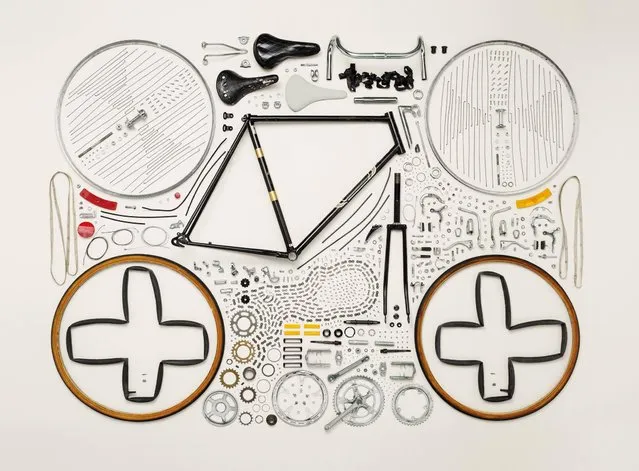
Deconstructed Objects By Todd McLellan

It is simply staggering how complicated some items really are. We never think about it, but some items that we use every day consist of hundreds of parts meticulously put together and working perfectly. Todd McLellan is a photographer who based his newest book “Things Come Apart” on the complexity of various old and new tech. By carefully taking apart various items and arranging all of the parts in perfect order, Todd has allowed us not only to look inside various appliances, but also to appreciate the astounding complexity of these items. Just like the human mind, we are so used to seeing and talking with people that we forget just how complicated their minds really are. It would be great if we could “take apart” the human mind in order to gain some insight into the person’s thoughts and desires. However, very few people are capable of doing it, while the rest will remain blind to the obvious. (Photo by Todd McLellan)
Details
15 Nov 2014 12:30:00
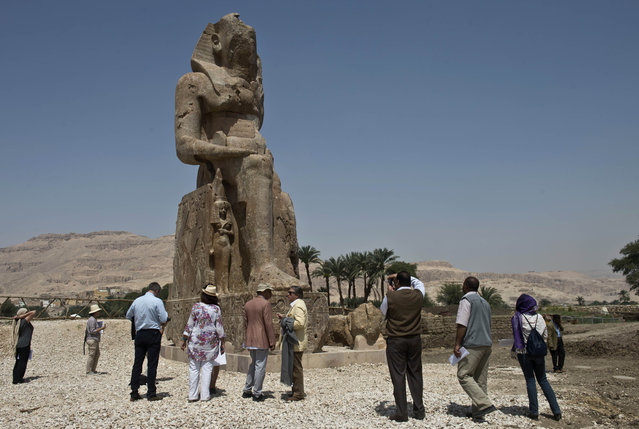
Tourists and journalists stand next to a newly displayed statue of pharaoh Amenhotep III and his wife Tiye (Down) in Egypt's temple city of Luxor on March 23, 2014. Two colossal statues of pharaoh Amenhotep III were unveiled by archaeologists today in their original sites in the funerary temple of the king, on the west bank of the Nile in Luxor, adding to the existing two famous ancient Memnon colossi. (Photo by Khaled Desouki/AFP Photo)

Tourists and journalists stand next to a newly displayed statue of pharaoh Amenhotep III and his wife Tiye (Down) in Egypt's temple city of Luxor on March 23, 2014. Two colossal statues of pharaoh Amenhotep III were unveiled by archaeologists today in their original sites in the funerary temple of the king, on the west bank of the Nile in Luxor, adding to the existing two famous ancient Memnon colossi. (Photo by Khaled Desouki/AFP Photo)
Details
25 Mar 2014 09:02:00