Travel concept: commercial airplane flying with beautiful charming stewardess on September 12, 2019. (Photo by Volodymyr Tverdokhlib/Alamy Stock Photo)
A reveller takes part in an annual block party known as “Ceu na Terra” (Heaven on Earth), during carnival festivities in Rio de Janeiro, Brazil February 3, 2018. (Photo by Pilar Olivares/Reuters)
On August 31, 2012, a long filament of solar material that had been hovering in the sun's atmosphere, the corona, erupted out into space at 4:36 p.m. EDT. The coronal mass ejection, or CME, traveled at over 900 miles per second. The CME did not travel directly toward Earth, but did connect with Earth's magnetic environment, or magnetosphere, causing aurora to appear on the night of Monday, September 3. (Photo by NASA/GSFC/SDO via The Atlantic)
A performer takes part in the opening of the Temple Fair, part of Chinese New Year celebrations at Ditan Park, also known as the Temple of Earth, in Beijing, February 18, 2015. (Photo by Kim Kyung-Hoon/Reuters)
Yakutsk, with a population of around 270,000, holds its own title: that of the coldest city on Earth. Here: Frost-encrusted house in the city centre. (Photo by Amos Chapple/Courtesy Images/RFE/RL)
Young Japanese women pose with a green bear costumed person during the 'Earth Parade 2015' in Tokyo, Japan, Saturday, November 28, 2015. Ahead of the U.N. climate change summit in Paris starting this week, about 1,000 citizens and environmental activists took to the streets of Tokyo on Saturday, calling for strong actions to combat global warming. (Photo by Franck Robichon/EPA)
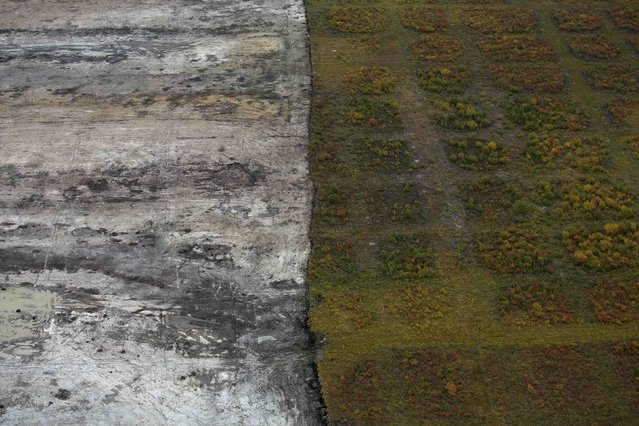
The top layer of muskeg and earth (L) is removed at the Syncrude tar sands operations near Fort McMurray, Alberta, September 17, 2014. Syncrude currently produces 350,000 barrels per day of high quality light, low sulphur crude oil according to company reports. (Photo by Todd Korol/Reuters)