Loading...
Done
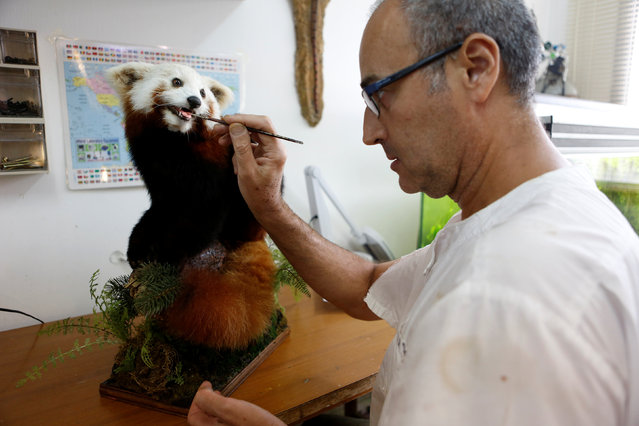
Igor Gavrilov, the main taxidermist of the Zoological centre at Tel Aviv University, works on a taxidermied animal, part of a collection which will be housed at the Steinhardt Museum of Natural History, a new Israeli natural history museum set to open next year in Tel Aviv, Israel June 8, 2016. Legions of insects, sea creatures and ancient fossils are lining up in a new museum shaped liked a giant Noah's Ark, telling the story of a crucial evolutionary byway across Israel. Experts say all humans and other animals had to pass through Israel on their first journey out of Africa into Europe and Asia. (Photo by Nir Elias/Reuters)

Igor Gavrilov, the main taxidermist of the Zoological centre at Tel Aviv University, works on a taxidermied animal, part of a collection which will be housed at the Steinhardt Museum of Natural History, a new Israeli natural history museum set to open next year in Tel Aviv, Israel June 8, 2016. Legions of insects, sea creatures and ancient fossils are lining up in a new museum shaped liked a giant Noah's Ark, telling the story of a crucial evolutionary byway across Israel. (Photo by Nir Elias/Reuters)
Details
25 Aug 2016 09:42:00
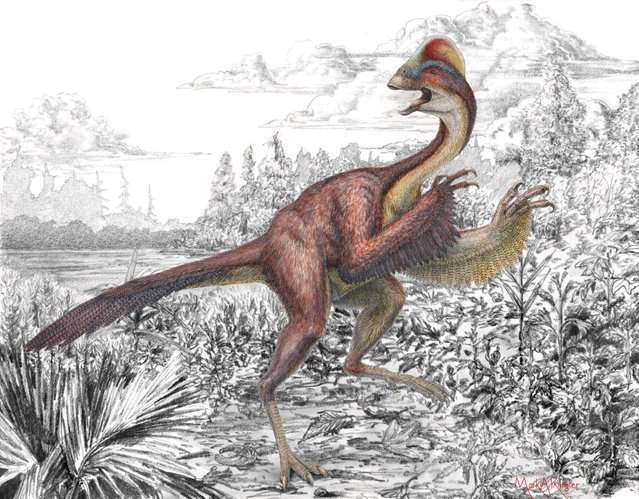
Life reconstruction of the new oviraptorosaurian dinosaur species Anzu wyliei in its 66 million-year-old environment in western North America as seen in an undated handout illustration by Mark A. Klinger, Carnegie Museum of Natural History. Some 18,000 species, great and small, were discovered in 2014, adding to the 2 million already known, scientists said on May 21, 2015 as they released a “Top 10” list that highlights the diversity of life. (Photo by Mark A. Klingler/Reuters/Carnegie Museum of Natural History)

Life reconstruction of the new oviraptorosaurian dinosaur species Anzu wyliei in its 66 million-year-old environment in western North America as seen in an undated handout illustration by Mark A. Klinger, Carnegie Museum of Natural History. Some 18,000 species, great and small, were discovered in 2014, adding to the 2 million already known, scientists said on May 21, 2015 as they released a “Top 10” list that highlights the diversity of life. Anzu wyliei, one of the top 10, dubbed “the chicken from hell”, is extinct. The feathered dinosaur whose partial skeletons were unearthed in the Dakotas was a contemporary of T. rex and Triceratops. (Photo by Mark A. Klingler/Reuters/Carnegie Museum of Natural History)

Details
22 May 2015 12:31:00
Employees cover bacon on fried dranik, a potato pancake that is the national dish of Belarus, in the Sula History Park near the village of Sula, Belarus March 7, 2016. (Photo by Vasily Fedosenko/Reuters)

Employees cover bacon on fried dranik, a potato pancake that is the national dish of Belarus, in the Sula History Park near the village of Sula, Belarus March 7, 2016. According to the park's representatives, the two-metre-wide pancake was an attempt to enter the Guinness World Records as the world's largest dranik. (Photo by Vasily Fedosenko/Reuters)
Details
08 Mar 2016 13:41:00
This photo provided by Netflix/naturepl.com and WWF-International shows an African Elephant (Loxodonta africana) in front of double rainbow, in Masai Mara, Kenya, included in the Netflix natural history series, “Our Planet”, in collaboration with Silverback Films and WWF. The eight-part series debuts in 2019. (Photo by Andy Rouse/Naturepl.com/WWF-International/Netflix via AP Photo)

This photo provided by Netflix/naturepl.com and WWF-International shows an African Elephant (Loxodonta africana) in front of double rainbow, in Masai Mara, Kenya, included in the Netflix natural history series, “Our Planet”, in collaboration with Silverback Films and WWF. The eight-part series debuts in 2019. (Photo by Andy Rouse/Naturepl/WWF-International/Netflix via AP Photo)
Details
09 Oct 2015 08:05:00
Women wearing braided straw hats dance as the Owara Kaze-no-Bon dance festival begins on September 1, 2025 in Toyama, Japan. The festival, believed to have more than 300 years history, continues till September 3. (Photo by The Asahi Shimbun via Getty Images)

Women wearing braided straw hats dance as the Owara Kaze-no-Bon dance festival begins on September 1, 2025 in Toyama, Japan. The festival, believed to have more than 300 years history, continues till September 3. (Photo by The Asahi Shimbun via Getty Images)
Details
20 Sep 2025 03:35:00
Bouwe Brouwer: Postcards from Fryslân (series finalist). “People from Fryslân are looked upon by the rest of the Netherlands as stubborn people. Going back as far as the Spanish occupation, they have a history of resisting authority. Postcards from Fryslân is still an ongoing project – hopefully a lifelong one. When it started, it represented only a collection of places that seemed interesting. Currently, the hope is to cover most of the province, as you never know in advance where the best narratives are. But still, it is all candid, unposed and in the public realm”. (Photo by Bouwe Brouwer/Street Photographers Awards 2021)

Bouwe Brouwer: Postcards from Fryslân (series finalist). “People from Fryslân are looked upon by the rest of the Netherlands as stubborn people. Going back as far as the Spanish occupation, they have a history of resisting authority. Postcards from Fryslân is still an ongoing project – hopefully a lifelong one. When it started, it represented only a collection of places that seemed interesting. Currently, the hope is to cover most of the province, as you never know in advance where the best narratives are. But still, it is all candid, unposed and in the public realm”. (Photo by Bouwe Brouwer/Street Photographers Awards 2021)
Details
17 Oct 2021 07:54:00
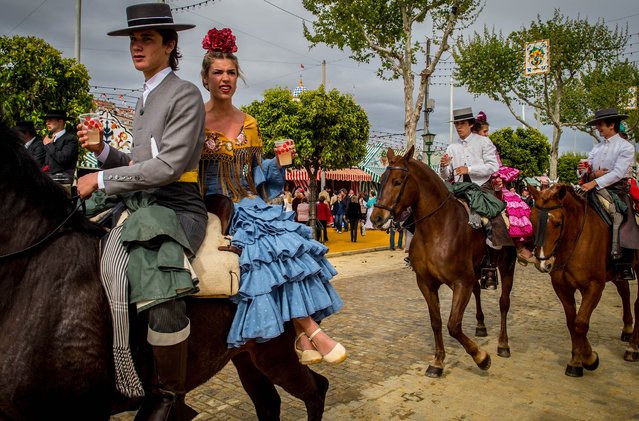
Participants in traditional dress ride on horseback as they enjoy the atmosphere at the Feria de Abril (April's Fair) on April 12, 2016 in Seville, Spain. The Feria de Abril has a history that dates back to 1857 and takes place a fortnight after Easter each year. The origin of the fair was a cattle market but the event quickly turned its goal from commerce to having fun. More than 1 million local and international participants are expected to attend the Feria de Abril. (Photo by David Ramos/Getty Images)

Participants in traditional dress ride on horseback as they enjoy the atmosphere at the Feria de Abril (April's Fair) on April 12, 2016 in Seville, Spain. The Feria de Abril has a history that dates back to 1857 and takes place a fortnight after Easter each year. The origin of the fair was a cattle market but the event quickly turned its goal from commerce to having fun. More than 1 million local and international participants are expected to attend the Feria de Abril. (Photo by David Ramos/Getty Images)
Details
14 Apr 2016 12:25:00
A man in “Red Army” garb hits the pavement during a simulated attack during a re-staging of part of the Long March in Jinggangshan September 14, 2017. The scene brings alive an extraordinary chapter in China's history that established the supremacy of Chairman Mao Zedong and the Communist Party. Deep in the mountains of Jinggangshan in the southeastern province of Jiangxi, a classroom of bank tellers participates in an ideological boot camp that plays into Chinese President Xi Jinping's drive to further consolidate his grip on power. (Photo by Thomas Peter/Reuters)

A man in “Red Army” garb hits the pavement during a simulated attack during a re-staging of part of the Long March in Jinggangshan September 14, 2017. The scene brings alive an extraordinary chapter in China's history that established the supremacy of Chairman Mao Zedong and the Communist Party. Deep in the mountains of Jinggangshan in the southeastern province of Jiangxi, a classroom of bank tellers participates in an ideological boot camp that plays into Chinese President Xi Jinping's drive to further consolidate his grip on power. (Photo by Thomas Peter/Reuters)
Details
25 Sep 2017 06:46:00