Loading...
Done
A visitor tries out Lenovo augmented reality glasses with the Star Wars Jedi Challenges during the Mobile World Congress in Barcelona, Spain, February 26, 2018. (Photo by Yves Herman/Reuters)

A visitor tries out Lenovo augmented reality glasses with the Star Wars Jedi Challenges during the Mobile World Congress in Barcelona, Spain, February 26, 2018. The Mobile World Congress, the world' s biggest mobile fair, is held in Barcelona from February 26 to March 1. (Photo by Yves Herman/Reuters)
Details
01 Mar 2018 00:03:00
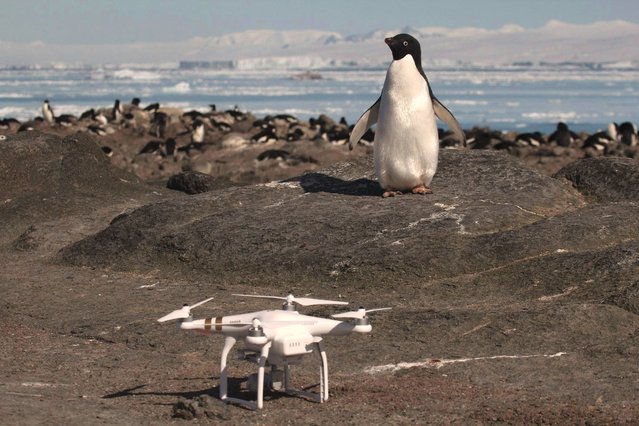
This undated handout photograph released by Stony Brook University/ Louisiana State University on March 2, 2018, shows an Adélie penguin (R) looking at a drone at breeding colony on Heroina Island, Danger Islands, Antarctica. A thriving “hotspot” of some 1.5 million Adelie penguins has been discovered on the remote Danger Islands in the east Antarctic, surprised scientists announced on March 2, 2018. (Photo by Rachael Herman/AFP Photo/Louisiana State University AND Stony Brook University)

This undated handout photograph released by Stony Brook University/ Louisiana State University on March 2, 2018, shows an Adélie penguin looking at a drone at breeding colony on Heroina Island, Danger Islands, Antarctica. A thriving “hotspot” of some 1.5 million Adelie penguins has been discovered on the remote Danger Islands in the east Antarctic, surprised scientists announced on March 2, 2018. (Photo by Rachael Herman/AFP Photo/Louisiana State University AND Stony Brook University)
Details
04 Mar 2018 00:03:00
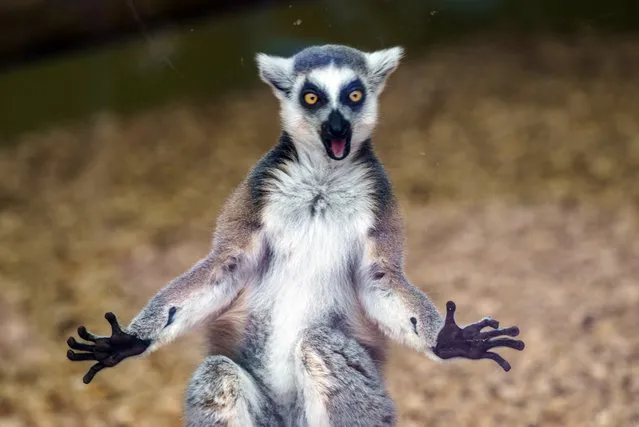
A calico sits in its enclosure and suns itself in Hessen, Germany on May 28, 2021. The Opel Zoo presents a walk-in Madagascar aviary for caltas and varis. The primate species is native to Madagascar and is threatened with extinction. (Photo by Andreas Arnold/dpa)

A calico sits in its enclosure and suns itself in Hessen, Germany on May 28, 2021. The Opel Zoo presents a walk-in Madagascar aviary for caltas and varis. The primate species is native to Madagascar and is threatened with extinction. (Photo by Andreas Arnold/dpa)
Details
30 May 2021 09:19:00
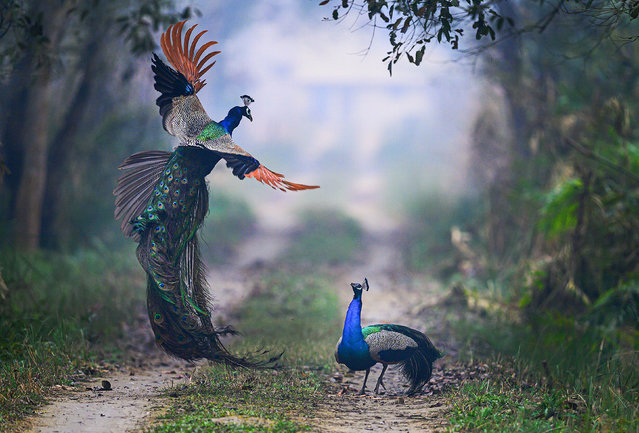
A peacock leaps into the air as it battles a rival over territory on a foggy morning. The brightly coloured bird jumped almost six feet into the air before crashing down on its opponent. The fight was captured by amateur photographer Nilesh Patel, in Dudhwa National Park, India. (Photo by Nilesh Patel/Solent News & Photo Agency/Solent News)

A peacock leaps into the air as it battles a rival over territory on a foggy morning. The brightly coloured bird jumped almost six feet into the air before crashing down on its opponent. The fight was captured by amateur photographer Nilesh Patel, in Dudhwa National Park, India. (Photo by Nilesh Patel/Solent News & Photo Agency/Solent News)
Details
24 May 2020 00:01:00
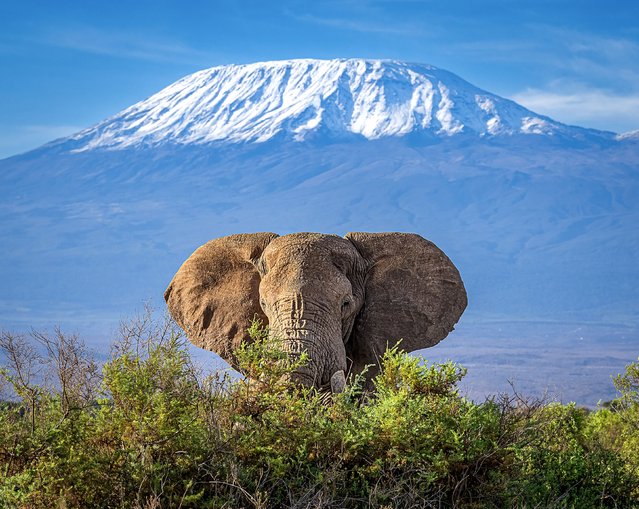
Mount Kilimanjaro looms behind an elephant at Amboseli National Park in southern Kenya, 2024. (Photo byYaron Schmid/YS Wildlife Photography/Solent News)

Mount Kilimanjaro looms behind an elephant at Amboseli National Park in southern Kenya, 2024. (Photo byYaron Schmid/YS Wildlife Photography/Solent News)
Details
03 Feb 2025 03:08:00
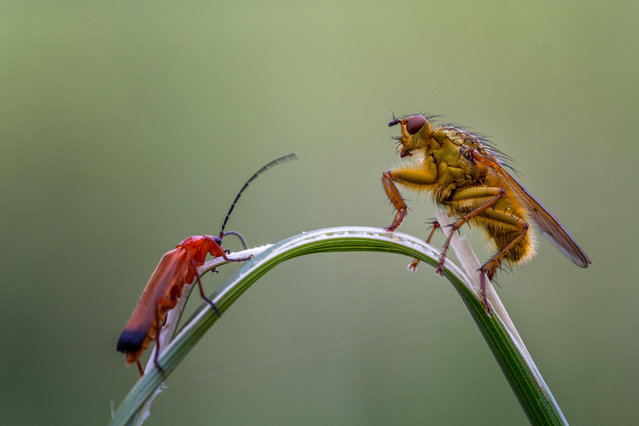
A hogweed bonking beetle and yellow dung fly in a stalk standoff (the fly gave in), in Burley-in-Wharfedale, Yorkshire, England. (Photo by Rebecca Cole/Alamy Stock Photo)

A hogweed bonking beetle and yellow dung fly in a stalk standoff (the fly gave in), in Burley-in-Wharfedale, Yorkshire, England. (Photo by Rebecca Cole/Alamy Stock Photo)
Details
19 Aug 2017 08:44:00
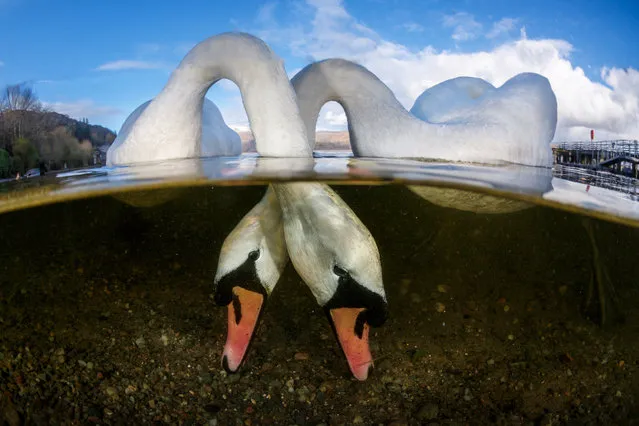
British underwater photographer of the year – winner. “Love Birds” by Grant Thomas (UK). Location: Luss Pier, Loch Lomond, Scotland. Thomas’s initial idea was to frame a split shot of one swan feeding below the surface of the water but when he noticed how comfortable they were around him he was confident, with some patience, he could get that magical shot of the two. (Photo by Grant Thomas/UPY 2018)

British underwater photographer of the year – winner. “Love Birds” by Grant Thomas (UK). Location: Luss Pier, Loch Lomond, Scotland. Thomas’s initial idea was to frame a split shot of one swan feeding below the surface of the water but when he noticed how comfortable they were around him he was confident, with some patience, he could get that magical shot of the two. (Photo by Grant Thomas/UPY 2018)
Details
16 Feb 2018 00:02:00
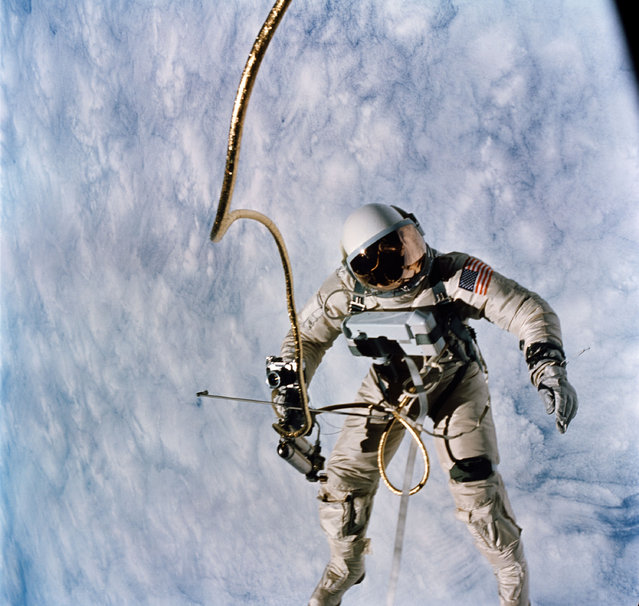
Astronaut Edward H. White II, pilot for the Gemini-Titan 4 (GT-4) spaceflight, floats in the zero-gravity of space during the third revolution of the GT-4 spacecraft on June 3, 1965. White wears a specially designed spacesuit. His face is shaded by a gold-plated visor to protect him from unfiltered rays of the sun. (Photo by NASA)

Astronaut Edward H. White II, pilot for the Gemini-Titan 4 (GT-4) spaceflight, floats in the zero-gravity of space during the third revolution of the GT-4 spacecraft on June 3, 1965. White wears a specially designed spacesuit. His face is shaded by a gold-plated visor to protect him from unfiltered rays of the sun. In his right hand he carries a Hand-Held Self-Maneuvering Unit (HHSMU) that gives him control over his movements in space. White also wears an emergency oxygen chest pack; and he carries a camera mounted on the HHSMU for taking pictures of the sky, Earth and the GT-4 spacecraft. He is secured to the spacecraft by a 25-feet umbilical line and a 23-feet tether line. Both lines are wrapped together in gold tape to form one cord. Astronaut James A. McDivitt, command pilot, remained inside the spacecraft during the extravehicular activity (EVA). Astronaut White died in the Apollo/Saturn 204 fire at Cape Kennedy on January 27, 1967. (Photo by NASA)

Details
22 Jul 2014 12:05:00