Loading...
Done
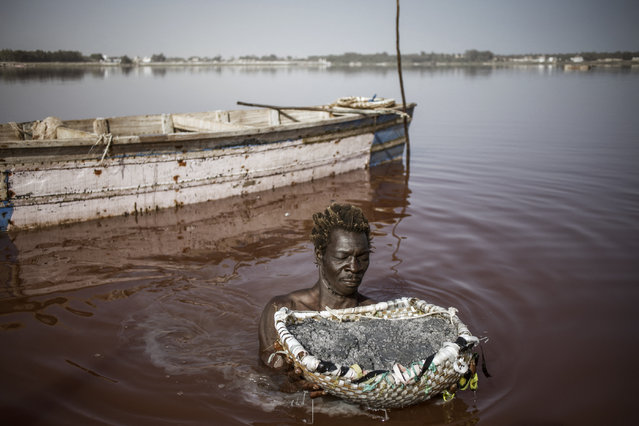
Toure, a Gambian salt harvester, holds a basket filled with  the salt collected from the crust of the bottom of the Lake Retba (Pink Lake) in Senegal on March 16, 2021. Lake Retba, divided from the Atlantic Ocean by a narrow corridor of dunes, owes its name to the pink waters caused by the Dunaliella salina algae and is known for its high salt content, up to 40% in some areas. (Photo by Marco Longari/AFP Photo)

Toure, a Gambian salt harvester, holds a basket filled with the salt collected from the crust of the bottom of the Lake Retba (Pink Lake) in Senegal on March 16, 2021. Lake Retba, divided from the Atlantic Ocean by a narrow corridor of dunes, owes its name to the pink waters caused by the Dunaliella salina algae and is known for its high salt content, up to 40% in some areas. (Photo by Marco Longari/AFP Photo)
Details
24 Mar 2021 10:29:00
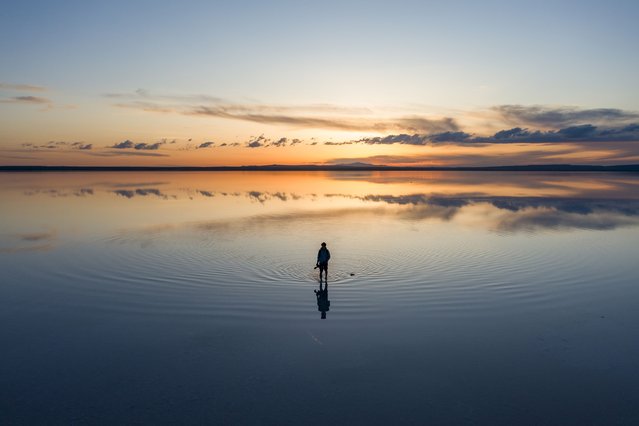
An aerial view of a man standing on Lake Tuz, Turkiye's second largest lake, during sunset in Ankara, Turkiye on April 22, 2024. The lake, which is on the UNESCO World Heritage Tentative List with its unique natural structure, welcomes many local and foreign tourists every year as it provides 70 per cent of the country's salt needs. (Photo by Hakan Nural/Anadolu via Getty Images)

An aerial view of a man standing on Lake Tuz, Turkiye's second largest lake, during sunset in Ankara, Turkiye on April 22, 2024. The lake, which is on the UNESCO World Heritage Tentative List with its unique natural structure, welcomes many local and foreign tourists every year as it provides 70 per cent of the country's salt needs. (Photo by Hakan Nural/Anadolu via Getty Images)
Details
01 Jul 2024 04:27:00
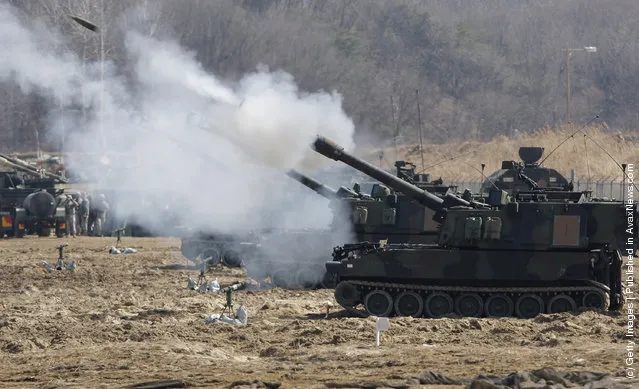
U.S. soldiers from 145th Field Artillery Battalion deployed from the United States fire Paladin self propelled gun during the Foal Eagle training exercise at firing point 180 at the Rodriguez Live Fire Range

U.S. soldiers from 145th Field Artillery Battalion deployed from the United States fire Paladin self propelled gun during the Foal Eagle training exercise at firing point 180 at the Rodriguez Live Fire Range on March 15, 2012 in Pocheon, South Korea. (Photo by Chung Sung-Jun/Getty Images)
Details
16 Mar 2012 11:23:00
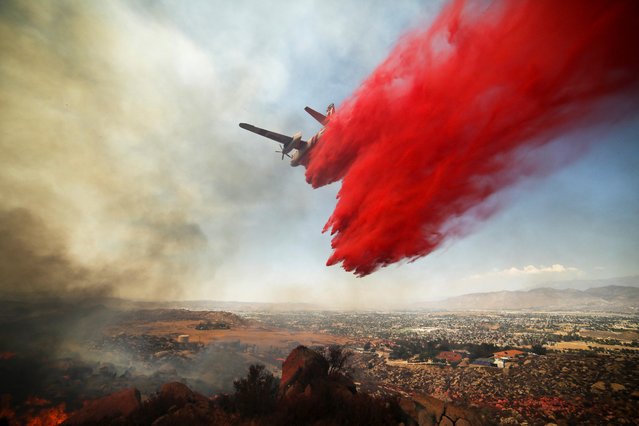
Fire retardant is dropped on the Fairview Fire burning near Hemet, California, U.S., September 6, 2022. (Photo by David Swanson/Reuters)

Fire retardant is dropped on the Fairview Fire burning near Hemet, California, U.S., September 6, 2022. (Photo by David Swanson/Reuters)
Details
13 Sep 2022 04:05:00
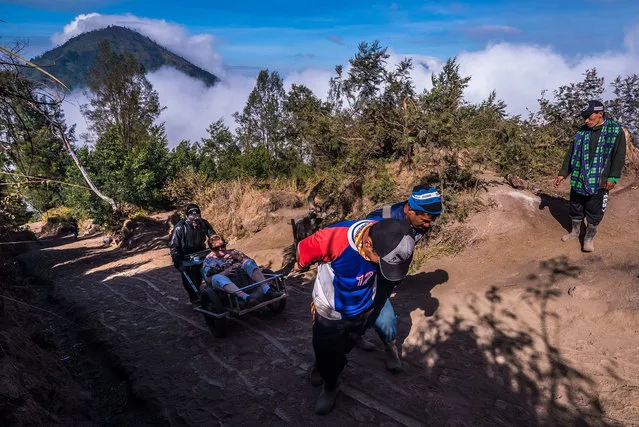
Miners pulling up lazy tourists to the rim of Kawah Ijen (Ijen Volcano), East Java, Indonesia on September 21, 2017. They will earn as much as they would bring down a load of sulfur. Nomadic Explorer, Cultural Lifestyle Photographer Claudio Sieber captured striking images of miners working at Ijen volcanic range in East Java, Indonesia. The sulphur miners risk their lives daily as they climb the active volcano carrying heavy loads, which they sell to sugar refineries. Shortly after midnight curious tourists are flocking in hundreds through the gate of Ijen's foothills to be right on time, driven by the images others took before them. Kawah Ijen is the one of the world's largest acidic volcanic crater lake; famous for its turquoise color as well as the unreal atmosphere it offers during darkness. A dusty path zigzags 3 kilometers up to the crater rim. This doesn't mean anything challenging; in particular, special sights have to be deserved anyway. The irritating smell of sulfur announces the near of the crater's existence. Arriving on the crater's rim the reward for the torture becomes visible. Blue fire darts its tongues through the fumes of sulfur dioxide. Somehow, the spectacle isn't as romantic as expected, since it is also the rough working space of approx. 150 sulfur miners who start their shift at 1 am. Lately, harvesting the abundance of devil's gold received international attention. This did obviously not really improve a miner's lifestyle; neither did it contribute to a better wage. (Photo by Claudio Sieber/Barcroft Images)

Miners pulling up lazy tourists to the rim of Kawah Ijen (Ijen Volcano), East Java, Indonesia on September 21, 2017. They will earn as much as they would bring down a load of sulfur. Nomadic Explorer, Cultural Lifestyle Photographer Claudio Sieber captured striking images of miners working at Ijen volcanic range in East Java, Indonesia. The sulphur miners risk their lives daily as they climb the active volcano carrying heavy loads, which they sell to sugar refineries. (Photo by Claudio Sieber/Barcroft Images)
Details
02 Oct 2017 08:31:00
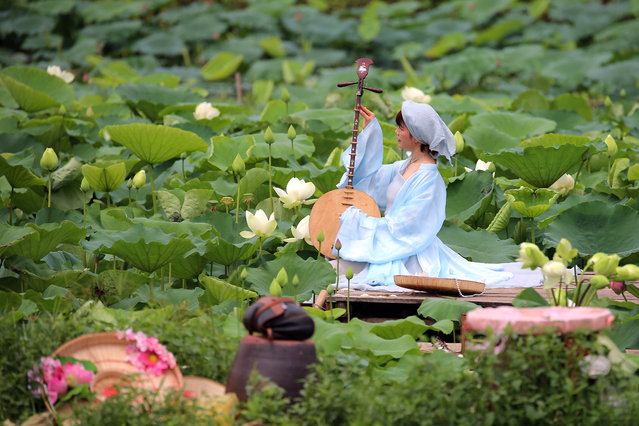
A woman poses for a photo next to lotus flowers in West lake in Hanoi, Vietnam, 09 June 2025.. Lotus flowers bloom from late May to August in Vietnam and are commonly found growing in the muddy waters of lakes and ponds across the country. (Photo by Luong Thai Linh/EPA)

A woman poses for a photo next to lotus flowers in West lake in Hanoi, Vietnam, 09 June 2025.. Lotus flowers bloom from late May to August in Vietnam and are commonly found growing in the muddy waters of lakes and ponds across the country. (Photo by Luong Thai Linh/EPA)
Details
16 Aug 2025 03:28:00
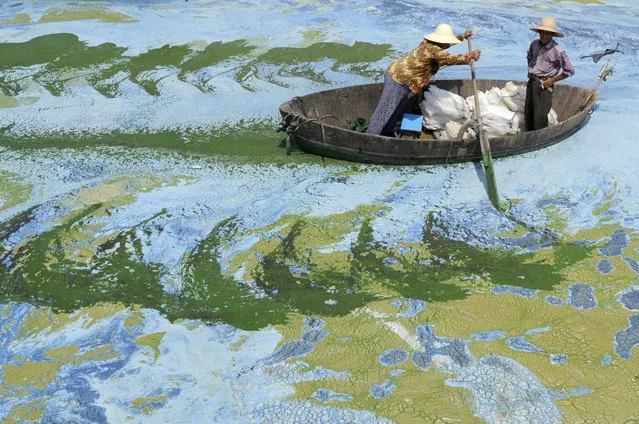
Fishermen row a boat in the algae-filled Chaohu Lake in Hefei, Anhui province, June 19, 2009. The country has invested 51 billion yuan ($7.4 billion) towards the construction of 2,712 projects for the treatment of eight rivers and lakes including Huaihe River, Haihe River, Liaohe River, Chaohu Lake, Dianchi Lake, Songhua River, the Three Gorges region of the Yangtze River and its upstream area, Xinhua News Agency reported. (Photo by Jianan Yu/Reuters)

Growing cities, overuse of fertilizers and factory wastewater have degraded China's water supplies to the extent that half the nation's rivers and lakes are severely polluted. China aims to spend $850 billion to improve filthy water supplies over the next decade, but even such huge outlays may do little to reverse damage caused by decades of pollution and overuse in Beijing's push for rapid economic growth. Photo: Fishermen row a boat in the algae-filled Chaohu Lake in Hefei, Anhui province, June 19, 2009. (Photo by Jianan Yu/Reuters)
Details
03 Aug 2014 08:01:00
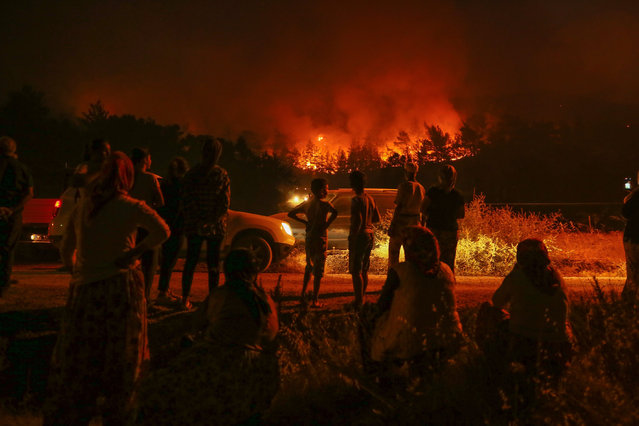
Flames and smoke rising after a fire that broke out in Izmir province of Aegean Turkey on August 19, 2019. Fire brigade crew continue their works. Forest fires have consumed some 500 hectares (over 1,200 acres) of land in Izmir, Turkeys Aegean coast. On Sunday, the fires broke out in four different regions – including two in the southwestern Mugla province and others in Izmir province, according to Agriculture and Forest Ministry. (Photo by Emin Menguarslan/Anadolu Agency via Getty Images)

Flames and smoke rising after a fire that broke out in Izmir province of Aegean Turkey on August 19, 2019. Fire brigade crew continue their works. Forest fires have consumed some 500 hectares (over 1,200 acres) of land in Izmir, Turkeys Aegean coast. On Sunday, the fires broke out in four different regions – including two in the southwestern Mugla province and others in Izmir province, according to Agriculture and Forest Ministry. (Photo by Emin Menguarslan/Anadolu Agency via Getty Images)
Details
22 Aug 2019 00:05:00