Loading...
Done
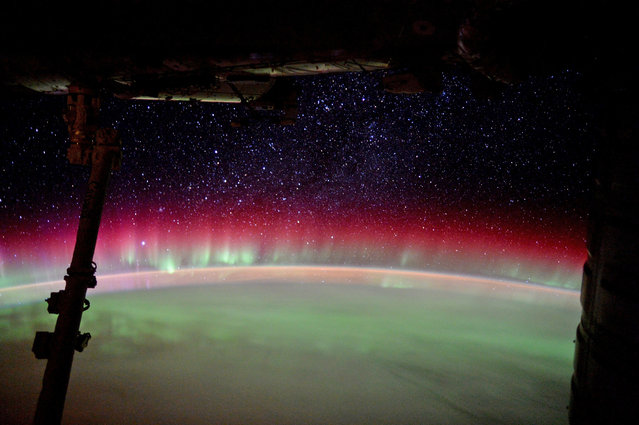
ESA astronaut Tim Peake posted this stunning image on his social media channels, commenting: “Station passed through magnificent aurora Australis last night”. Tim is set to return to Earth on 18 June 2016, bringing his six-month Principia mission to the ISS to an end. During his stay he performed more than 30 scientific experiments for ESA and taking part in numerous others from ESA's international partners. ESA and the UK Space Agency have partnered to develop many exciting educational activities around the Principia mission, aimed at sparking the interest of young children in science and space. (Photo by Tim Peake/ESA/NASA)

ESA astronaut Tim Peake posted this stunning image on his social media channels, commenting: “Station passed through magnificent aurora Australis last night”. Tim is set to return to Earth on 18 June 2016, bringing his six-month Principia mission to the ISS to an end. During his stay he performed more than 30 scientific experiments for ESA and taking part in numerous others from ESA's international partners. ESA and the UK Space Agency have partnered to develop many exciting educational activities around the Principia mission, aimed at sparking the interest of young children in science and space. (Photo by Tim Peake/ESA/NASA)
Details
31 Dec 2016 10:21:00
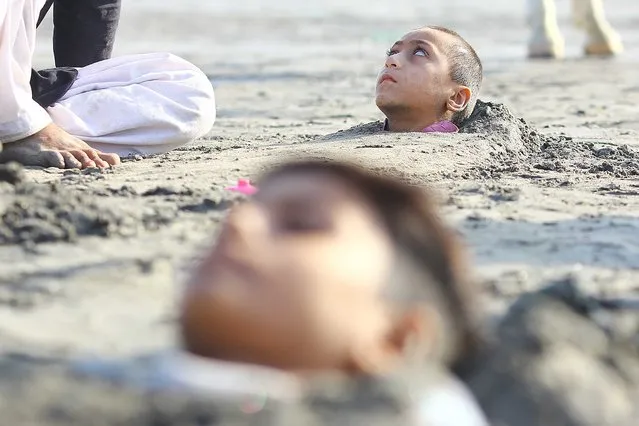
A disabled child is buried up to his neck in sand during the partial solar eclipse in belief its rays can heal, in Karachi, Pakistan, 25 October 202. A partial solar eclipse occurs when a portion of the Earth is engulfed by the shadow (penumbra) cast by the Moon as it passes between our planet and the Sun in imperfect alignment. During this eclipse - the first of the decade – the Moon appears to cover the Sun, leaving the Sun's halo as a visible rim forming an annulus, popularly known as the 'ring of fire. (Photo by Shahzaib Akber/EPA/EFE/Rex Features/Shutterstock)

A disabled child is buried up to his neck in sand during the partial solar eclipse in belief its rays can heal, in Karachi, Pakistan, 25 October 202. A partial solar eclipse occurs when a portion of the Earth is engulfed by the shadow (penumbra) cast by the Moon as it passes between our planet and the Sun in imperfect alignment. During this eclipse - the first of the decade – the Moon appears to cover the Sun, leaving the Sun's halo as a visible rim forming an annulus, popularly known as the 'ring of fire. (Photo by Shahzaib Akber/EPA/EFE/Rex Features/Shutterstock)
Details
09 Nov 2022 05:24:00


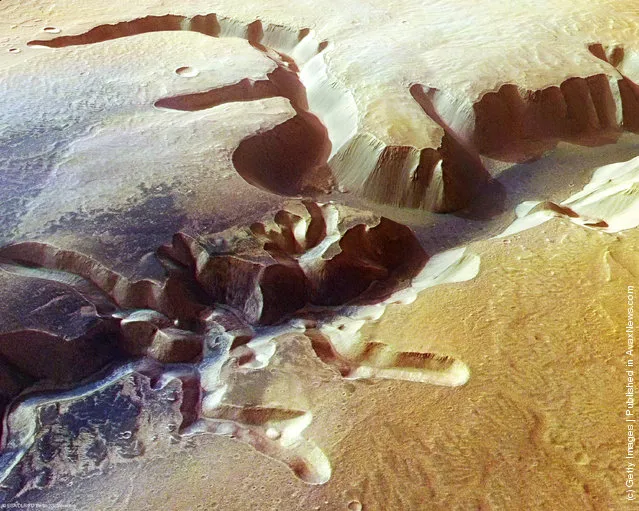
“Echus Chasma is a chasma in the Lunae Planum high plateau north of the Valles Marineris canyon system of Mars. Clay has been found in Echus Chasma that means that water once sat there for a time. Echus Chasma is approximately 100 km long and 10 km wide, with valleys ranging in depth from around 1 km to 4 km”. – Wikipedia

Photo: In this handout image supplied by the European Space Agency (ESA) on July 16, 2008, The Echus Chasma, one of the largest water source regions on Mars, is pictured from ESA's Mars Express. The data was acquired on September 25, 2005. The dark material shows a network of light-coloured, incised valleys that look similar to drainage networks known on Earth. It is still debated whether the valleys originate from precipitation, groundwater springs or liquid or magma flows on the surface. (Photo by ESA via Getty Images)
Details
18 Jul 2011 11:47:00
File photo of an iceberg floating near a harbour in the town of Kulusuk, east Greenland August 1, 2009. The United Nations 19th Climate Change Conference (COP19) will take place November 11-22, 2013 in Warsaw. The main goal of the talks with almost almost 200 nations assembled, is to lay the foundation for the new global climate agreement, aiming at further emission reduction, which is to be signed in 2015 in Paris and be launched in 2020. (Photo by Bob Strong/Reuters)

It's taken roughly five months, but a massive iceberg has separated from Antarctica's Pine Island Glacier. According to NASA's Earth Observatory, the estimated size of this iceberg, named B-31, is around 660 square kilometres (33 km long by 20 km wide) – a city-sized block of ice that has slowly migrated away from the continent, and is now floating out to sea. Take a look at some massive icebergs afloat in the oceans. Photo: File photo of an iceberg floating near a harbour in the town of Kulusuk, east Greenland August 1, 2009. (Photo by Bob Strong/Reuters)
Details
27 Apr 2014 07:47:00
NASA's New Space Launch System

“The Space Launch System, or SLS, is a Shuttle-Derived heavy launch vehicle being designed by NASA, following the cancellation of the Constellation Program, to replace the Space Shuttle after its retirement. The NASA Authorization Act of 2010 envisions the transformation of the Ares I and Ares V vehicle designs into a single launch vehicle usable for both crew and cargo. It is to be upgraded over time with more powerful versions. The proposed SLS is visually similar to the legacy Saturn V booster and in particular the proposed, two-stage, Saturn INT-20”. – Wikipedia

Photo: In this illustration provided by NASA, the design for a new space rocket system, the Space Launch System, is seen. NASA's new rocket design will reportedly cost about $35 billion and be ready to for test launch in 2017. According to NASA, the rocket will be used to carry Orion Multi-Purpose Crew Vehicle as well as cargo and science experiments to earth's orbit, as a backup for the space station and possibly destinations beyond that. (Illustration by NASA via Getty Images)
Details
15 Sep 2011 10:50:00
«After Presents», 1996. Siri Kaur: “I was 14 when Simran was born in 1990. We have different mothers, so we grew up separately and I made pictures with her whenever I saw her. The work of Sally Mann and Nan Goldin gave me permission to see my family as a valid art subject. This image shows the aftermath of Christmas morning. Simran is unselfconsciously lounging on the floor, melding into her beloved dog”. (Photo by Siri Kaur)

«After Presents», 1996. Siri Kaur: “I was 14 when Simran was born in 1990. We have different mothers, so we grew up separately and I made pictures with her whenever I saw her. The work of Sally Mann and Nan Goldin gave me permission to see my family as a valid art subject. This image shows the aftermath of Christmas morning. Simran is unselfconsciously lounging on the floor, melding into her beloved dog”. (Photo by Siri Kaur)
Details
10 Aug 2025 04:03:00


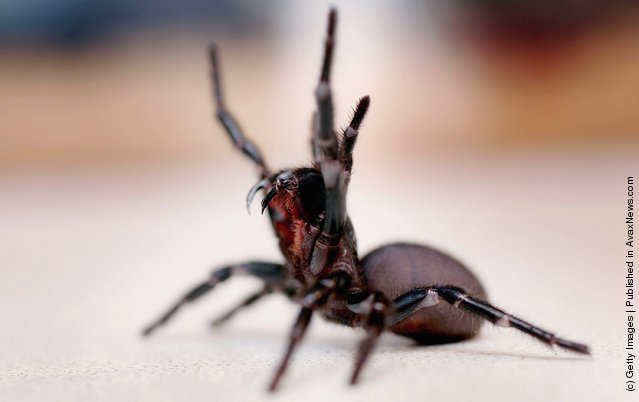
A Funnel Web spider is pictured at the Australian Reptile Park January 23, 2006 in Sydney, Australia. The Funnel Web is one of Australia's deadliest animals, with a venom that is packed with at least 40 different toxic proteins. A bite from a Funnel Web causes massive electrical over-load in the body's nervous system. Finally, fatalities occur from either heart attack or a pulmonary oedema, where the capillaries around the lungs begin to leak fluid and the patient effectively drowns. Death can come as quickly as two hours after a bite if no medical treatment is sought. Due to advances in anti-venom, there has been no death from a Funnel Web bite in Australia since 1980. Australia is home to some of the most deadly and poisonous animals on earth. (Photo by Ian Waldie/Getty Images)
Details
25 Apr 2011 07:49:00
Edinburgh Zoo is proud to introduce this baby three-banded armadillo Rica who was born to mum Rio and dad Rodar in Edinburgh, Scotland, UK on Sunday 24 August 2014. (Photo by SWNS/ABACAPress)

Edinburgh Zoo is proud to introduce this baby three-banded armadillo Rica who was born to mum Rio and dad Rodar in Edinburgh, Scotland, UK on Sunday 24 August 2014. A tiny 81g at birth and around the same size as a golf ball, Rica is a female three banded armadillo who has grown rapidly in her first month, already quadrupling in weight. (Photo by SWNS/ABACAPress)
Details
29 Sep 2014 10:31:00