Loading...
Done
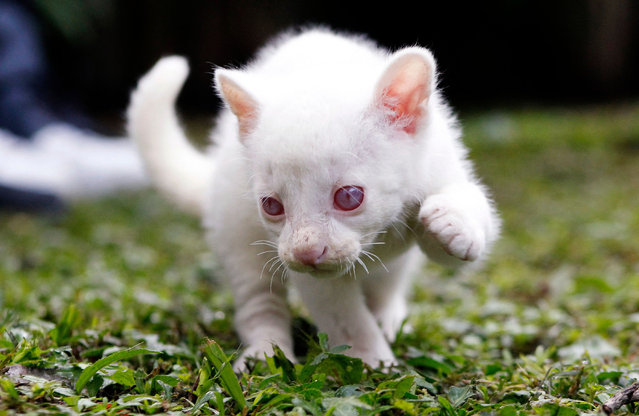
An alleged albino cub of Jaguarundi (Herpailurus yagouaroundi) plays at the Conservation Park in Medellin, Colombia, on December 23, 2021. According to environmentalists of the Conservation Park of Medellin, the little Jaguarundi will have to live in captivity as its albinism prevents it to hunt, camouflage, and protect itself from predators in the wild. (Photo by Fredy Builes/AFP Photo)

An alleged albino cub of Jaguarundi (Herpailurus yagouaroundi) plays at the Conservation Park in Medellin, Colombia, on December 23, 2021. According to environmentalists of the Conservation Park of Medellin, the little Jaguarundi will have to live in captivity as its albinism prevents it to hunt, camouflage, and protect itself from predators in the wild. (Photo by Fredy Builes/AFP Photo)
Details
02 Jan 2022 07:07:00
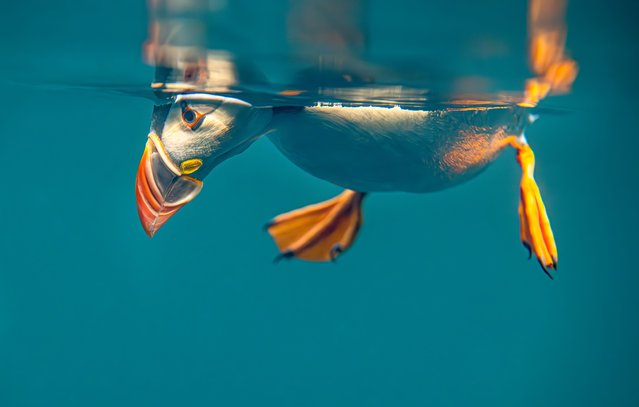
A puffin swims underwater in search for fish off the coast of the Farne Islands in Northumberland, North East England in the last decade of July 2025. (Photo by Brian Matthews/Solent News & Photo Agency)

A puffin swims underwater in search for fish off the coast of the Farne Islands in Northumberland, North East England in the last decade of July 2025. (Photo by Brian Matthews/Solent News & Photo Agency)
Details
03 Aug 2025 03:45:00
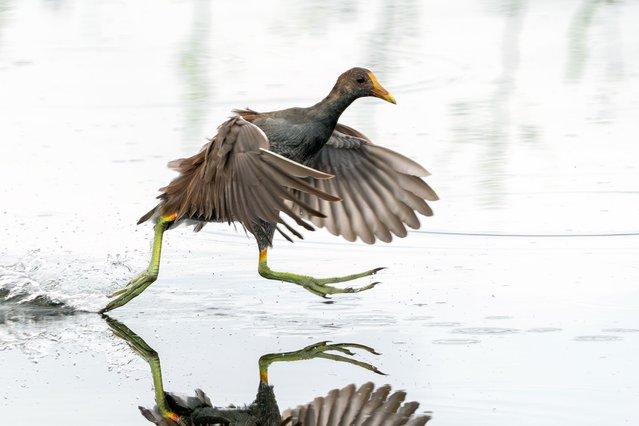
A common gallinule runs across the water to escape a nearby alligator at Green Cay Nature Center in Boynton Beach, Florida on September 4, 2025. Unlike most waterbirds, gallinules have long toes that allow them to walk on floating vegetation. The species is known for its loud, cackling calls that often echo through wetlands. (Photo by Ronen Tivony/NurPhoto/Rex Features/Shutterstock)

A common gallinule runs across the water to escape a nearby alligator at Green Cay Nature Center in Boynton Beach, Florida on September 4, 2025. Unlike most waterbirds, gallinules have long toes that allow them to walk on floating vegetation. The species is known for its loud, cackling calls that often echo through wetlands. (Photo by Ronen Tivony/NurPhoto/Rex Features/Shutterstock)
Details
21 Sep 2025 03:35:00
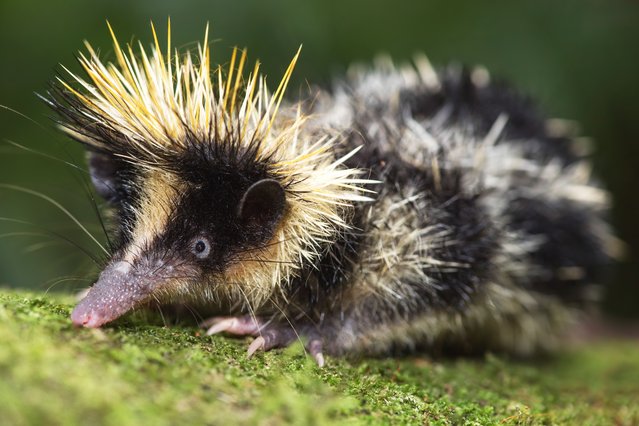
This spiky tenrec was spotted in Madagascar’s Mantadia National Park in the last decade of September 2025. Mostly nocturnal and rarely seen, it puffs out its spines when threatened. Spiky tenrecs are excellent swimmers — unlike most spiny mammals, some species of tenrec can forage in streams and rivers, using their spines for protection while hunting aquatic insects and small prey. (Photo by Dale Morris/Solent News & Photo Agency)

This spiky tenrec was spotted in Madagascar’s Mantadia National Park in the last decade of September 2025. Mostly nocturnal and rarely seen, it puffs out its spines when threatened. Spiky tenrecs are excellent swimmers — unlike most spiny mammals, some species of tenrec can forage in streams and rivers, using their spines for protection while hunting aquatic insects and small prey. (Photo by Dale Morris/Solent News & Photo Agency)
Details
05 Oct 2025 04:02:00
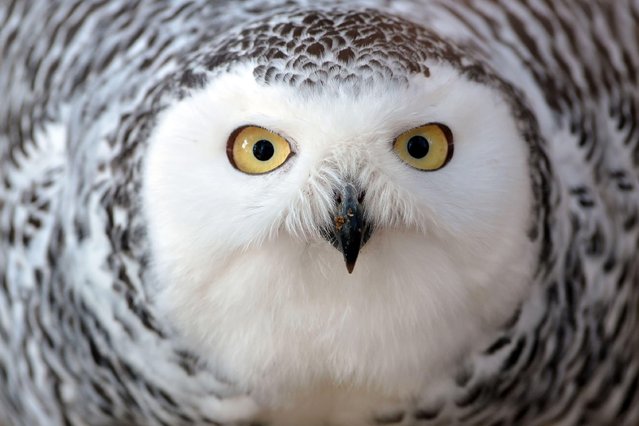
A snowy owl (Bubo scandiacus) raised by a falconer as part of a captive-breeding program, pictured in its enclosure in Vysocina, Czech Republic on October 22, 2025. (Photo by Slavek Ruta/ZUMA Press Wire via Alamy Live News)

A snowy owl (Bubo scandiacus) raised by a falconer as part of a captive-breeding program, pictured in its enclosure in Vysocina, Czech Republic on October 22, 2025. (Photo by Slavek Ruta/ZUMA Press Wire via Alamy Live News)
Details
02 Nov 2025 05:16:00
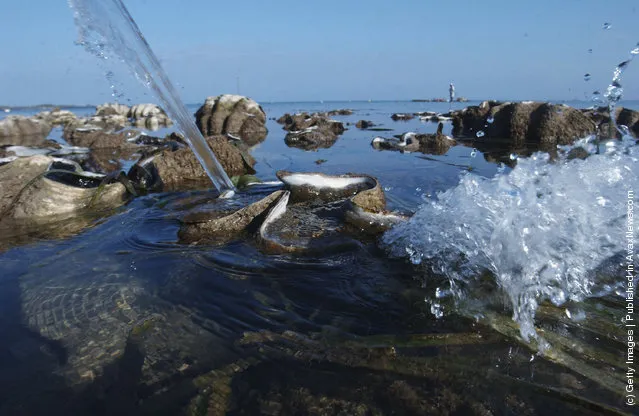
Tridacna Gigas, or Giant Clams

“The giant clam, Tridacna gigas (known as pā’ua in Cook Islands Māori), is the largest living bivalve mollusc. T. gigas is one of the most endangered clam species. It was mentioned as early as 1825 in scientific reports. One of a number of large clam species native to the shallow coral reefs of the South Pacific and Indian oceans, they can weigh more than 200 kilograms (440 lb) measure as much as 120 cm (47 in) across, and have an average lifespan in the wild of 100 years or more”. – Wikipedia

Photo: Tridacna Gigas, or Giant Clams spew water as a traditional fisherman passes by a small sanctuary on January 23, 2004 near Bolinao in the Northern Philippines. The clams, prime builders for coral reefs and providing shelter for spawning fish and other marine life, are exposed by low tides in the sanctuary. Overfishing and pollution throughout the country are not only threatening food security, but are also starting to choke one of the few working clam sanctuaries in the world. (Photo by David Greedy/Getty Images)

Details
01 Oct 2011 13:10:00
Heesco, Windsor. Born and raised in Mongolia and now living and working in Melbourne, Heesco is well known for his skill in rendering photo-realistic portraits. They speak to the viewer in a way that the subtext is enjoyable to decipher. Just what is the Blue Lady’s message? The sunglasses might mask the confronting gaze but her body language fills in the gaps. Heesco’s characters often wear traditional jewellery and clothing that remind us of his Mongolian cultural heritage. (Photo by Lou Chamberlin/The Guardian)

Heesco, Windsor. Born and raised in Mongolia and now living and working in Melbourne, Heesco is well known for his skill in rendering photo-realistic portraits. They speak to the viewer in a way that the subtext is enjoyable to decipher. Just what is the Blue Lady’s message? The sunglasses might mask the confronting gaze but her body language fills in the gaps. Heesco’s characters often wear traditional jewellery and clothing that remind us of his Mongolian cultural heritage. (Photo by Lou Chamberlin/The Guardian)
Details
26 Dec 2017 08:28:00
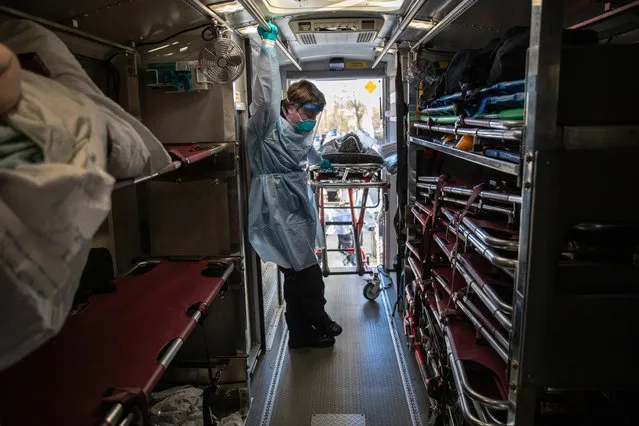
EMT Christian Amoroso, wearing personal protective equipment (PPE), pauses while unloading COVID-19 patients at the Montefiore Medical Center Wakefield Campus on April 06, 2020 in the Bronx borough of New York City. A specialized bus known as a Medical Evacuation Transport Unit (METU), caries infected patients on stretchers and benches between hospitals. The patient transfers are designed to help overwhelmed hospitals even out caseloads in Westchester County and New York City at the epicenter of the U.S. coronavirus pandemic. The patients were being transferred from the Einstein Campus, Wyler Hospital, also a Bronx Montefiore hospital. The transfers are staffed by Empress EMS, Yonkers police and hospital staff on both ends wearing PPE. (Photo by John Moore/Getty Images)

EMT Christian Amoroso, wearing personal protective equipment (PPE), pauses while unloading COVID-19 patients at the Montefiore Medical Center Wakefield Campus on April 06, 2020 in the Bronx borough of New York City. A specialized bus known as a Medical Evacuation Transport Unit (METU), caries infected patients on stretchers and benches between hospitals. (Photo by John Moore/Getty Images)
Details
19 Apr 2020 00:01:00