Loading...
Done
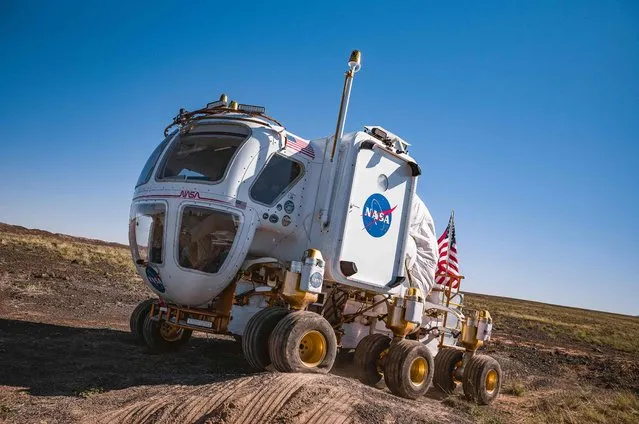
NASAs Desert Research and Technology Studies (Desert RATS) team members practice with a Moon rover prototype for future Artemis missions at the Black Point Lava Flow near Flagstaff, Arizona, on October 24, 2022. (Photo by Olivier Touron/AFP Photo)

NASAs Desert Research and Technology Studies (Desert RATS) team members practice with a Moon rover prototype for future Artemis missions at the Black Point Lava Flow near Flagstaff, Arizona, on October 24, 2022. (Photo by Olivier Touron/AFP Photo)
Details
20 Dec 2023 22:31:00
Models on the catwalk for the launch of retailer Myer’s autumn 17 collection at the University of Melbourne, Australia on February 16, 2017. (Photo by Tracey Nearmy/AAP)

Models on the catwalk for the launch of retailer Myer’s autumn 17 collection at the University of Melbourne, Australia on February 16, 2017. (Photo by Tracey Nearmy/AAP)
Details
18 Feb 2017 00:02:00
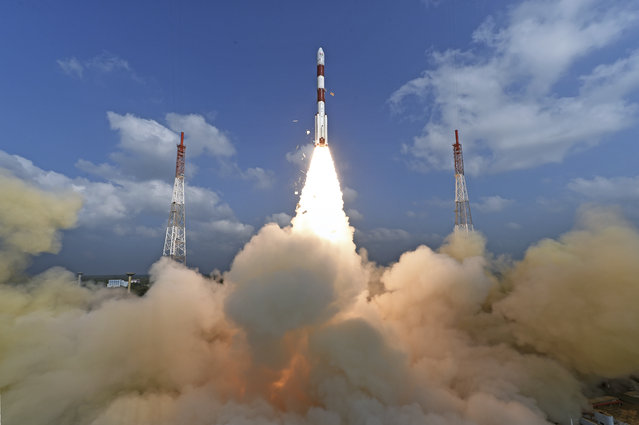
This photograph released by Indian Space Research Organization shows its polar satellite launch vehicle lifting off from a launch pad at the Satish Dhawan Space Centre in Sriharikota, India, Wednesday, February 15, 2017. India's space agency said it successfully launched more than 100 foreign nano satellites into orbit Wednesday aboard a single rocket.(Photo by Indian Space Research Organization via AP Photo)

This photograph released by Indian Space Research Organization shows its polar satellite launch vehicle lifting off from a launch pad at the Satish Dhawan Space Centre in Sriharikota, India, Wednesday, February 15, 2017. India's space agency said it successfully launched more than 100 foreign nano satellites into orbit Wednesday aboard a single rocket.(Photo by Indian Space Research Organization via AP Photo)
Details
16 Feb 2017 11:18:00
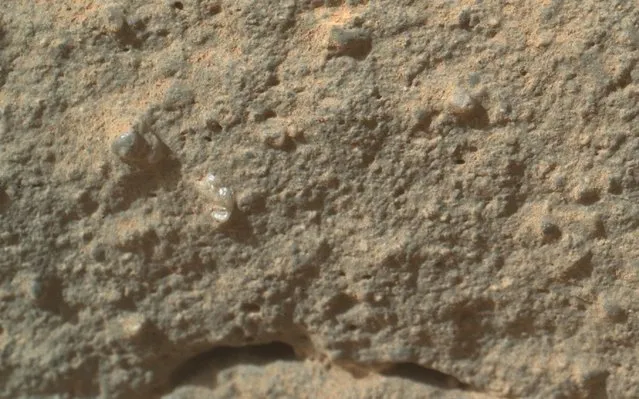
Scientists say that a “Martian flower”, seen here in an image from the Curiosity rover's Mars Hand Lens Imager, is a 2-millimeter-wide grain or pebble that's embedded in the surrounding rock. Another, darker-colored mineral grain can be seen above and to the left. (Photo by NASA)

“The scientists behind NASA's $2.5 billion Curiosity rover mission on Mars on Tuesday explained the nature of a tiny, gleaming "flower" embedded in Red Planet rock, and revealed where they'll be using the SUV-sized robot's drill for the first time”. – Alan Boyle via NBCNews.com

Photo: Scientists say that a “Martian flower”, seen here in an image from the Curiosity rover's Mars Hand Lens Imager, is a 2-millimeter-wide grain or pebble that's embedded in the surrounding rock. Another, darker-colored mineral grain can be seen above and to the left. (Photo by NASA)
Details
16 Jan 2013 11:12:00


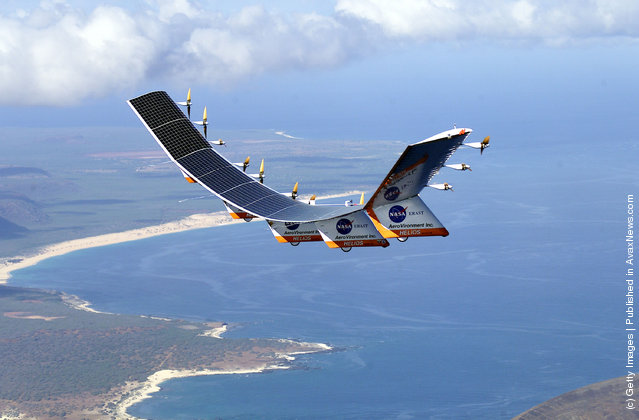
“NASA's Pathfinder, Pathfinder Plus, Centurion and Helios Prototype were an evolutionary series of solar- and fuel-cell-system-powered unmanned aerial vehicles. AeroVironment, Inc. developed the vehicles under NASA's Environmental Research Aircraft and Sensor Technology (ERAST) program. They were built to develop the technologies that would allow long-term, high-altitude aircraft to serve as “atmospheric satellites”, to perform atmospheric research tasks as well as serve as communications platforms”. – Wikipedia

Photo: The solar-electric Helios Prototype flying wing is flies over the Hawaiian islands of Niihau and Lehua during the first solar-powered test flight July 14, 2001 from the U.S. Navy's Pacific Missile Range Facility on Kauai, HI. The 18-hour flight was a functional checkout of the aircraft's systems and performance in preparation for an attempt to reach sustained flight at 100,000 feet altitude later in the summer. (Photo Courtesy of NASA/Getty Images)

Details
14 Jul 2011 09:24:00
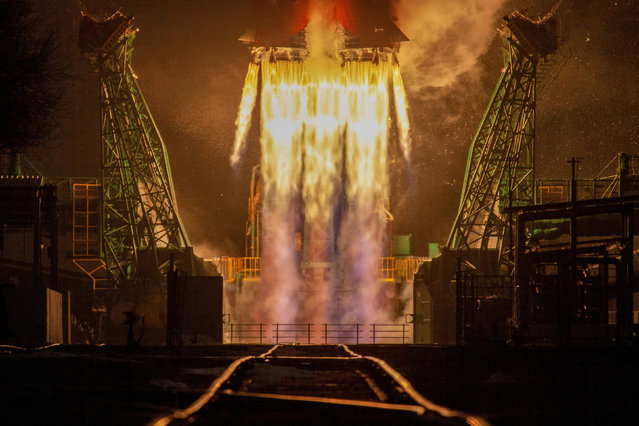
The Soyuz 2.1b rocket with a Fregat-M booster and meteorology and emergency communications satellite Arktika-M No 1 launches from Baikonur Cosmodrome in Baikonur, Kazakhstan on February 28, 2021. Arktika-M No 1 is the first of ten Arktika satellites to be launched by Roscosmos into orbit. (Photo by Roscomos/TASS)

The Soyuz 2.1b rocket with a Fregat-M booster and meteorology and emergency communications satellite Arktika-M No 1 launches from Baikonur Cosmodrome in Baikonur, Kazakhstan on February 28, 2021. Arktika-M No 1 is the first of ten Arktika satellites to be launched by Roscosmos into orbit. (Photo by Roscomos/TASS)
Details
10 Mar 2021 10:12:00
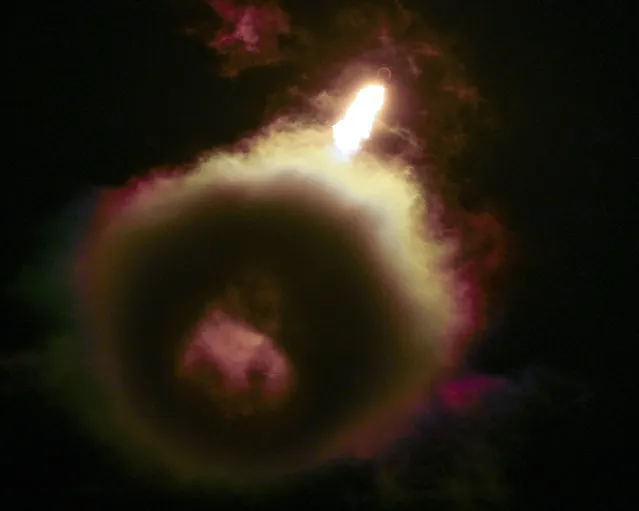
A SpaceX Falcon 9 rocket breaks the sound barrier as it launches the next batch of Starlink satellites (mission; Starlink 6-7), at 12:01 AM from Launch Complex 40 at the Cape Canaveral Space Force Station, Florida on Friday, July 28, 2023. (Photo by Joe Marino/UPI/Rex Features/Shutterstock)

A SpaceX Falcon 9 rocket breaks the sound barrier as it launches the next batch of Starlink satellites (mission; Starlink 6-7), at 12:01 AM from Launch Complex 40 at the Cape Canaveral Space Force Station, Florida on Friday, July 28, 2023. (Photo by Joe Marino/UPI/Rex Features/Shutterstock)
Details
02 Aug 2023 03:01:00
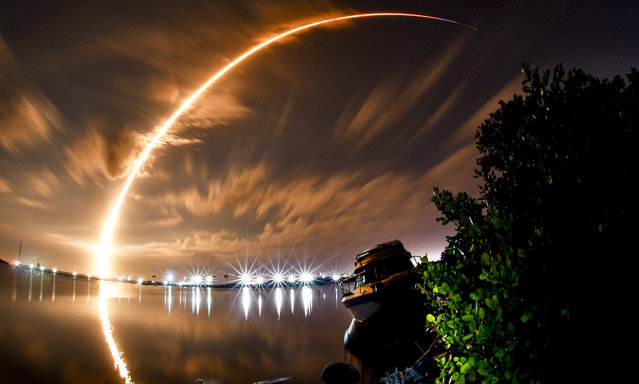
A three minute time exposure shows the launch of a SpaceX Falcon 9 from Cape Canaveral Space Force Station Launch Complex 40, Thursday, January 7, 2021 in Port Canaveral, Fla. The rocket is carrying the Turksat 5A satellite for Turkey. (Photo by Malcolm Denenark/Florida Today via AP Photo)

A three minute time exposure shows the launch of a SpaceX Falcon 9 from Cape Canaveral Space Force Station Launch Complex 40, Thursday, January 7, 2021 in Port Canaveral, Fla. The rocket is carrying the Turksat 5A satellite for Turkey. (Photo by Malcolm Denenark/Florida Today via AP Photo)
Details
18 Jan 2021 00:01:00