Italian Prime Minister Silvio Berlusconi and Miss Italia 2008 Miriam Leone appear on “Porta a Porta” in Rome, Italy on September 15, 2008. (Photo by WENN)
A woman from the Pataxo tribe poses for a photo at an indigenous protest camp on the fourth day of the Terra Livre Indigenous Camp in Brasilia on April 7, 2022. The 10-day annual protest is held by indigenous people from tribes that arrive from all over Brazil, and calls for greater protection of their land and rights. (Photo by Carl de Souza/AFP Photo)
Robots of the Zurich Federal Institute of Technology play a football game during the International Telecommunication Union (ITU) AI for Good Global Summit in Geneva on May 30, 2024. (Photo by Fabrice Coffrini/AFP Photo)
People gather outside Red Square and the Kremlin for the New Year celebrations in downtown Moscow late on December 31, 2023. (Photo by Tatyana Makeyeva/AFP Photo)
An illumination is held at a commercial facility “NAMBA PARKS” in Osaka City, Osaka Prefecture on November 15, 2022. Approximately 650,000 LED (light-emitting diode) bulbs are decorated to imagine waterfalls and meadows at the event. (Photo by Naoya Azuma/Yomiuri/The Yomiuri Shimbun via AFP Photo)
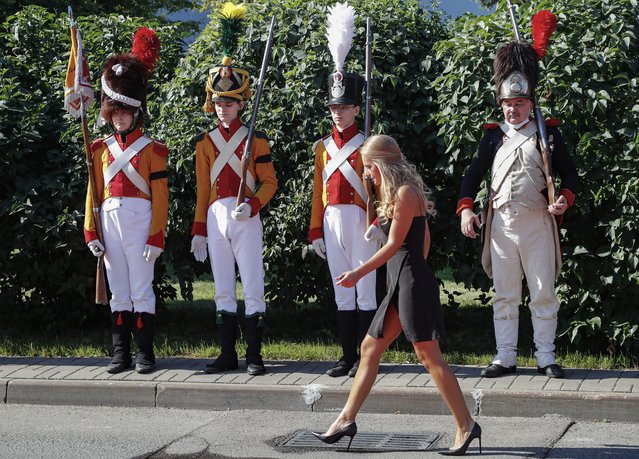
A participant of the “Mrs Universe 2015” contest from Caribbean Coast, Mayra Joli poses for a photo with a woman during their visit in central botanical garden in Minsk, Belarus, August 25, 2015. (Photo by Vasily Fedosenko/Reuters)
Sydney resident Virginia Maddock watches the supermoon rise off the Sydney beachside suburb of Wanda, August 10, 2014. Sunday’s moon was at its closest approach to Earth, appearing bigger and brighter than any other moon this year. The moon was 221,765 miles away and looked 16 percent larger and 30 percent brighter than usual. (Photo by Jason Reed/Reuters)
An infrared portrait from NASA's Spitzer Space Telescope which shows generations of stars is seen in this undated NASA handout image released February 14, 2013. In this wispy star-forming region, called W5, the oldest stars can be seen as blue dots in the centers of the two hollow cavities (other blue dots are background and foreground stars not associated with the region). Red shows heated dust that pervades the region's cavities, while green highlights dense clouds. (Photo by NASA/Reuters/JPL-Caltech/Harvard-Smithsonian/Handout)