Loading...
Done
A man walks behind camels at the Birqash Camel Market, ahead of Eid al-Adha or Festival of Sacrifice, on the outskirts of Cairo September 29, 2014. (Photo by Amr Abdallah Dalsh/Reuters)

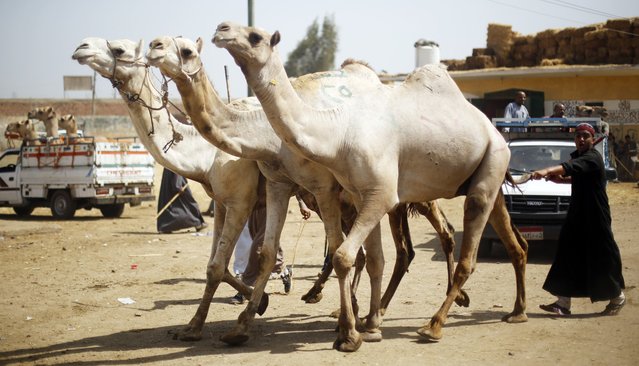
A man walks behind camels at the Birqash Camel Market, ahead of Eid al-Adha or Festival of Sacrifice, on the outskirts of Cairo September 29, 2014. Birqash Camel Market, one of the biggest markets for camel meat in Africa, draws sellers from Libya, Sudan, Somalia and other regions in Egypt. The camels sold at the market are also used in tourism. Traders say that the selling rate for a camel in 2014 is anywhere between 5,000 and 20,000 Egyptian pounds (700 – 2800 USD). (Photo by Amr Abdallah Dalsh/Reuters)
Details
02 Oct 2014 10:20:00


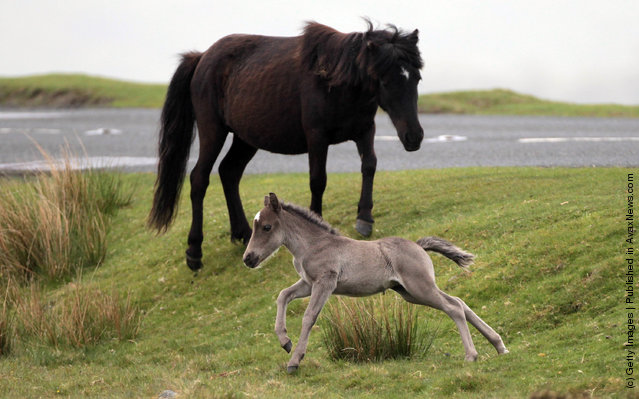
A Dartmoor Hill pony foal runs on the moor on Dartmoor on May 17, 2011 in Princetown England. Although a tourist attraction, especially during the foaling season and often seen as part of the landscape of Dartmoor, many ponies face an uncertain future due to unsustainable breeding and their falling market values. The charity South West Equine Protection estimates that last year 1500 ponies were slaughtered – with many being sold for lion meat to nearby zoos. Along with other equine charities, they are calling for the removal of stallions from the moor to bring numbers down to sustainable levels. (Photo by Matt Cardy/Getty Images)
Details
18 May 2011 11:15:00
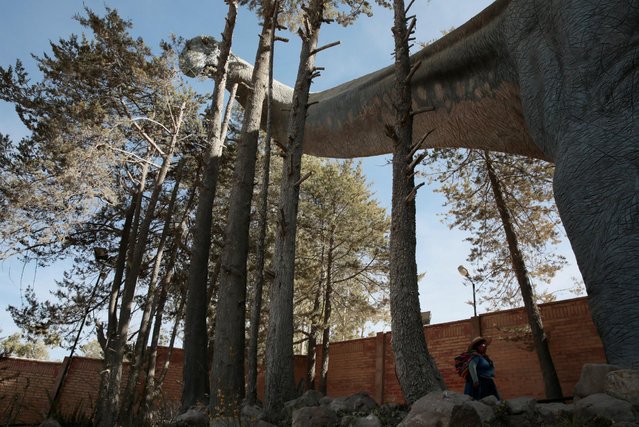
A visitor walks underneath a replica of a Titanosaur at the Cretaceous park in Cal Orcko, on the outskirts of Sucre, Bolivia, July 22, 2016. (Photo by David Mercado/Reuters)

A visitor walks underneath a replica of a Titanosaur at the Cretaceous park in Cal Orcko, on the outskirts of Sucre, Bolivia, July 22, 2016. A footprint measuring over a meter wide that was made by a meat-eating predator some 80 million years ago has been discovered in Bolivia, one of the largest of its kind ever found. (Photo by David Mercado/Reuters)
Details
28 Jul 2016 13:32:00
A devotee of the Chinese Samkong Shrine walks with flowers pierced through his cheeks during a procession celebrating the annual vegetarian festival in Phuket, Thailand, October 16, 2015. (Photo by Jorge Silva/Reuters)

A devotee of the Chinese Samkong Shrine walks with flowers pierced through his cheeks during a procession celebrating the annual vegetarian festival in Phuket, Thailand, October 16, 2015. The festival, featuring face-piercing, spirit mediums and strict vegetarianism celebrates the local Chinese community's belief that abstinence from meat and various stimulants during the ninth lunar month of the Chinese calendar will help them obtain good health and peace of mind. (Photo by Jorge Silva/Reuters)
Details
19 Oct 2015 08:06:00
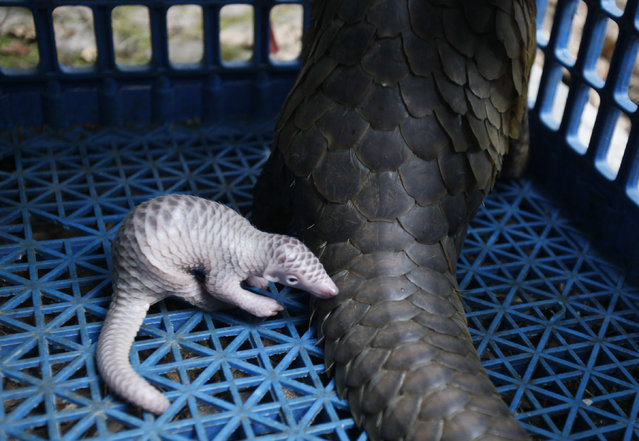
A baby pangolin sits with its mother inside a cage prior to their release into the wild in Sibolangit, North Sumatra, Indonesia, Monday, April 27, 2015. (Photo by Binsar Bakkara/AP Photo)

A baby pangolin sits with its mother inside a cage prior to their release into the wild in Sibolangit, North Sumatra, Indonesia, Monday, April 27, 2015. The anteaters are part of dozens of live pangolins and around five tons (11,000 lbs) of pangolin meat ready to be shipped abroad confiscated in a police a raid last week. (Photo by Binsar Bakkara/AP Photo)
Details
29 Apr 2015 06:16:00
A health worker shows an empty syringe after inoculating a woman with AstraZeneca's COVID-19 vaccine during the first day of a nationwide three-day vaccination drive at a school in Quezon city, Philippines on Monday, November 29, 2021. There has been no reported infection so far caused by the new variant in the Philippines, a Southeast Asian pandemic hotspot where COVID-19 cases have considerably dropped to below 1,000 each day in recent days, but the emergence of the Omicron variant has set off a new alarm. (Photo by Aaron Favila/AP Photo)

A health worker shows an empty syringe after inoculating a woman with AstraZeneca's COVID-19 vaccine during the first day of a nationwide three-day vaccination drive at a school in Quezon city, Philippines on Monday, November 29, 2021. There has been no reported infection so far caused by the new variant in the Philippines, a Southeast Asian pandemic hotspot where COVID-19 cases have considerably dropped to below 1,000 each day in recent days, but the emergence of the Omicron variant has set off a new alarm. (Photo by Aaron Favila/AP Photo)
Details
30 Nov 2021 08:56:00
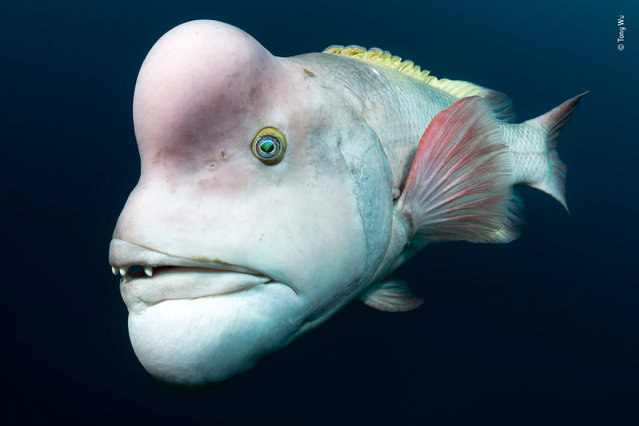
Looking for love by Tony Wu, USA. Highly commended, Animal Portraits. “Accentuating his mature appearance with pastel colours, protruding lips and an outstanding pink forehead, this Asian sheepshead wrasse sets out to impress females and see off rivals, which he will head-butt and bite, near Japan’s remote Sado Island. Individuals start out as females, and when they reach a certain age and size – up to a metre (more than 3 feet) long – can transform into males. Long-lived and slow-growing, the species is intrinsically vulnerable to overfishing”. (Photo by Tony Wu/2018 Wildlife Photographer of the Year)

Looking for love by Tony Wu, USA. Highly commended, Animal Portraits. “Accentuating his mature appearance with pastel colours, protruding lips and an outstanding pink forehead, this Asian sheepshead wrasse sets out to impress females and see off rivals, which he will head-butt and bite, near Japan’s remote Sado Island. Individuals start out as females, and when they reach a certain age and size – up to a metre (more than 3 feet) long – can transform into males. Long-lived and slow-growing, the species is intrinsically vulnerable to overfishing”. (Photo by Tony Wu/2018 Wildlife Photographer of the Year)
Details
03 Sep 2018 08:17:00
Young cheetahs eat meat at The Cheetah Conservation Fund (CCF) center in Otjiwarongo, Namibia, on August 13, 2013. The CCF started breeding Anatolian livestock dogs to promote cheetah-friendly farming after some 10,000 big cats – the current total worldwide population – were killed or moved off farms in the 1980s.  Up to 1,000 cheetahs were being killed a year, mostly by farmers who saw them as livestock killers. But the use of dogs has slashed losses for sheep and goat farmers and led to less retaliation against the vulnerable cheetah. (Photo by Jennifer Bruce/AFP Photo)

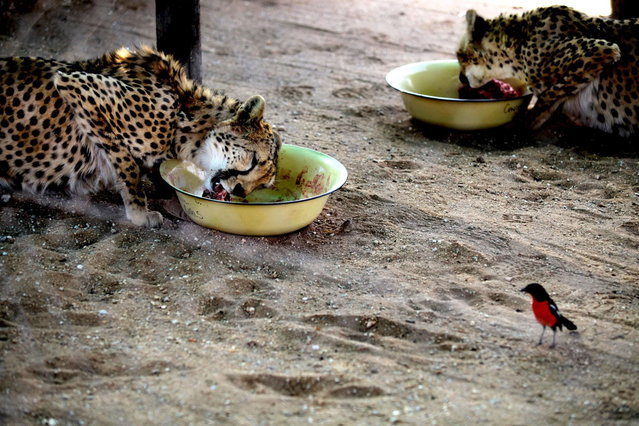
Young cheetahs eat meat at The Cheetah Conservation Fund (CCF) center in Otjiwarongo, Namibia, on August 13, 2013. The CCF started breeding Anatolian livestock dogs to promote cheetah-friendly farming after some 10,000 big cats – the current total worldwide population – were killed or moved off farms in the 1980s. Up to 1,000 cheetahs were being killed a year, mostly by farmers who saw them as livestock killers. But the use of dogs has slashed losses for sheep and goat farmers and led to less retaliation against the vulnerable cheetah. (Photo by Jennifer Bruce/AFP Photo)
Details
29 Aug 2013 10:56:00