Musher Michael Ruopp of Germany starts with his sled dogs at the 23rd International Sled Dog Race in Oberhof, central Germany, Sunday, February 24, 2013. (Photo by Jens Meyer/AP Photo)
A German fan cheers prior to the Group A match between Germany and Scotland at the Euro 2024 soccer tournament in Munich, Germany, Friday, June 14, 2024. (Photo by Antonio Calanni/AP Photo)
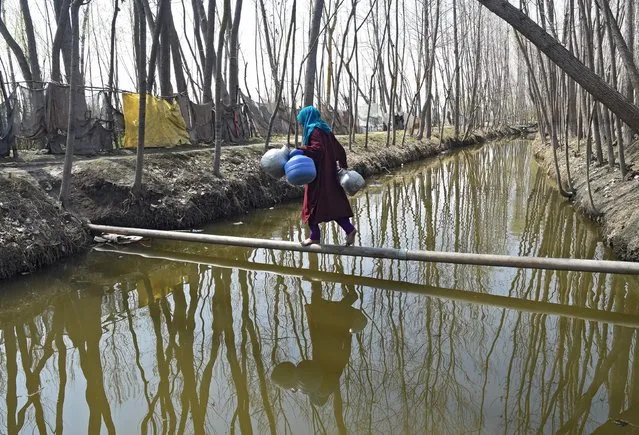
A Kashmiri Muslim woman balances on a water pipe before collecting water at Dasilpora village on March 22, 2018. World Water Day is held annually on 22 March as a means of focusing attention on the importance of freshwater and advocating for the sustainable management of freshwater resources. (Photo by Tauseef Mustafa/AFP Photo)
Ameca, a humanoid robot developed by the British company Engineered Arts Digital, at the Re:publica trade fair in Berlin, Germany on May 28, 2024. (Photo by dts News Agency Germany/Rex Features/Shutterstock)
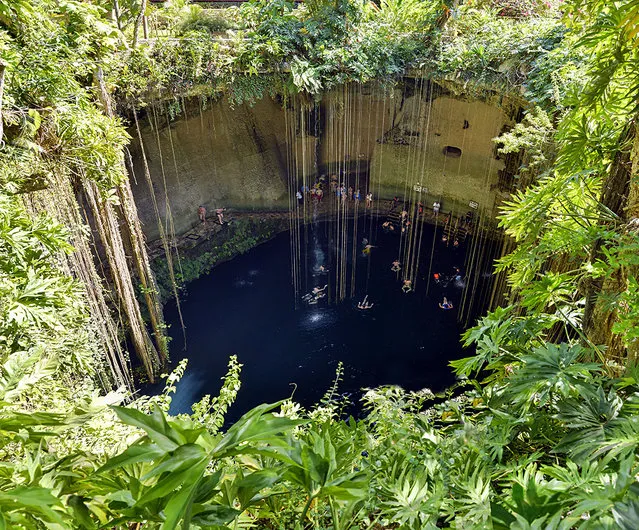
A cenote is a natural phenomenon, a sinkhole in the Earth’s surface. The Yucatan Peninsula in Mexico has an estimated 7,000 cenotes because it is primarily made up of porous limestone. For millions of years, rainfall slowly ate away at the limestone and a huge system of underground caves and caverns was formed. Many filled with water from rain or from the underground water table. When the roof of a water filled cave collapses, a cenote is born. The water found in a cenote may be fresh water, salt water, or both. Structurally it may be completely open, like a lake, almost completely closed with just a small opening at the top, or somewhere in between.
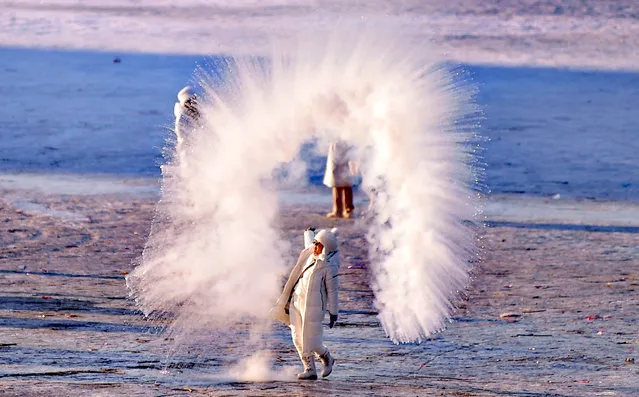
A tourist splashes water on the frozen Songhua River on December 18, 2023 in Harbin, Heilongjiang Province of China. The water immediately freezes into ice in the frigid air. (Photo by VCG/VCG via Getty Images)
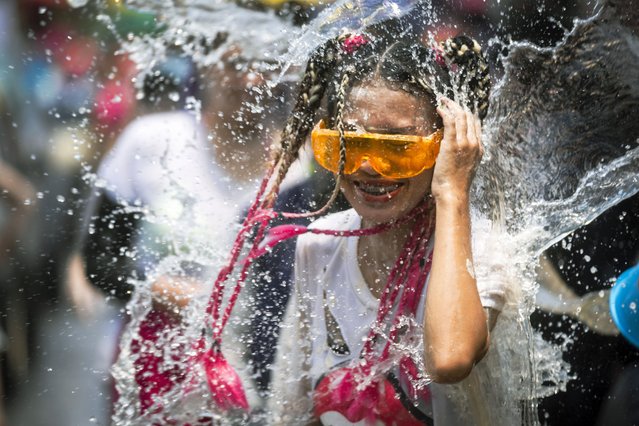
A bucket of water is splashed on a woman during the Songkran water festival to celebrate the Thai New Year, in Prachinburi Province, Thailand, April 13, 2024. (Photo by Wason Wanichakorn/AP Photo)