Loading...
Done
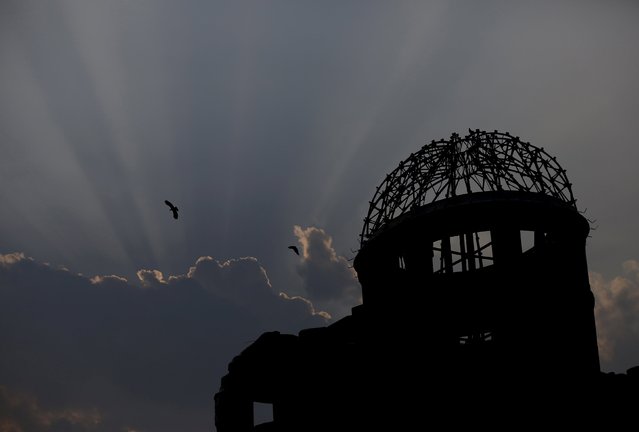
Birds fly over the Atomic Bomb Dome in Hiroshima, western Japan July 29, 2015. On August 6, 1945, the U.S. dropped the atomic bomb on Hiroshima, killing about 140,000 by the end of the year in a city of 350,000 residents, in the world's first nuclear attack. (Photo by Issei Kato/Reuters)

Birds fly over the Atomic Bomb Dome in Hiroshima, western Japan July 29, 2015. On August 6, 1945, the U.S. dropped the atomic bomb on Hiroshima, killing about 140,000 by the end of the year in a city of 350,000 residents, in the world's first nuclear attack. Three days later, a second atomic bomb was dropped on Nagasaki. Influenced by the shadows scorched into outdoor surfaces by the heat of the blasts 70 years ago, Reuters photographer Issei Kato pays homage to survivors, residents and historic buildings in both cities in a personal project that captures the shadows of today. (Photo by Issei Kato/Reuters)
Details
04 Aug 2015 12:01:00
Negin Ekhpulwak, leader of the Zohra orchestra, an ensemble of 35 women, practises on a piano at Afghanistan's National Institute of Music, in Kabul, Afghanistan April 9, 2016. (Photo by Ahmad Masood/Reuters)

Negin Ekhpulwak, leader of the Zohra orchestra, an ensemble of 35 women, practises on a piano at Afghanistan's National Institute of Music, in Kabul, Afghanistan April 9, 2016. Playing instruments was banned under Taliban rule in Afghanistan, and even today, many conservative Muslims frown on most forms of music. Living in an orphanage in the capital, Kabul, 19-year-old Negin Ikhpolwak leads an ensemble of 35 women that plays both Western and Afghan musical instruments. In a country notorious internationally for harsh restrictions on women in most areas of life, Negin's story highlights a double challenge. (Photo by Ahmad Masood/Reuters)
Details
19 Apr 2016 13:47:00
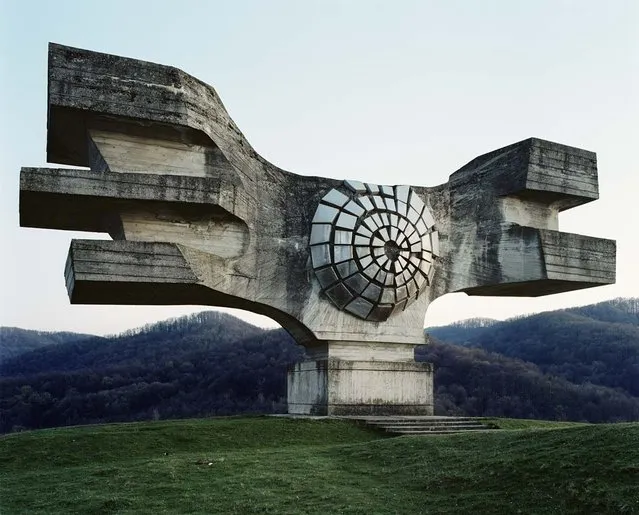
The monument of Ilirska Bistrica was designed by Janez Lenassi and built in 1965. It is dedicated to Slovenian soldiers that fell in World War II. (Photo by Jan Kempenaers)

The brutalist war memorials found throughout the former Yugoslavia were weird enough when they were built in the 1960s and 70s. Today, separated by the end of an architectural movement and the disintegration of the country, they seem almost alien. Belgian photographer Jan Kempenaers treats them purely as artistic objects in his book, “Spomenik”, named for the Serb-Croat word for monument. Known for photographing geographical oddities, Kempenaers was captivated by the spomenik after seeing them in an art encyclopedia. After hearing that many had been destroyed or abandoned, he set out to record what was left. (Photo by Jan Kempenaers)
Details
18 Aug 2014 09:07:00
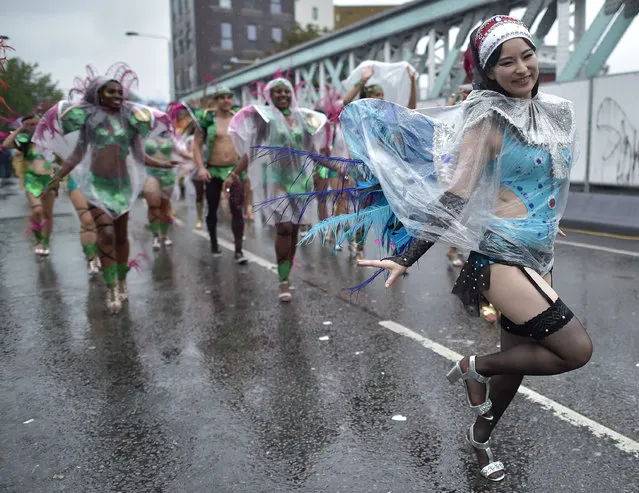
Performers in costume perform in the rain during the parade on the second day of the Notting Hill Carnival in west London on August 31, 2015. Nearly one million people are expected by the organizers Sunday and Monday in the streets of west London's Notting Hill to celebrate Caribbean culture at a carnival considered the largest street demonstration in Europe.  (Photo by Leon Neal/AFP Photo)

Performers in costume perform in the rain during the parade on the second day of the Notting Hill Carnival in west London on August 31, 2015. Nearly one million people are expected by the organizers Sunday and Monday in the streets of west London's Notting Hill to celebrate Caribbean culture at a carnival considered the largest street demonstration in Europe. The Notting Hill Carnival started in the 1960s, when the area had a large population of immigrants recently arrived from the Caribbean and was notorious for its slums – a far cry from today when it is one of London's most expensive places to live. (Photo by Leon Neal/AFP Photo)
Details
01 Sep 2015 15:17:00
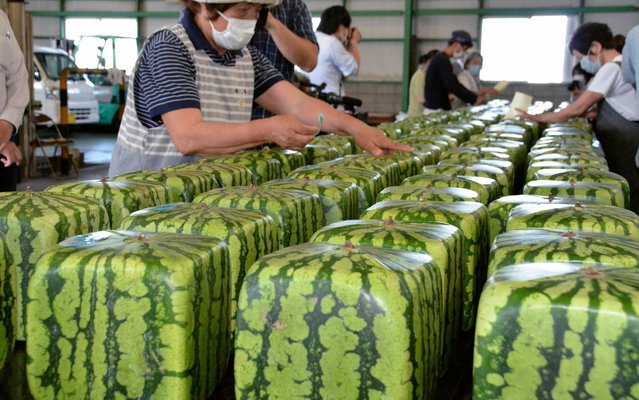
Japan Agricultural Cooperation Kagawa employees arrange cubic watermelons to be shipped within the country, in Zentsuji city, Kagawa prefecture, western Japan, Wednesday, June 24, 2020. The about 18x18x18-centimeter (7x7x7-inch) square watermelons, grown in transparent square containers, will be sold for about 10,000 yen ($94) each. (Photo ny Maiko Hirai/Kyodo News via AP Photo)

Japan Agricultural Cooperation Kagawa employees arrange cubic watermelons to be shipped within the country, in Zentsuji city, Kagawa prefecture, western Japan, Wednesday, June 24, 2020. The about 18x18x18-centimeter (7x7x7-inch) square watermelons, grown in transparent square containers, will be sold for about 10,000 yen ($94) each. (Photo ny Maiko Hirai/Kyodo News via AP Photo)
Details
08 Jul 2020 00:05:00
Hotel staff demonstrates “Lantern Dining Experience”, which enables diners to enjoy meals while protecting themselves against the spread of the coronavirus disease (COVID-19) at Hoshinoya Tokyo in Tokyo, Japan, February 2, 2022. The lantern-shaped transparent partitions are created by Japan’s traditional craftsman and guests staying at the hotel who pay 30,000 yen (about 260 USD) as venue charge can invite others to dine with them under the partitions. (Photo by Kim Kyung-Hoon/Reuters)

Hotel staff demonstrates “Lantern Dining Experience”, which enables diners to enjoy meals while protecting themselves against the spread of the coronavirus disease (COVID-19) at Hoshinoya Tokyo in Tokyo, Japan, February 2, 2022. The lantern-shaped transparent partitions are created by Japan’s traditional craftsman and guests staying at the hotel who pay 30,000 yen (about 260 USD) as venue charge can invite others to dine with them under the partitions. (Photo by Kim Kyung-Hoon/Reuters)
Details
11 Feb 2022 06:55:00
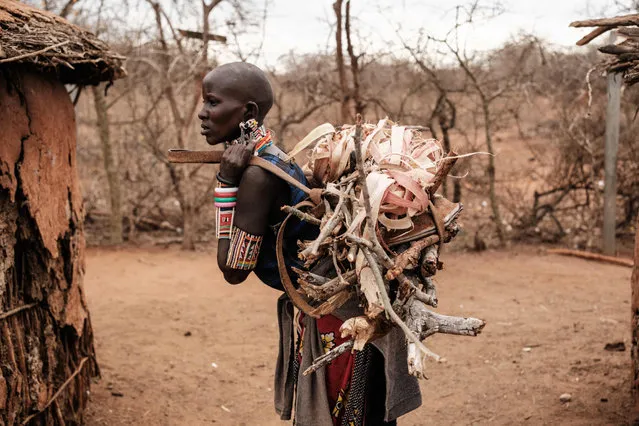
A Maasai woman arrives with collected firewoods at a village nearby Selenkay Conservancy, a community-owned conservation area running by a private company, in Amboseli, Kenya, on June 22, 2022. The camp's ten luxurious tents see tourists flocking again, after the shutdown linked to Covid-19. They observe in small groups elephants, giraffes, antelopes or lions on 5,000 hectares, located on the edge of Amboseli National Park, in the south of the country, and have a glimpse of the life of the Masai, the owners of the land. (Photo by Yasuyoshi Chiba/AFP Photo)

A Maasai woman arrives with collected firewoods at a village nearby Selenkay Conservancy, a community-owned conservation area running by a private company, in Amboseli, Kenya, on June 22, 2022. The camp's ten luxurious tents see tourists flocking again, after the shutdown linked to Covid-19. They observe in small groups elephants, giraffes, antelopes or lions on 5,000 hectares, located on the edge of Amboseli National Park, in the south of the country, and have a glimpse of the life of the Masai, the owners of the land. (Photo by Yasuyoshi Chiba/AFP Photo)
Details
22 Jul 2022 04:32:00
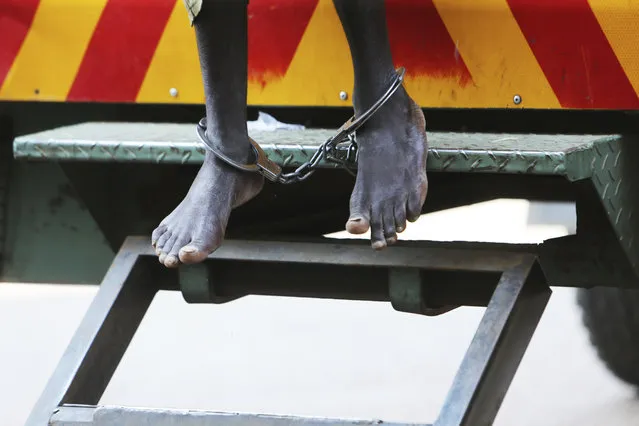
A man arrested for protesting over human rights abuses makes a court appearance in leg irons at the magistrates courts in Harare, Monday, September 14, 2020. Human rights defenders say it appears the government is using restrictions imposed to combat COVID-19 to suppress political criticism. Opposition officials, human rights groups and some analysts accuse Mnangagwa of abusing the rights of critics, using tactics as harsh as his predecessor, the late Robert Mugabe. (Photo by Tsvangirayi Mukwazhi/AP Photo)

A man arrested for protesting over human rights abuses makes a court appearance in leg irons at the magistrates courts in Harare, Monday, September 14, 2020. Human rights defenders say it appears the government is using restrictions imposed to combat COVID-19 to suppress political criticism. Opposition officials, human rights groups and some analysts accuse Mnangagwa of abusing the rights of critics, using tactics as harsh as his predecessor, the late Robert Mugabe. (Photo by Tsvangirayi Mukwazhi/AP Photo)
Details
28 Sep 2020 00:01:00