Zimbabwe University students run away from police during a protest outside the magistrates courts in Harare, Monday, September 14, 2020. Police broke up the protest and arrested some students demonstrating in support of a university union leader who was making a court appearance following his arrest for protesting against human rights abuses in the country. (Photo by Tsvangirayi Mukwazhi/AP Photo)
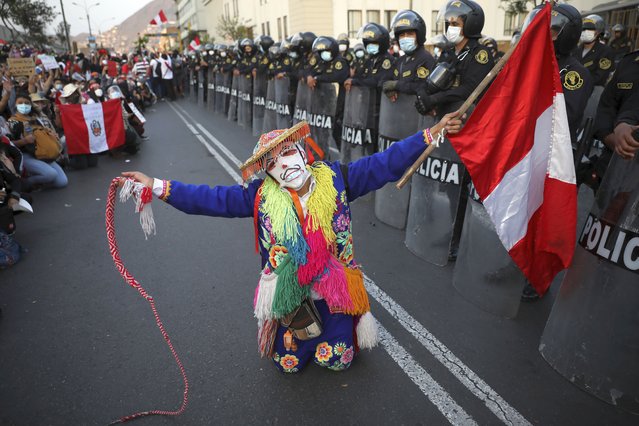
Local folk artists perform next to a police line outside Congress building, as they wait for news from inside on who will be the country's next president, in Lima, Peru, Sunday, November 15, 2020. Interim President Manuel Merino announced his resignation following massive protests unleashed when lawmakers ousted President Martin Vizcarra. (Photo by Rodrigo Abd/AP Photo)
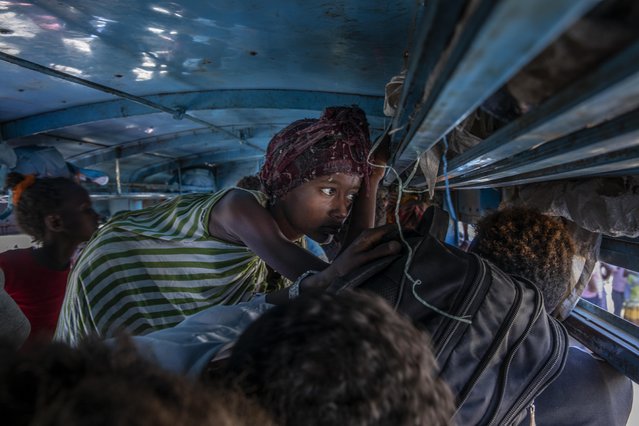
Tigray refugees who fled the conflict in the Ethiopia's Tigray ride a bus going to the Village 8 temporary shelter, near the Sudan-Ethiopia border, in Hamdayet, eastern Sudan, Tuesday, December 1, 2020. (Photo by Nariman El-Mofty/AP Photo)
The mother of a protester mourns at a hospital after her son was killed was killed during clashes on March 03, 2021 in Yangon, Myanmar. Medics and health workers have found themselves on the front lines and under intense pressure, as they try to help anti-coup protesters as resistance continues to erupt across the country, to be met with deadly force by the military junta. (Photo by Stringer/Getty Images)
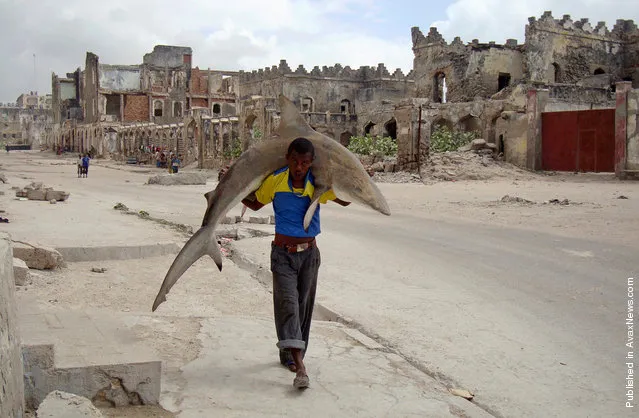
In this photo provided by World Press Photo, the 1st Prize Daily Life Single of the 2011 World Press Photo Contest by Omar Feisal, Somalia, Reuters, shows a man carrying a shark through the streets of Mogadishu, Somalia, September 23, 2010. (AP Photo/Omar Feisal/Reuters)
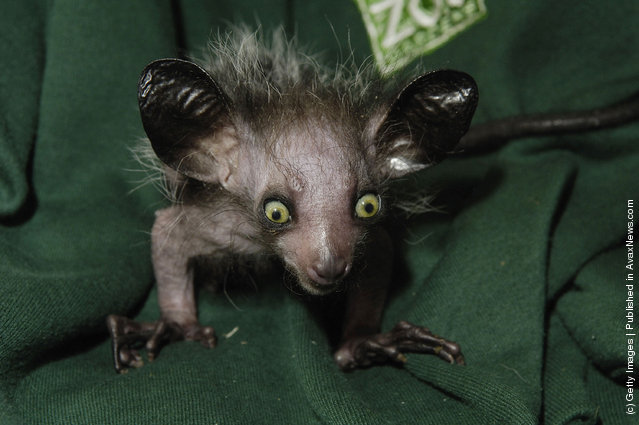
“The aye-aye (Daubentonia madagascariensis) is a lemur, a strepsirrhine primate native to Madagascar that combines rodent-like teeth and a special thin middle finger to fill the same ecological niche as a woodpecker. It is the world's largest nocturnal primate, and is characterized by its unusual method of finding food; it taps on trees to find grubs, then gnaws holes in the wood and inserts its narrow middle finger to pull the grubs out. The only other animal species known to find food in this way is the striped possum. From an ecological point of view the aye-aye fills the niche of a woodpecker as it is capable of penetrating wood to extract the invertebrates within”. – Wikipedia
Photo: In this handout image from Bristol Zoo is seen the first captive bred aye-aye in the UK named “Kintana” (meaning star in Malagasy) April 15, 2005 at Bristol Zoo Gardens, England. The zoo announced today only the second baby aye-aye to be hand-reared in the world (the first was in Jersey Zoo) and has now made his first public appearance since his birth on 11 February 2005. (Photo by Rob Cousins/Bristol Zoo via Getty Images)
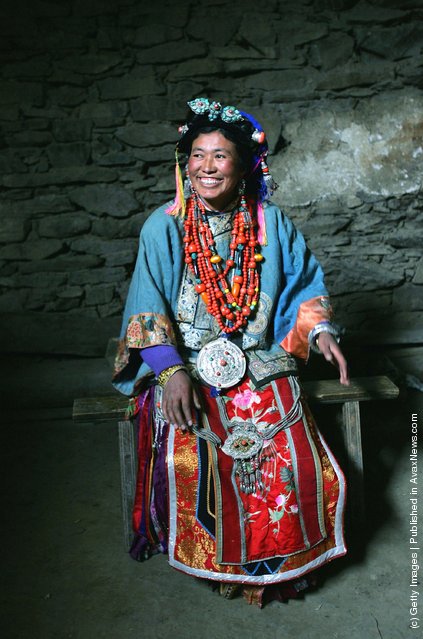
A Tibetan woman displays her Qing Dynasty family dress in Zhailong Village on April 24, 2005 in Danba County of Ganzi Tibetan Autonomous Prefecture, Sichuan Province, China. (Photo by China Photos/Getty Images)