Loading...
Done
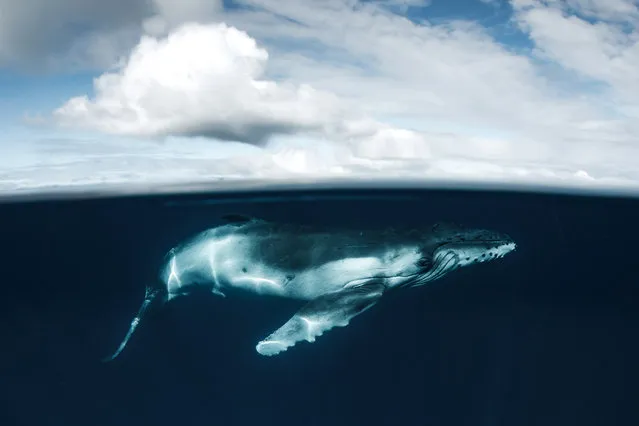
The images were taken off the coast of Tonga in the South Pacific. Photographer Grant Thomas said: “Through my images I aim to show off the amazing life we have on our planet in hope of inspiring more people to experience it for themselves and, most importantly, care for it. There is nothing to be afraid of with the humpback whales, as these animals are some of the most majestic and peaceful creatures in the sea. They will often be very curious of people in the water and will even seek out interactions with us”. (Photo by Grant Thomas/Caters News Agency)

The images were taken off the coast of Tonga in the South Pacific. Photographer Grant Thomas said: “Through my images I aim to show off the amazing life we have on our planet in hope of inspiring more people to experience it for themselves and, most importantly, care for it”. (Photo by Grant Thomas/Caters News Agency)
Details
28 Nov 2019 00:03:00
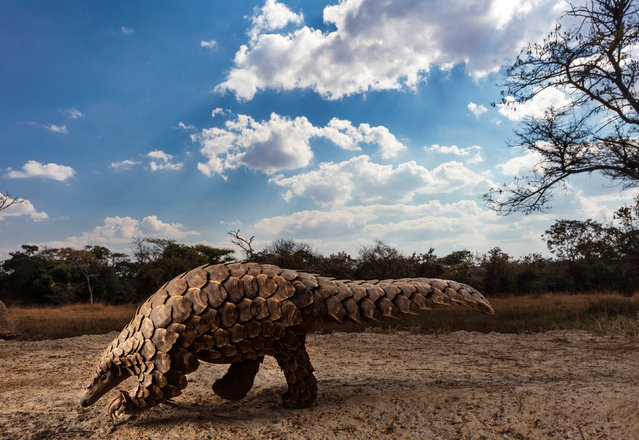
Pangolins in Crisis: Brent Stirton, South Africa; 1st place, Natural world and wildlife. “Pangolins are the world’s most illegally trafficked mammals, with an estimated one million trafficked to Asia in the last 10 years. Their scales are used in traditional Chinese and Vietnamese medicine, and their meat is sold as a high-priced delicacy. As a result, pangolins are listed as critically endangered and anyone who trades or consumes them is breaking the law. This body of work exposes the trade, while exploring aspects of illegality and celebrating the people who are trying to save these animals”. (Photo by Brent Stirton/Sony World Photography Awards 2020)

Pangolins in Crisis: Brent Stirton, South Africa; 1st place, Natural world and wildlife. “Pangolins are the world’s most illegally trafficked mammals, with an estimated one million trafficked to Asia in the last 10 years. Their scales are used in traditional Chinese and Vietnamese medicine, and their meat is sold as a high-priced delicacy. As a result, pangolins are listed as critically endangered and anyone who trades or consumes them is breaking the law. This body of work exposes the trade, while exploring aspects of illegality and celebrating the people who are trying to save these animals”. (Photo by Brent Stirton/Sony World Photography Awards 2020)
Details
11 Jun 2020 00:05:00
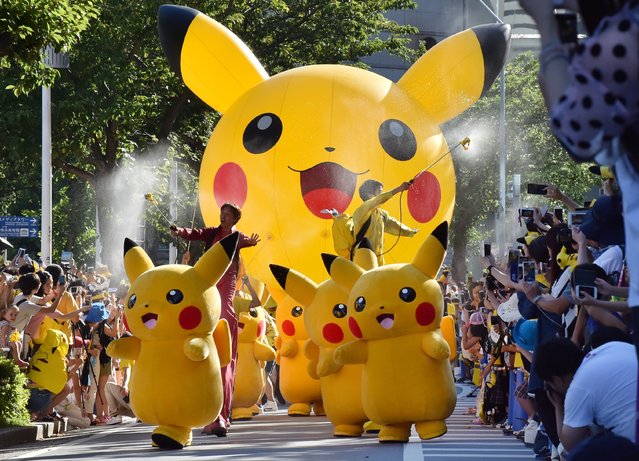
Performers dressed as Pikachu, the popular animation Pokemon series character, perform in the Pikachu parade in Yokohama on August 7, 2016. Some 50 life-size Pikachu characters, the most famous from the Pokemon game, marched along the city’s waterfront street as visitors took mobile phone pictures and videos of them in scorching sunshine. Some participants said they attended the event to search for rare characters of Pokemon – a word short for “pocket monster” – for the megahit smartphone app, which was launched in several countries around the world last month. (Photo by Kazuhiro Nogi/AFP Photo)

Performers dressed as Pikachu, the popular animation Pokemon series character, perform in the Pikachu parade in Yokohama on August 7, 2016. Some 50 life-size Pikachu characters, the most famous from the Pokemon game, marched along the city’s waterfront street as visitors took mobile phone pictures and videos of them in scorching sunshine. Some participants said they attended the event to search for rare characters of Pokemon – a word short for “pocket monster” – for the megahit smartphone app, which was launched in several countries around the world last month. (Photo by Kazuhiro Nogi/AFP Photo)
Details
08 Aug 2016 10:41:00
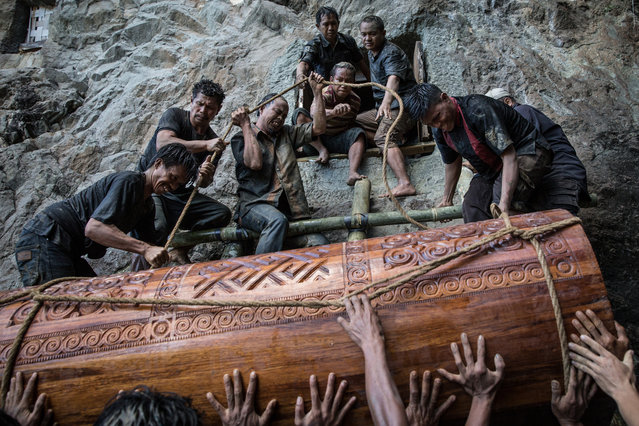
It is said that Torajans are people who “live to die”. For this Indonesian ethnic group, funerals are such extravagant events that they sometimes attract tourists. Families can postpone burials years (and the deceased are considered sick and hosted at home until the funeral) until the family can raise enough money and gather as many relatives as possible. And then it’s a jubilant multiday social event with a parade, dances and animal sacrifices. Agung Parameswara photographed these funerary practices when he traveled to South Sulawesi province, where the Torajans live. But often, their funeral isn’t the last time the dead are seen. In August, crypts are opened, coffins are slid back out and bodies delicately unsheathed. This tender ritual is known as Ma’Nene, which is customarily performed every few years. (Photo by Agung Parameswara/The Washington Post)

It is said that Torajans are people who “live to die”. For this Indonesian ethnic group, funerals are such extravagant events that they sometimes attract tourists. Families can postpone burials years (and the deceased are considered sick and hosted at home until the funeral) until the family can raise enough money and gather as many relatives as possible. And then it’s a jubilant multiday social event with a parade, dances and animal sacrifices. Agung Parameswara photographed these funerary practices when he traveled to South Sulawesi province, where the Torajans live. (Photo by Agung Parameswara/The Washington Post)
Details
06 Oct 2016 09:15:00
Women wear the traditional costume of the Alto Tio Diego carnival during the Women's Afro-Mestizo Carnival of Alto Tio Diego on February 11, 2024 in Veracruz, Mexico. Alto Tio Diego is a small town near the State capital Xalapa where every year inhabitants celebrate their traditional carnival. Women of the town demanded a special day for them to parade and few years ago, they started to do it by walking through the streets wearing traditional costumes and masks (mostly of animals) but the attires have evolved to more modern characters. (Photo by Hector AD Quintanar/Getty Images)

Women wear the traditional costume of the Alto Tio Diego carnival during the Women's Afro-Mestizo Carnival of Alto Tio Diego on February 11, 2024 in Veracruz, Mexico. Alto Tio Diego is a small town near the State capital Xalapa where every year inhabitants celebrate their traditional carnival. Women of the town demanded a special day for them to parade and few years ago, they started to do it by walking through the streets wearing traditional costumes and masks (mostly of animals) but the attires have evolved to more modern characters. (Photo by Hector AD Quintanar/Getty Images)
Details
24 May 2025 02:27:00


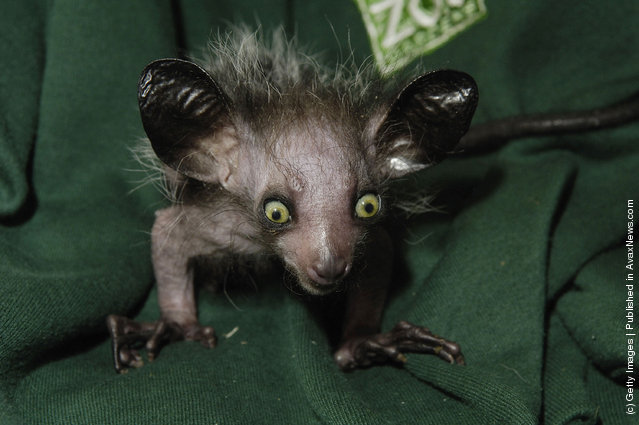
“The aye-aye (Daubentonia madagascariensis) is a lemur, a strepsirrhine primate native to Madagascar that combines rodent-like teeth and a special thin middle finger to fill the same ecological niche as a woodpecker. It is the world's largest nocturnal primate, and is characterized by its unusual method of finding food; it taps on trees to find grubs, then gnaws holes in the wood and inserts its narrow middle finger to pull the grubs out. The only other animal species known to find food in this way is the striped possum. From an ecological point of view the aye-aye fills the niche of a woodpecker as it is capable of penetrating wood to extract the invertebrates within”. – Wikipedia

Photo: In this handout image from Bristol Zoo is seen the first captive bred aye-aye in the UK named “Kintana” (meaning star in Malagasy) April 15, 2005 at Bristol Zoo Gardens, England. The zoo announced today only the second baby aye-aye to be hand-reared in the world (the first was in Jersey Zoo) and has now made his first public appearance since his birth on 11 February 2005. (Photo by Rob Cousins/Bristol Zoo via Getty Images)
Details
13 Apr 2011 13:33:00


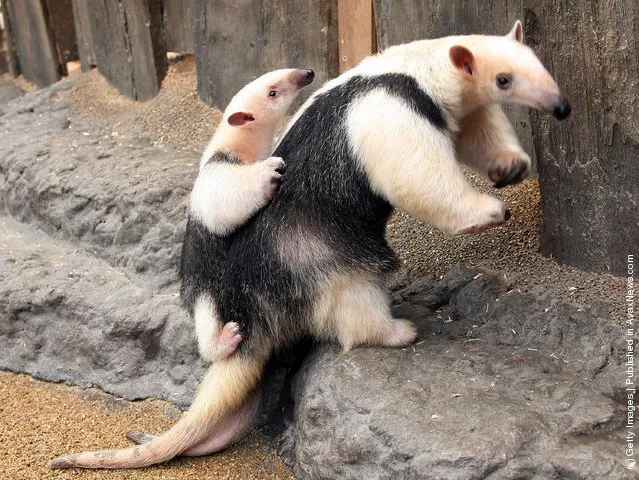
“The Southern Tamandua, Collared Anteater or Lesser Anteater (Tamandua tetradactyla) is a species of anteater from South America. It is a solitary animal, found in many habitats from mature to highly disturbed secondary forests and arid savannas. It feeds on ants, termites and bees. It has very strong foreclaws that can be used to break insect nests or to defend itself”. – Wikipedia

Photo: A three-month-old baby Southern Tamandua “Konbu” lies on its mother Tae's back at Sunshine International Aquarium on July 7, 2009 in Tokyo, Japan. Baby Southern Tamandua feels safe and comfortable holding onto something and normally stays on the mother's back until around 3 months old. (Photo by Junko Kimura/Getty Images)
Details
19 May 2011 10:31:00
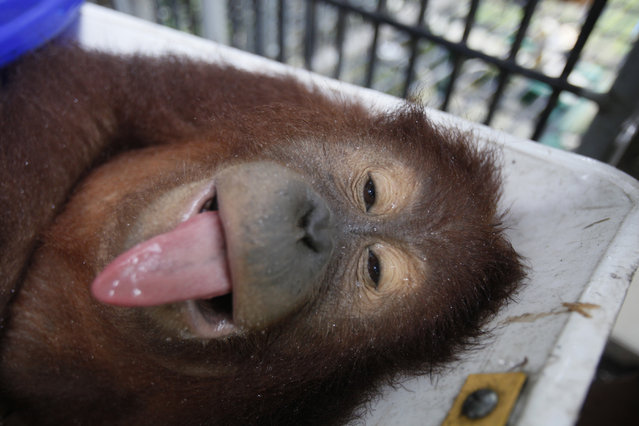
An approximately 8 year-old male orangutan named Siamang reacts under the influence of tranquilizer as it's being prepared to be released into the wild at a rehabilitation center in Kuta Mbelin, North Sumatra, Indonesia, Friday, July 10, 2015. (Photo by Binsar Bakkara/AP Photo)

An approximately 8 year-old male orangutan named Siamang reacts under the influence of tranquilizer as it's being prepared to be released into the wild at a rehabilitation center in Kuta Mbelin, North Sumatra, Indonesia, Friday, July 10, 2015. The orangutans at the center were mostly rescued from palm oil plantations or confiscated from homes where they were kept as pet animals. Orangutan populations in Indonesia's Borneo and Sumatra island are facing severe threats from habitat loss, illegal logging, fires and poaching. Conservationists predicted that without immediate action, orangutans are likely to be the first great ape to become extinct in the wild. (Photo by Binsar Bakkara/AP Photo)
Details
11 Jul 2015 13:57:00