Dancers perform a routine at the Renault display at the Beijing International Automotive Exhibition in Beijing, Tuesday, April 26, 2016. (Photo by Mark Schiefelbein/AP Photo)
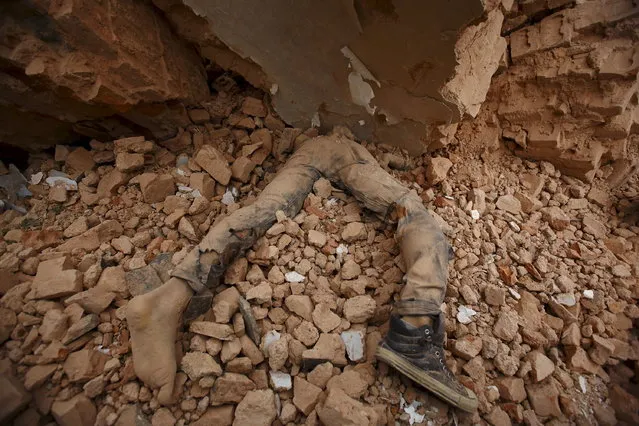
A body of a victim lies trapped in the debris after an earthquake hit, in Kathmandu, Nepal April 25, 2015. Rescue efforts in Nepal are intensifying after nearly 2,000 people were killed on Saturday in the worst earthquake there in more than 80 years. Many countries and charities have offered aid to deal with the disaster. Seventeen people have been killed on Mount Everest by avalanches – the mountain's worst-ever disaster. Meanwhile a powerful aftershock was felt on Sunday in Nepal, India and Bangladesh, and more avalanches were reported near Everest. (Photo by Navesh Chitrakar/Reuters)
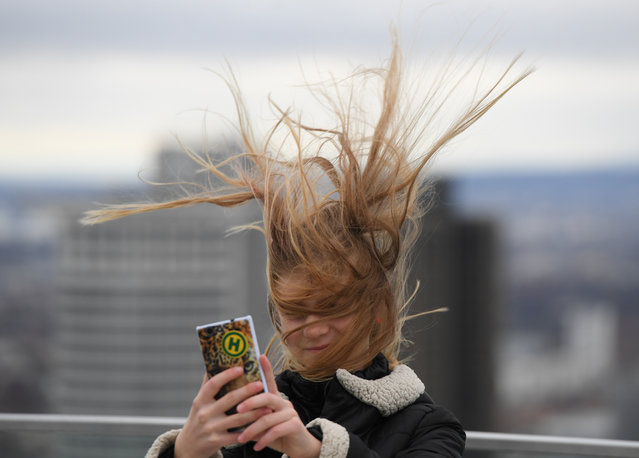
Elena from Dresden has her hair ruffled by the wind as she stands on a visitors' platform on the Maintower in Frankfurt am Main, western Germany, during stormy weather on February 22, 2017. (Photo by Arne Dedert/AFP Photo/DPA)
An artist has created series of wacky images turning everyday items into hilarious and all but impossible to use objects. Giuseppe Colarusso, 49, fashioned the unique work to make people question the functionality of the likes of cutlery, garden tools and office equipment. The set of playful pictures, entitled “Improbabilita”, makes some items impossible to use, others improbable and some given a completely new function altogether. From a dice with no spots, to a ping pong paddle with a hole in it, the items have all been given a quirky twist. Photo: Cuttlery with rope handles. (Photo by Giuseppe Colarusso/Caters News)
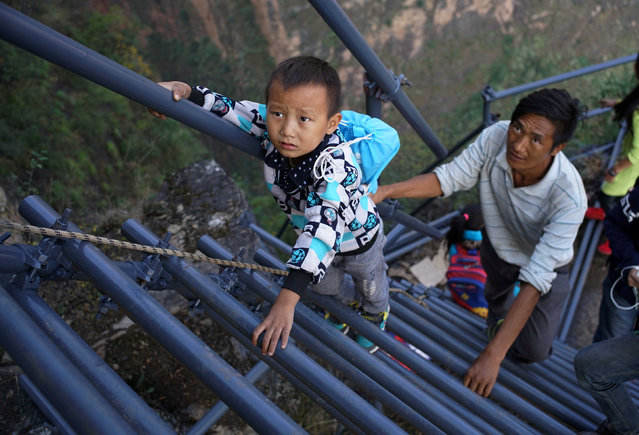
A student from “the cliff village” in Atule'er climbs newly-constructed steel ladders after school to go home for holidays, in Liangshan Sichuan province, China, November 19, 2016. The steel ladders which replaced the unsafe vine ladders shortened the time taken for the children to go home, from three hours to two. (Photo by Reuters/Stringer)
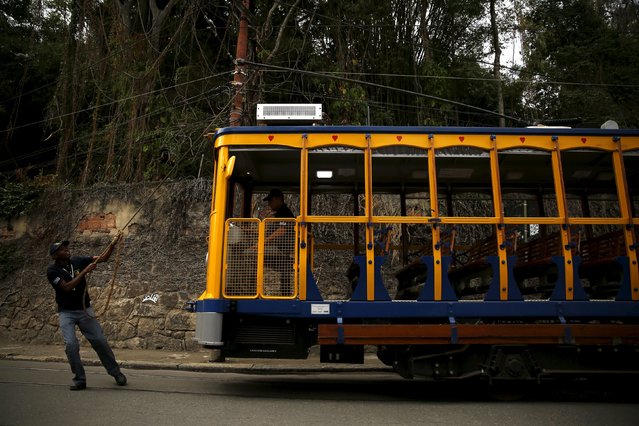
A worker manually changes the direction of the bonde, the typical tram line in Santa Teresa neighborhood, using a rope in Rio de Janeiro, Brazil, September 9, 2015. The Santa Teresa bonde, called “Bondinho” in Portuguese, is running with passengers as a part of a test period, after the service was suspended in 2011 following an accident that killed six people, according to residents. (Photo by Pilar Olivares/Reuters)