Loading...
Done
Children playing their smart phone during Lunar New Year's Eve celebrations at Fuk Ling Miau temple on January 28, 2025 in Yogyakarta, Indonesia. Chinese New Year, also known as Lunar New Year, will begin on January 29, 2025, marking the Year of the Snake. The celebrations, which last for approximately 15 days, are filled with traditional activities such as family gatherings, lion dances, and the exchange of red envelopes, making it a vibrant cultural event observed by Chinese communities worldwide. (Photo by Ulet Ifansasti/Getty Images)

Children playing their smart phone during Lunar New Year's Eve celebrations at Fuk Ling Miau temple on January 28, 2025 in Yogyakarta, Indonesia. Chinese New Year, also known as Lunar New Year, will begin on January 29, 2025, marking the Year of the Snake. The celebrations, which last for approximately 15 days, are filled with traditional activities such as family gatherings, lion dances, and the exchange of red envelopes, making it a vibrant cultural event observed by Chinese communities worldwide. (Photo by Ulet Ifansasti/Getty Images)
Details
25 Feb 2025 02:05:00
A tourist takes photos among fireweed, or kochia scoparia, at an archaeological site park on September 13, 2022 in Xi'an, Shaanxi Province of China. (Photo by Zhang Yuan/China News Service via Getty Images)

A tourist takes photos among fireweed, or kochia scoparia, at an archaeological site park on September 13, 2022 in Xi'an, Shaanxi Province of China. (Photo by Zhang Yuan/China News Service via Getty Images)
Details
20 Sep 2022 04:54:00
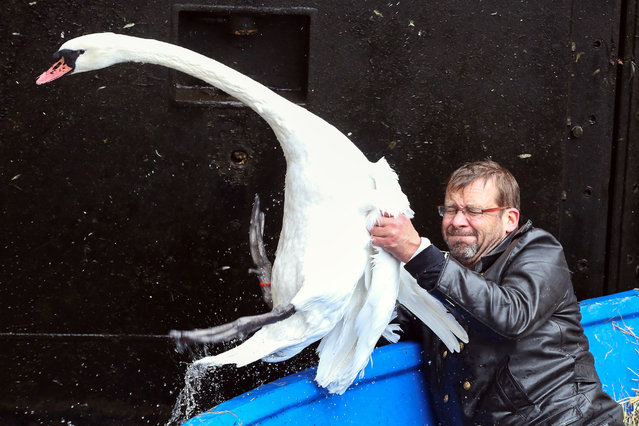
Olaf Niess catches swans on the river Alster near the town hall in Hamburg, Germany, 17 November 2015. The Alster swans are moving to their ice-free winter quarters on the Eppendorf Muehlenteich millpond until spring. (Photo by Bodo Marks/EPA)

Olaf Niess catches swans on the river Alster near the town hall in Hamburg, Germany, 17 November 2015. The Alster swans are moving to their ice-free winter quarters on the Eppendorf Muehlenteich millpond until spring. (Photo by Bodo Marks/EPA)
Details
18 Nov 2015 08:07:00
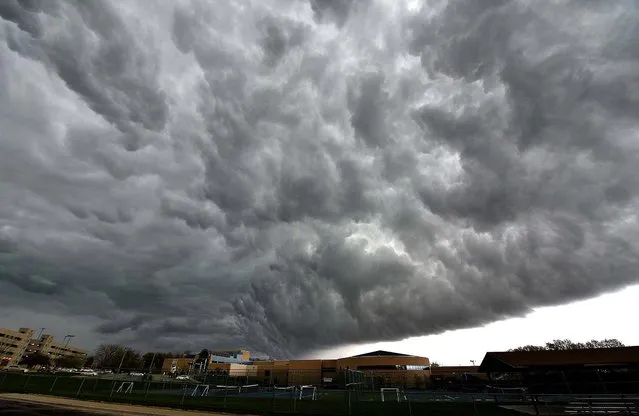
Storm clouds gather over the scene outside the Jewish Community Center in Leawood, Kansas following a shooting, on April 13, 2014. (Photo by John Sleezer/Kansas City Star/MCT)

Storm clouds gather over the scene outside the Jewish Community Center in Leawood, Kansas following a shooting, on April 13, 2014. (Photo by John Sleezer/Kansas City Star/MCT)
Details
01 May 2014 10:02:00
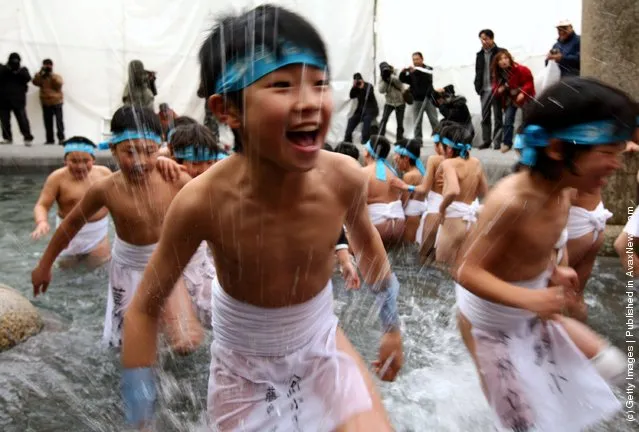
Japanese children wear loincloths as they splash about in freezing cold water during Saidaiji Naked Festival, at Saidaiji Temple

“A Hadaka Matsuri (“Naked Festival”) is a type of Japanese festival, or matsuri, in which participants wear a minimum amount of clothing; usually just a Japanese loincloth (called fundoshi), sometimes with a short happi coat, and rarely completely naked. Whatever the clothing, it is considered to be above vulgar, or everyday, undergarments, and on the level of holy Japanese shrine attire. Naked festivals are held in dozens of places throughout Japan every year, usually in the summer or winter. The most famous festival is held in Okayama, where the festival originated. Every year, over 9,000 men participate in this festival”. – Wikipedia

Photo: Japanese men wear loincloths as they splash about in freezing cold water during Saidaiji Naked Festival, at Saidaiji Temple on February 18, 2012 in Okayama, Japan. (Photo by Buddhika Weerasinghe/Getty Images)
Details
19 Feb 2012 12:18:00
The “Escape Velocity” moving sculpture by artist group Poetic Kinetics looms over Coachella festivalgoers on the Empire Polo Field, on the first day of the 2014 Coachella Music and Arts Festival in Indio, California, on April 11, 2014. (Photo by Chris Pizzello/Invision)

The “Escape Velocity” moving sculpture by artist group Poetic Kinetics looms over Coachella festivalgoers on the Empire Polo Field, on the first day of the 2014 Coachella Music and Arts Festival in Indio, California, on April 11, 2014. (Photo by Chris Pizzello/Invision)
Details
12 Apr 2014 12:55:00
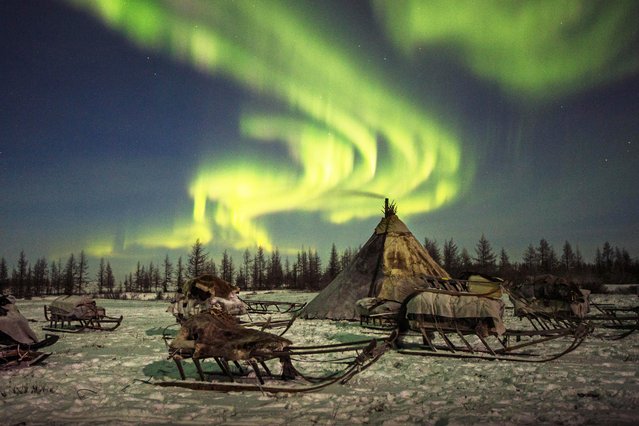
An empty camp is shown beneath a colourful sky in Siberia, December 2016. (Photo by Timothy Allen/Barcroft Productions)

A British photographer has captured life at the “edge of the world”. Timothy Allen, best known for his work on BBC's Human Planet, trekked through the freezing Siberian wilderness for 16 days as he joined part of an 800km migration of reindeer in the Yamal-Nenets region – a name that roughly translates to “edge of the world”. The stunning pictures feature the nomadic Nenets tribe, who drink blood to survive in -45°C temperatures. Timothy's epic journey, which will be revealed in an eight-minute documentary on Animal Planet USA, saw him travel across the bleak terrain of the frozen Ob River with the Nenets people in December last year. Here: An empty camp is shown beneath a colourful sky in Siberia, December 2016. (Photo by Timothy Allen/Barcroft Productions)
Details
19 Sep 2017 07:48:00
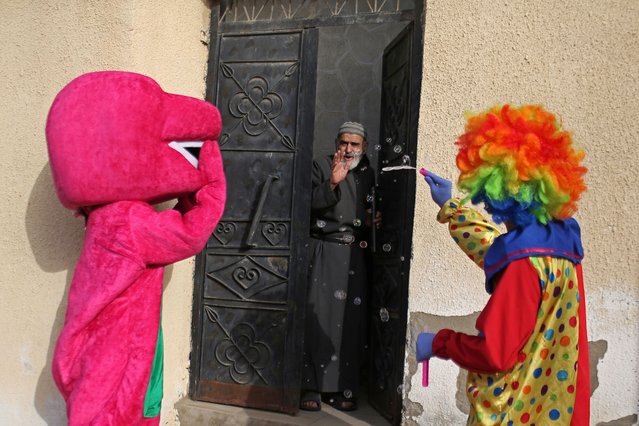
A Palestinian man waves from his home as a clown and a man in a costume perform to entertain people amid concerns about the spread of the coronavirus disease (COVID-19), in Khan Younis in the southern Gaza Strip April 19, 2020. (Photo by Ibraheem Abu Mustafa/Reuters)

A Palestinian man waves from his home as a clown and a man in a costume perform to entertain people amid concerns about the spread of the coronavirus disease (COVID-19), in Khan Younis in the southern Gaza Strip on April 19, 2020. (Photo by Ibraheem Abu Mustafa/Reuters)
Details
21 Apr 2020 00:07:00