Loading...
Done
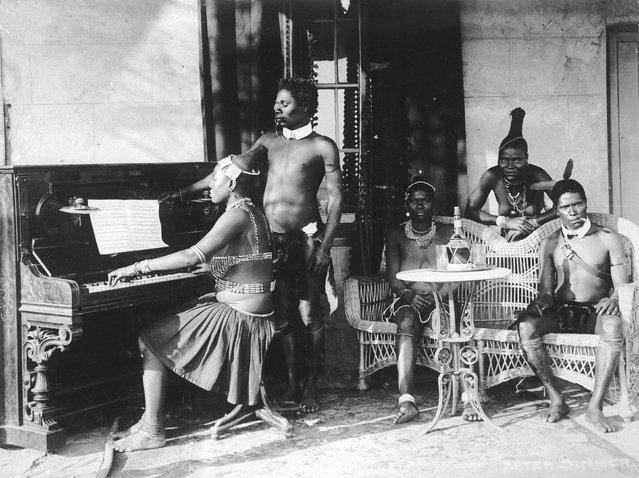
circa 1925:  A Zulu woman playing the piano while a group of others sit and listen.  (Photo by General Photographic Agency/Getty Images)

“The Zulu are the largest South African ethnic group, with an estimated 10–11 million people living mainly in the province of KwaZulu-Natal. Small numbers also live in Zimbabwe, Zambia, and Mozambique. Their language, Zulu, is a Bantu language; more specifically, part of the Nguni subgroup. The Zulu Kingdom played a major role in South African history during the 19th and 20th centuries. Under apartheid, Zulu people were classed as third-class citizens and suffered from state-sanctioned discrimination. They remain today the most numerous ethnic group in South Africa, and now have equal rights along with all other citizens”. – Wikipedia.

Photo: A Zulu woman playing the piano while a group of others sit and listen (to put it briefly, Englishmen scoff over Zulu). South Africa, circa 1925. (Photo by General Photographic Agency)

Details
03 Feb 2014 09:40:00
Eton Wall Game

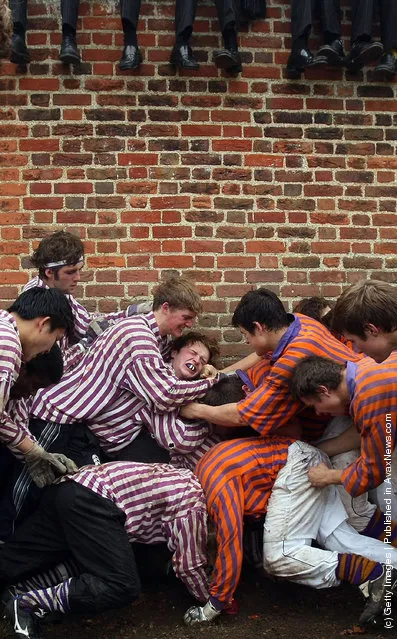
“The Eton wall game is a game similar to football and Rugby Union, that originated from and is still played at Eton College. It is played on a strip of ground 5 metres wide and 110 metres long next to a slightly curved brick wall, erected in 1717”. – Wikipedia

Photo: The “Collegers” and the “Oppidans” of Eton College take part in the “Wall Game” as boys in their traditional school uniform watch from on top of the wall on November 17, 2007 in Eton, near Windsor, Berkshire, England. The first recorded “Wall Game” took place in 1766 with competition between the two houses at the boarding school remaining as fierce as ever on the annual St. Andrew's day event. The object of the game is to get the ball to either end of the wall and score a goal, which has not happened since 1909. As well as scoring a goal the players can win points with a “shy”, where the ball is held against the wall and touched by the hand and awarded one point. (Photo by Christopher Furlong/Getty Images)
Details
22 Sep 2011 11:01:00
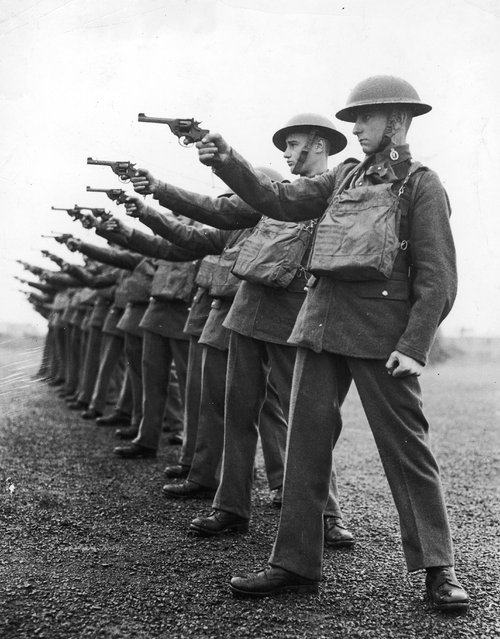
A line of soldiers firing handguns during a training session, circa 1920.  (Photo by Keystone)

A line of soldiers firing handguns during a training session, circa 1920. (Photo by Keystone). P.S. All pictures are presented in high resolution.
Details
03 Sep 2012 10:22:00
An Indonesian man displays his collection of rings with various  gemstones at an exhibition and competition of the best gemstone at a mall in Jakarta on August 6, 2015. The recent fad of collecting rings with precious gemstone or polished gemstone locally called “batu akik” is sweeping across Indonesia, with collectors going for the very rare stones and it's possession many believe will give the owner  supernatural power. (Photo by Bay Ismoyo/AFP Photo)

An Indonesian man displays his collection of rings with various gemstones at an exhibition and competition of the best gemstone at a mall in Jakarta on August 6, 2015. The recent fad of collecting rings with precious gemstone or polished gemstone locally called “batu akik” is sweeping across Indonesia, with collectors going for the very rare stones and it's possession many believe will give the owner supernatural power. (Photo by Bay Ismoyo/AFP Photo)
Details
07 Aug 2015 11:50:00
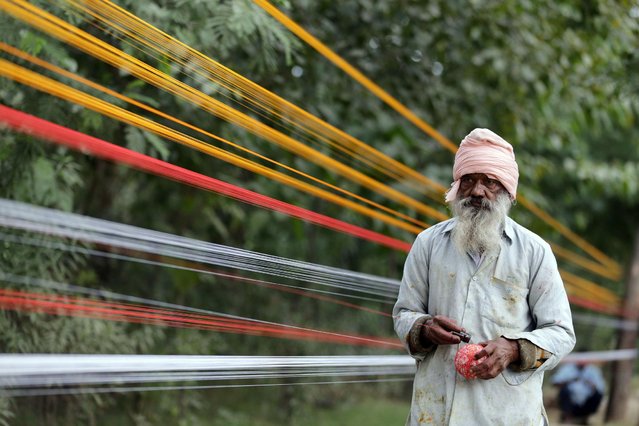
An Indian worker makes a roll of the kite thread being prepared on a roadside on the outskirts of Amritsar, India, 24 November 2020. The kite string or the “Dor”, in the local language, is made of crushed glass, glue, colors, and egg to make it strong enough to hold the kite. With the onset of the winter season, kite flying enthusiasts especially in northern Punjab, ranging from children to aged people, start flying kites as a leisure activity from their homes' rooftops and from open spaces, enjoying warmth of the winter sun at the same time. Kite flying season peaks in Amritsar on Lohri festival which marks the culmination of winter and is celebrated in the month of January every year. (Photo by Raminder Pal Singh/EPA/EFE)

An Indian worker makes a roll of the kite thread being prepared on a roadside on the outskirts of Amritsar, India, 24 November 2020. The kite string or the “Dor”, in the local language, is made of crushed glass, glue, colors, and egg to make it strong enough to hold the kite. (Photo by Raminder Pal Singh/EPA/EFE)
Details
07 Dec 2020 00:01:00
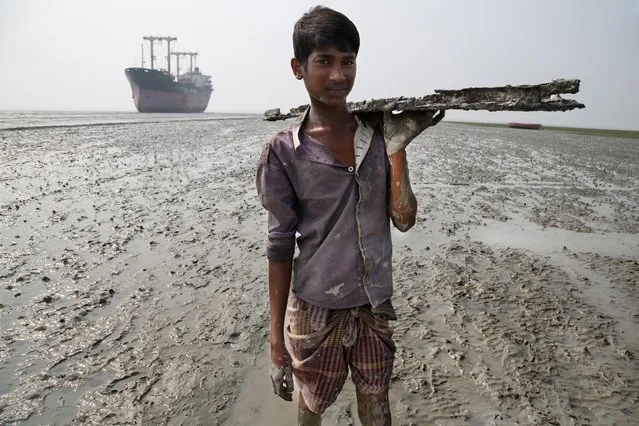
A child working at Ship breaking yard in Chittagong, Bangladesh on November 14, 2014. (Photo by  Pascal Mannaerts/Alamy Stock Photo)

A child working at Ship breaking yard in Chittagong, Bangladesh on November 14, 2014. (Photo by Pascal Mannaerts/Alamy Stock Photo)
Details
18 Dec 2020 00:03:00
Costumed participants of a lacquer and leather ship, the so-called “Torture Ship”, kiss before putting out to Lake Constance for a pleasure cruise at the harbor of Friedrichshafen, Germany, 29 June 2019. Hundreds of leather and rubber fans set sail for the boat trip through the night on Lake Constance. (Photo by Daniel Kopatsch/EPA/EFE)

Costumed participants of a lacquer and leather ship, the so-called “Torture Ship”, kiss before putting out to Lake Constance for a pleasure cruise at the harbor of Friedrichshafen, Germany, 29 June 2019. Hundreds of leather and rubber fans set sail for the boat trip through the night on Lake Constance. (Photo by Daniel Kopatsch/EPA/EFE)
Details
30 Jan 2021 08:25:00
An open water swimmer surfaces as she enjoys a socially-distanced dawn swim after breaking the ice on the surface of a lake near Scunthorpe, northern England, January 9, 2021. Faced by a sharp rise in coronavirus infections, driven by the new strain, England entered a strict lockdown on January 5, 2021, with schools and non-essential shops closed for at least six weeks after previous measures failed to halt the steep rise in cases. (Photo by Lindsey Parnaby/AFP Photo)

An open water swimmer surfaces as she enjoys a socially-distanced dawn swim after breaking the ice on the surface of a lake near Scunthorpe, northern England, January 9, 2021. Faced by a sharp rise in coronavirus infections, driven by the new strain, England entered a strict lockdown on January 5, 2021, with schools and non-essential shops closed for at least six weeks after previous measures failed to halt the steep rise in cases. (Photo by Lindsey Parnaby/AFP Photo)
Details
27 Feb 2021 10:02:00