Loading...
Done
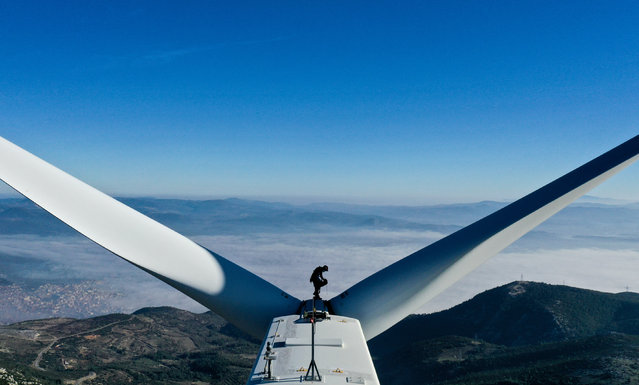
Rope access technicians carry out maintenance service on wind turbines including repairs, blade inspections and cleaning in Izmir, Turkey on February 19, 2021. In Turkey, where investments in renewable energy has increased, there are wind tribunes over 3,500. Turbines, where huge cranes and high platforms are used during the installation phase, require routine maintenance and repair work in certain periods. Technicians, who arrive at the wind park, stop the turbines to be maintained and repaired and the field mission of rope access technicians begins. The work of crews descending from a height of approximately 100 meters to perform maintenance and repair work take approximately 1 hour on each wing. (Photo by Mahmut Serdar Alakus/Anadolu Agency via Getty Images)

Rope access technicians carry out maintenance service on wind turbines including repairs, blade inspections and cleaning in Izmir, Turkey on February 19, 2021. In Turkey, where investments in renewable energy has increased, there are wind tribunes over 3,500. (Photo by Mahmut Serdar Alakus/Anadolu Agency via Getty Images)
Details
26 Feb 2021 11:29:00
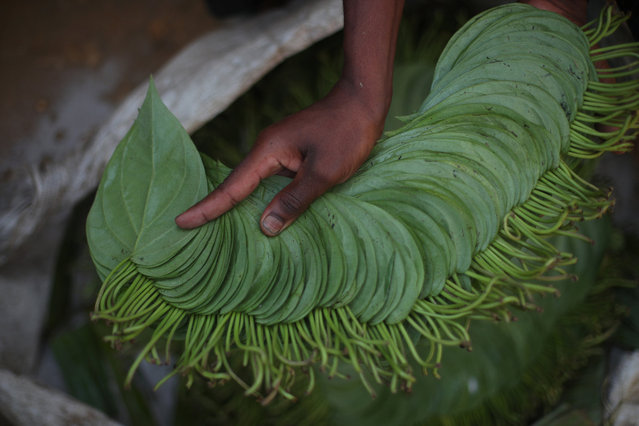
Faruk, 17, a Rohingya refugee trader holds betel leaves which are on sale at a stall in Palong Khali refugee camp near Cox's Bazar, Bangladesh, November 3, 2017. He left his village in Myanmar when the military opened fire towards the Rohingya. “I buy this betel leaf from Palong Khali market, in one bundle there are 160 pieces, I buy it for 80 taka and I sell it for 100 taka. Bangladeshi's and I sell for the same rate in the camp. Outside in the local market it is 80 taka per bundle. My problem is that I don't have money so I can't buy anything to eat, I can't buy fish to eat”, he said. (Photo by Hannah McKay/Reuters)

Faruk, 17, a Rohingya refugee trader holds betel leaves which are on sale at a stall in Palong Khali refugee camp near Cox's Bazar, Bangladesh, November 3, 2017. He left his village in Myanmar when the military opened fire towards the Rohingya. “I buy this betel leaf from Palong Khali market, in one bundle there are 160 pieces, I buy it for 80 taka and I sell it for 100 taka (1 Bangladeshi Taka = 0.012 US Dollar). Bangladeshi's and I sell for the same rate in the camp. Outside in the local market it is 80 taka per bundle. My problem is that I don't have money so I can't buy anything to eat, I can't buy fish to eat”, he said. (Photo by Hannah McKay/Reuters)
Details
27 Nov 2017 08:54:00
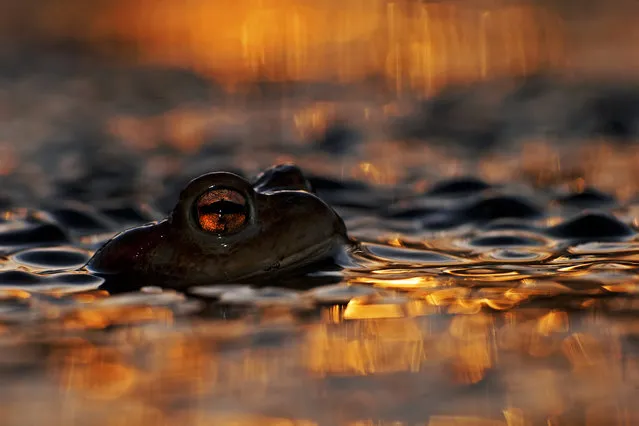
“Eye of a toad”. Animal Portraits, Łukasz Bożycki, Poland.  (Photo by Łukasz Bożycki)

“Eye of a toad”. Animal Portraits, Łukasz Bożycki, Poland. Early spring sees a pond near Łukasz’s home city of Warsaw, Poland, full of mating frogs and a few toads. On this March day, Łukasz shared the pond with them for an evening, sitting in the icy water in his chest-high waders, keeping as still as possible, despite the numbing cold, so that the amphibians could get used to him. “I wanted to find a fresh way of portraying the amphibians”, he says, “at water level”. Using a telephoto lens, he focused on one lone toad and waited for the sun to dip almost below the horizon before pressing the shutter, using flash to bring out the details in the shadow. His prize was “the glorious pool of sunset colour” and fiery glow of the toad’s eye. Nikon D80 + 70-300mm f4.5-5.6 lens + extension tube; 1/125 sec at f9 (-2.3 e/v); ISO 100; built-in flash. (Photo by Łukasz Bożycki)

Details
28 Aug 2013 11:45:00


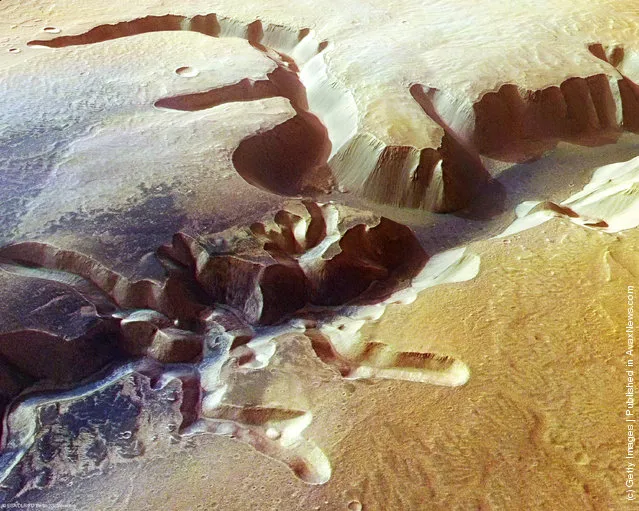
“Echus Chasma is a chasma in the Lunae Planum high plateau north of the Valles Marineris canyon system of Mars. Clay has been found in Echus Chasma that means that water once sat there for a time. Echus Chasma is approximately 100 km long and 10 km wide, with valleys ranging in depth from around 1 km to 4 km”. – Wikipedia

Photo: In this handout image supplied by the European Space Agency (ESA) on July 16, 2008, The Echus Chasma, one of the largest water source regions on Mars, is pictured from ESA's Mars Express. The data was acquired on September 25, 2005. The dark material shows a network of light-coloured, incised valleys that look similar to drainage networks known on Earth. It is still debated whether the valleys originate from precipitation, groundwater springs or liquid or magma flows on the surface. (Photo by ESA via Getty Images)
Details
18 Jul 2011 11:47:00
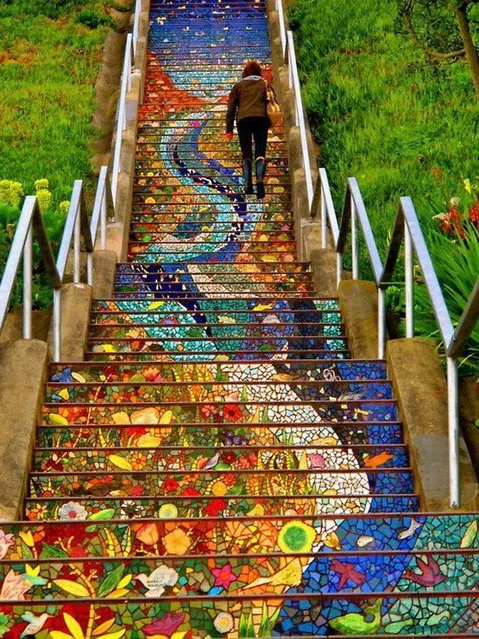
16th Avenue Tiled Step Project

The 16th Avenue Tiled Steps project is a wonderful display of community effort and artistic vision. 163 steps are tiled with mosaic panels set into the risers which were designed by artists Aileen Barr and Colette Crutcher. Over 300 neighbors helped in the making of the panels with over 220 neighbors sponsoring handmade animal, bird, and fish name tiles which are imbedded within the mosaics. KZ Tile, a major San Franciscan tile-setting company generously agreed to set the mosaic panels into the risers and to tile the step treads with rough, nonslip tile.
Details
03 Nov 2012 13:14:00
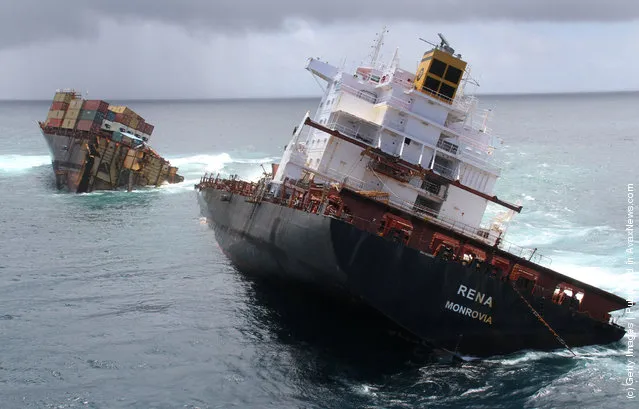
MV Rena Splits In Two After Large Swells

In this handout provided by Maritime New Zealand, MV Rena is seen in two pieces after overnight bad weather pounded the vessel, on January 8, 2012 in Tauranga, New Zealand. (Photo by Maritime New Zealand via Getty Images)
Details
08 Jan 2012 11:21:00
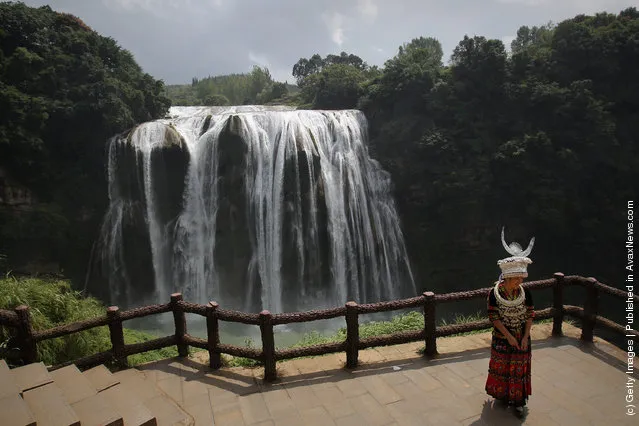
Huangguoshu Waterfall

“Huangguoshu Waterfall, also known as Yellow Fruit Tree Waterfall, is one of the largest waterfalls in China and East Asia located on the Baihe River in Anshun, Guizhou Province. It is 77.8 m (255 ft) high and 101 m (331 ft) wide. The main waterfall is 67 m (220 ft) high and 83.3 m (273 ft) wide”. – Wikipedia

Photo: The Miao ethnic minority women rest in front of Huangguoshu Cataract, Asia's largest waterfall, on September 13, 2011 in Anshun city of Guizhou Province, China. (Photo by Feng Li/Getty Images)
Details
14 Sep 2011 12:11:00
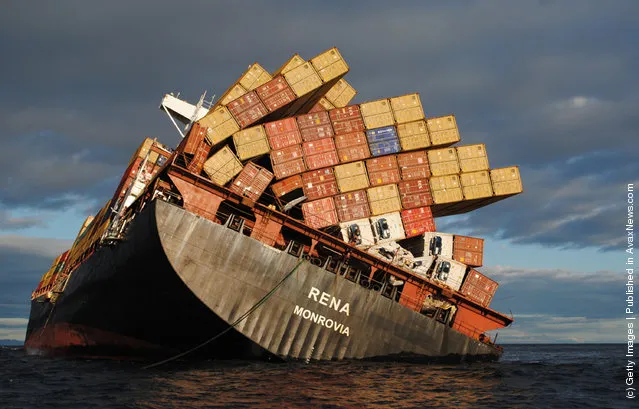
Oil Pumping From Rena Continues

The stern of the stranded cargo vessel Rena grounded on the Astrolabe Reef is seen on October 20, 2011 in Tauranga, New Zealand. Salvage crews continue to pump oil off the ship in an effort to remove as much as possible before bad weather predicted for the evening threatens to break the vessel and release more oil into the sea. Over 300 tonnes of oil has leaked from Rena since it hit the reef on October 5. (Photo by New Zealand Defence Force via Getty Images)
Details
20 Oct 2011 09:11:00