Loading...
Done
A leader “Rolli” of a yodel group “Schuppel” runs in the snow in front of a farmstead during the “Silvesterchlausen” in the early morning in Urnaesch in the Swiss canton Appenzell Ausserroden on January 13, 2017. The “Silvesterchlausen” is a tradition of the Swiss canton Appenzell, where colorfull characters organized in groups called “Schuppel”, chase out the old year and welcome the new one. They run all day long from farmstead to farmstead, gather together to sing a jodel and great the farmers. A “Schuppel” consists of some “Schelli” and two “Rolli”, sometimes with female dresses and nice scenes over the head, despite the dress all participants are males. The Silversterchlausen run twice a year, first for the new Silvester on December 31, and then again on January 13, for the old Silvester following the Julian calendar. (Photo by Michael Buholzer/AFP Photo)

A leader “Rolli” of a yodel group “Schuppel” runs in the snow in front of a farmstead during the “Silvesterchlausen” in the early morning in Urnaesch in the Swiss canton Appenzell Ausserroden on January 13, 2017. (Photo by Michael Buholzer/AFP Photo)
Details
14 Jan 2017 12:41:00
US M142 High Mobility Artillery Rocket System (HIMARS) is launched as journalists film during a military exercise in Capas, Tarlac province, Philippines, 13 October 2022. The Philippines hosted simultaneous combat drills with the United States, South Korea, and Japan to improve interoperability in times of conflict. (Photo by Francis R. Malasig/EPA/EFE)

US M142 High Mobility Artillery Rocket System (HIMARS) is launched as journalists film during a military exercise in Capas, Tarlac province, Philippines, 13 October 2022. The Philippines hosted simultaneous combat drills with the United States, South Korea, and Japan to improve interoperability in times of conflict. (Photo by Francis R. Malasig/EPA/EFE)
Details
02 Nov 2022 04:23:00
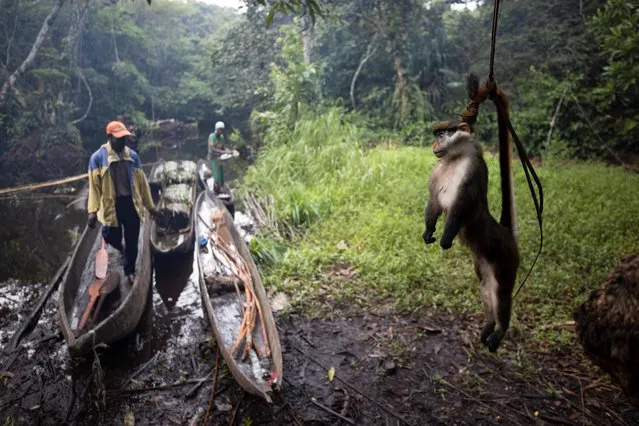
A dead red-tailed monkey hangs by its tail above the ground, in order to keep it away from ants, in the forest near the city of Mbandaka, Democratic Republic of the Congo, April 5, 2019. Bushmeat hunters are emptying Central Africa's forests at a high rate, researchers say. A growing appetite for wild meat in cities has ramped up the scale of hunting. Research shows around 6 million tonnes of bushmeat are sourced annually from the Congo Basin, whose forest spans across six countries and is second in size only to the Amazon. (Photo by Thomas Nicolon/Reuters)

A dead red-tailed monkey hangs by its tail above the ground, in order to keep it away from ants, in the forest near the city of Mbandaka, Democratic Republic of the Congo, April 5, 2019. Bushmeat hunters are emptying Central Africa's forests at a high rate, researchers say. A growing appetite for wild meat in cities has ramped up the scale of hunting. Research shows around 6 million tonnes of bushmeat are sourced annually from the Congo Basin, whose forest spans across six countries and is second in size only to the Amazon. (Photo by Thomas Nicolon/Reuters)
Details
14 Oct 2019 00:03:00
Ethnic “Kam” (also known as Dong) women get ready for a traditional wedding ritual known as the “steal the chicken at the drum tower” in a minority Dong village in southwestern Chinese city of Congjiang, Guizhou province, China January 29, 2017. The ceremony held in the ethnic Kam minority village of Gantuan in Guizhou province is based on a tradition dating back some 500 years that was revived and modified in the 1990s for villagers and tourists. (Photo by Tyrone Siu/Reuters)

Ethnic “Kam” (also known as Dong) women get ready for a traditional wedding ritual known as the “steal the chicken at the drum tower” in a minority Dong village in southwestern Chinese city of Congjiang, Guizhou province, China January 29, 2017. The ceremony held in the ethnic Kam minority village of Gantuan in Guizhou province is based on a tradition dating back some 500 years that was revived and modified in the 1990s for villagers and tourists. (Photo by Tyrone Siu/Reuters)
Details
03 Feb 2017 07:57:00
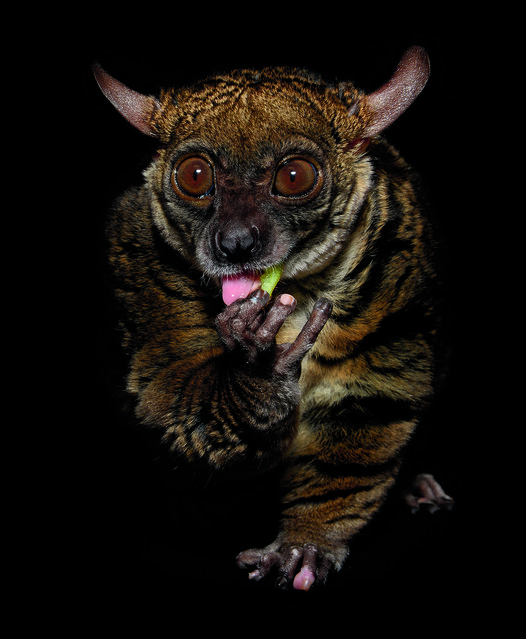
Galagos, more commonly known as bush babies, are tiny African primates with remarkable jumping abilities. Thanks to the elastic energy stored in the tendons of their lower legs, small-eared galagos can jump 6 feet straight up in the air. (Photo by Traer Scott/Chronicle Books)

Galagos, more commonly known as bush babies, are tiny African primates with remarkable jumping abilities. Thanks to the elastic energy stored in the tendons of their lower legs, small-eared galagos can jump 6 feet straight up in the air. (Photo by Traer Scott/Chronicle Books)
Details
07 Sep 2014 12:38:00
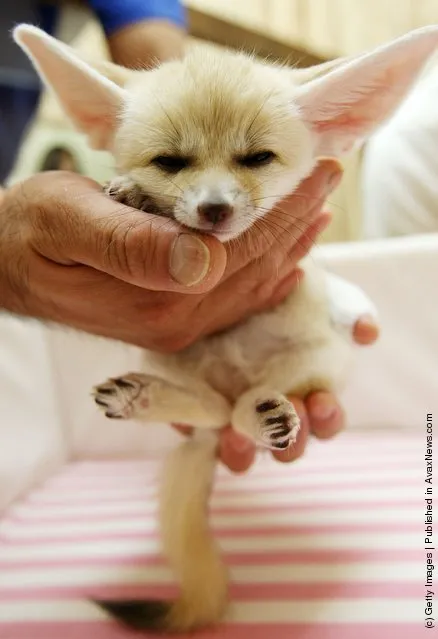
Baby Fennec Fox

“The fennec fox is a small nocturnal fox found in the Sahara of North Africa. Its most distinctive feature is unusually large ears. The name “fennec” comes from the Arabic word for fox, and the species name zerda has a Greek origin that refers to its habitat. The fennec is the smallest species of canid in the world; coat, ears and kidney functions have adapted to a high-temperature, low-water, desert environment. In addition, its hearing is sensitive enough to hear prey moving underground”. – Wikipedia

Photo: A Baby Fennec is seen at Sunshine International Aquarium on June 24, 2009 in Tokyo, Japan. The small nocturnal fox babies were born on May 17 2009. (Photo by Junko Kimura/Getty Images)
Details
16 Sep 2011 12:02:00
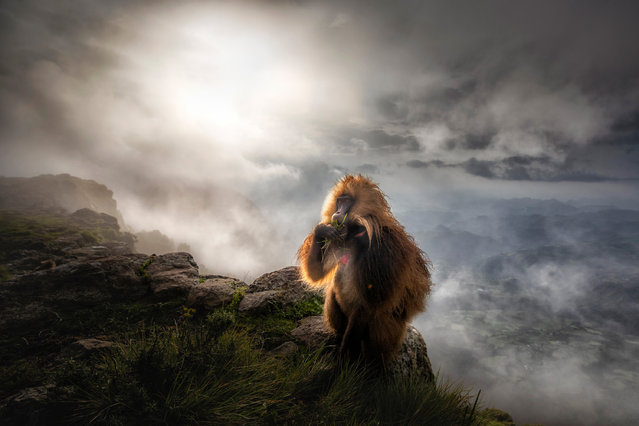
Highly commended, mammals: Gelada after the storm – Marco Gaiotti (Italy). “Gelada baboons are the only monkey species in the world that feed on grasses. They are native to the tableland of Ethiopia. Every morning large family groups wander from their sleeping places in the steep rock face, up to 1,000 metres high, to the feeding grounds at the tablelands. This image clearly depicts their feeding strategy: they pull out bunches of grass, sort the stalks and then lift them to their mouth. This shot was taken towards the end of the rainy season after a heavy storm”. (Photo by Marco Gaiotti/2019 GDT European Wildlife Photographer of the Year)

Highly commended, mammals: Gelada after the storm – Marco Gaiotti (Italy). “Gelada baboons are the only monkey species in the world that feed on grasses. They are native to the tableland of Ethiopia. Every morning large family groups wander from their sleeping places in the steep rock face, up to 1,000 metres high, to the feeding grounds at the tablelands. This image clearly depicts their feeding strategy: they pull out bunches of grass, sort the stalks and then lift them to their mouth. This shot was taken towards the end of the rainy season after a heavy storm”. (Photo by Marco Gaiotti/2019 GDT European Wildlife Photographer of the Year)
Details
31 Oct 2019 00:03:00
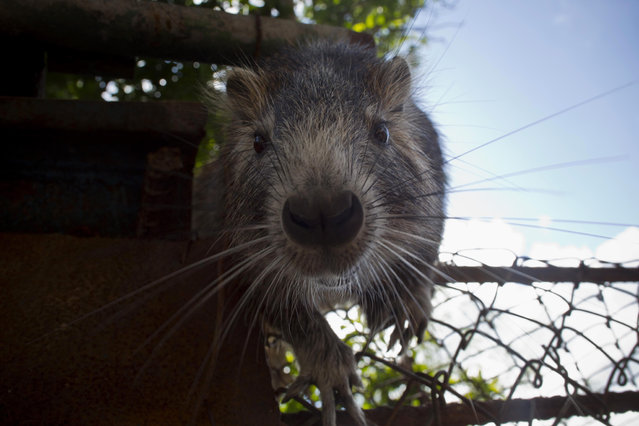
In this November 17, 2014 photo, Pancho, a domesticated huitia, confronts a camera, in Bainoa, Cuba. With their rope-like, dark tails, long front teeth, and whiskers that appear to be vibrating, huitias look like giant rats. They measure nearly a foot long (about 30 centimeters), with the largest ones weighing in bigger than a small dog. (Photo by Ramon Espinosa/AP Photo)

In this November 17, 2014 photo, Pancho, a domesticated huitia, confronts a camera, in Bainoa, Cuba. With their rope-like, dark tails, long front teeth, and whiskers that appear to be vibrating, huitias look like giant rats. They measure nearly a foot long (about 30 centimeters), with the largest ones weighing in bigger than a small dog. (Photo by Ramon Espinosa/AP Photo)
Details
21 Nov 2014 12:58:00