Meghan Puhr participates in a virtual realty presentation during an Intel news conference before CES International, Wednesday, January 4, 2017, in Las Vegas. (Photo by John Locher/AP Photo)
A general view of atmosphere at the annual VOLT Festival in Sopron, 208 kms west of Budapest, Hungary on August 16, 2016. (Photo by Mudra László/Rockstar Photographers)
Visitors hold ice blocks to cool themselves in hot weather at a water park on June 23, 2016 in Chongqing, China. Citizens and visitors escaped high temperature at a water park in Yangren Jie (also known as Foreigner Street), Nan'an District of south China's Chongqing. (Photo by VCG/VCG via Getty Images)
Two Barbary apes at the animal park which city authorities want to close, in Burg Stargard, Germany, 8 September 2015. (Photo by Stefan Sauer/DPA via ZUMA Press)
“Woman with Umbrella in Rain” by Raimund von Stillfried. Artist: Kusakabe Kimbei (Japanese, 1841–1934), 1870s. Commercial photography studios in Meiji-era Japan were renowned for the subtlety and refinement of their coloring techniques. This hand-tinted image of a young woman caught in a heavy rainstorm achieved its naturalistic effect by knitting together multiple strands of artifice: the greenery in the foreground was a studio prop; the flaps of the kimono were suspended by thin wires to create the impression of a strong wind; and long, diagonal marks were made on the negative to suggest streaks of rain. (Photo courtesy of The Metropolitan Museum of Art)
Selena Gomez, left, and Taylor Swift arrive at the MTV Video Music Awards at the Microsoft Theater on Sunday, August 30, 2015, in Los Angeles. (Photo by Jordan Strauss/Invision/AP Photo)
An young Indian Jain devotee dressed as Lord Krishna participates in a religious rally organised on the occasion of Mahavir Jayanti in Kolkata on April 2, 2015. The most important religious holiday in Jainism, Mahavir Jayanti celebrates the birth of Mahavira, the last Tirthankara, which is generally accepted as 599 BCE. (Photo by Dibyangshu Sarkar/AFP Photo)
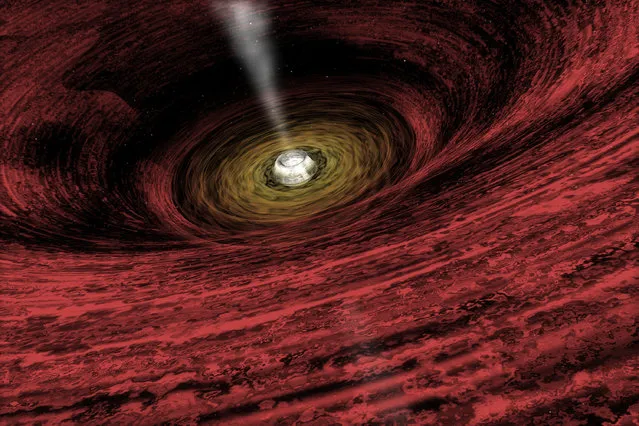
An artist's impression of a growing supermassive black hole located in the early Universe is seen in this NASA handout illustration released on June 15, 2011. Using the deepest X-ray image ever taken, astronomers found the first direct evidence that massive black holes were common in the early universe. This discovery from NASA's Chandra X-Ray Observatory shows that very young black holes grew more aggressively than previously thought, in tandem with the growth of their host galaxies. (Photo by Reuters/NASA/Chandra X-Ray Observatory/A.Hobart)